In short
• A sample day is a guide. Every baby's appetite is different, and the baby's hunger and fullness cues are followed [1].
• The World Health Organization (WHO) advises 2 to 3 meals a day from 6 to 8 months and 3 to 4 meals from 9 to 23 months [1].
• Breast milk or formula stays the main drink for the first year [2].
• No salt or sugar is added to a baby's food [2, 3].
How should a sample day be read?
The examples below are based on general guidance. WHO advises responsive feeding, which means noticing and responding to the baby's hunger and fullness cues [1]. The National Health Service (NHS) advises letting the baby eat at their own pace [2]. So portions vary from baby to baby. If you have a question about growth, talk with your pediatrician.
What does a day look like at 6 months?
The NHS notes that a baby just starting solids does not need 3 meals a day. At first, a few pieces or a few teaspoons of food are enough [2]. The baby still gets most energy and nutrients from breast milk or formula [2]. WHO advises increasing to 2 to 3 meals a day from 6 to 8 months [1]. Sips of water are offered in a cup with meals [2].
A sample day could look like this. Milk is given on waking. Mashed banana or soft cooked vegetable sticks are offered at breakfast. Milk is given again in the afternoon. Mashed lentils or soft cooked potato are offered at dinner. Milk is given before bed. These foods are among the NHS examples of first foods [2].
What does a day look like at 9 months?
The NHS notes that from 7 months a baby gradually moves to 3 meals a day. About 4 milk feeds a day continue at this stage. A formula-fed baby may need about 600 milliliters of milk a day [2]. The American Academy of Pediatrics (AAP) notes that from 8 to 12 months a baby needs 750 to 900 calories a day. About 400 to 500 of these come from breast milk or formula [4].
In the AAP sample menu, breakfast has 2 to 4 ounces of cereal or one mashed egg and 2 to 4 ounces of fruit. A snack has diced cheese or cooked vegetables. Lunch has yogurt, beans or meat with a yellow or orange vegetable. Dinner has poultry, meat or tofu, a green vegetable, pasta or potato and fruit [4]. Breast milk or formula comes with each meal [4].
What does a day look like at 12 months?
The NHS notes that from 10 months a baby eats 3 meals a day. At this stage there are about 3 milk feeds a day. A formula-fed baby drinks about 400 milliliters a day [2]. From 12 months the NHS advises 3 meals and 2 snacks a day [2]. WHO advises 3 to 4 meals a day from 9 to 23 months, with 1 to 2 snacks as needed [1].
The NHS lists four groups for meals after 12 months. Starchy foods such as potatoes, bread and rice, fruit and vegetables, dairy, and animal or plant proteins make up these groups [2]. Snacks can be fruit slices, vegetable sticks, plain full-fat yogurt or cheese sticks [2]. The AAP advises about 16 ounces of whole milk a day from 12 to 24 months [5].
What matters at mealtimes?
No salt or sugar is added to a baby's food or cooking water [2]. WHO advises not adding salt or sugar to complementary foods [3]. The NHS advises no honey before age 1, because honey can cause infant botulism [6]. The NHS advises offering finger foods at each meal, because this helps the baby learn to self-feed [2].
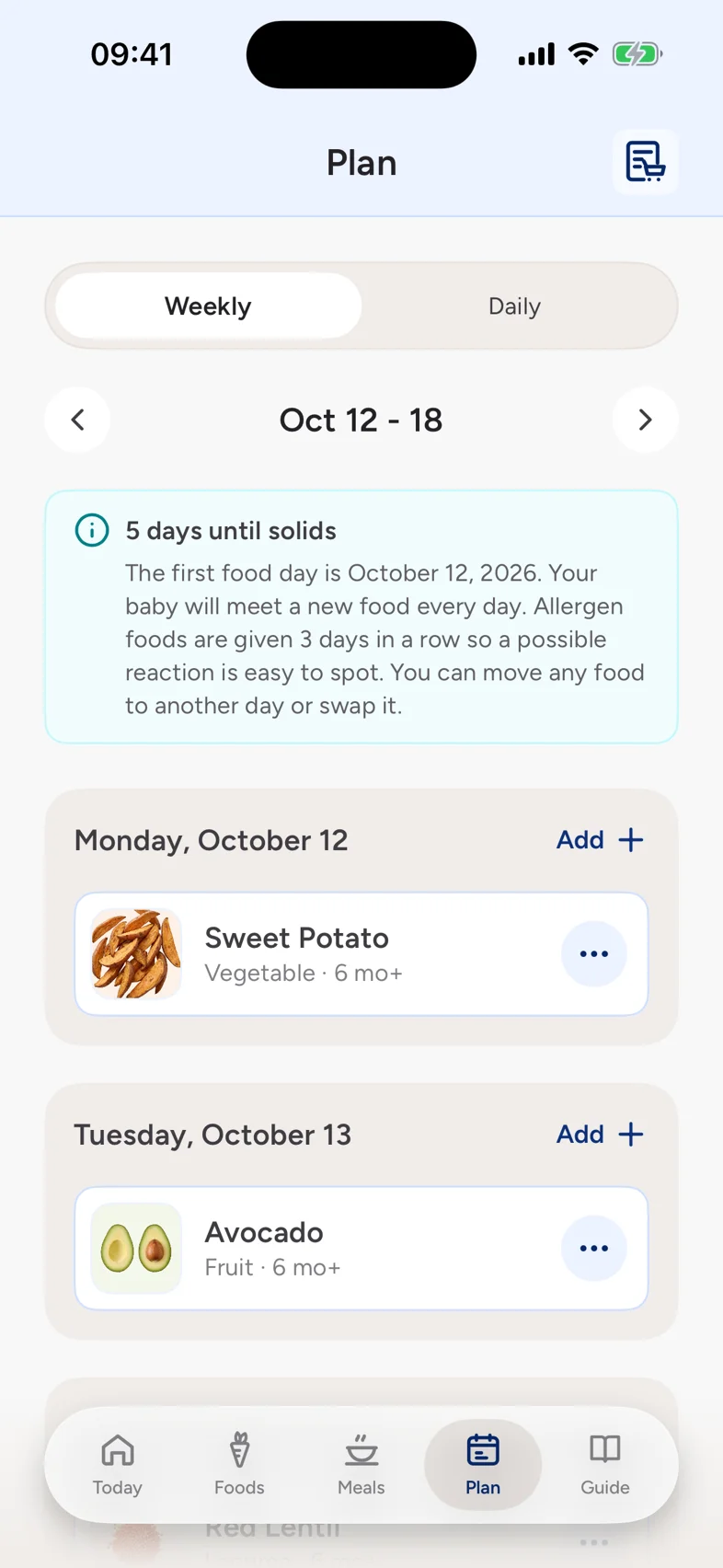
A starting solids calendar by age
Lokmini sets up a day-by-day starting solids calendar for your baby's age, introduces allergens one at a time and shows how to prepare every food by age.
Start with LokminiFrequently asked questions
What if my baby does not eat the amounts in the sample day?
Sample feeding days do not show portions that every baby must finish. Your baby's appetite, growth rate and feeding skills can differ. What matters is offering enough variety, keeping up milk feeds and responding to hunger and fullness cues. Tracking growth and development also matters when judging whether your baby is eating enough.
Should milk or food come first?
For the early stage of complementary feeding, the NHS notes that food can be offered before the usual milk feed, so that your baby is not too full but also not overly hungry. Even so, breast milk or formula stays the main source of milk throughout the first year. The order of feeding can be adjusted to your baby's hunger and daily routine. [1]
Does my baby need formula after 12 months?
For healthy, well-nourished children who have turned 12 months, follow-on or growing-up milks are not routinely needed. Pasteurized cow's milk can be the main drink. Breastfeeding can continue for as long as mother and child want. [1, 4, 7]
Written by the Lokmini teamLast updated November 19, 2026
Sources
- World Health Organization (WHO). (2026). Infant and young child feeding (fact sheet).
- National Health Service (NHS). (2026). Your baby's first solid foods.
- World Health Organization (WHO). (2026). Healthy diet (fact sheet).
- American Academy of Pediatrics (AAP). (2025). Sample Menu for a Baby 8 to 12 Months Old.
- American Academy of Pediatrics (AAP). (2023). Recommended Drinks for Children Age 5 & Younger.
- National Health Service (NHS). (2026). Foods to avoid giving babies and young children.
Lokmini is not a healthcare provider and does not offer health services. Lokmini shares information and does not diagnose. This information does not replace medical advice. Talk to your baby's doctor.