Behind every first bite, there's a family
Lokmini, the starting solids guide and app. We started Lokmini to help you go through starting solids with more calm and more joy. It's the app we were looking for when we went through this stage ourselves.
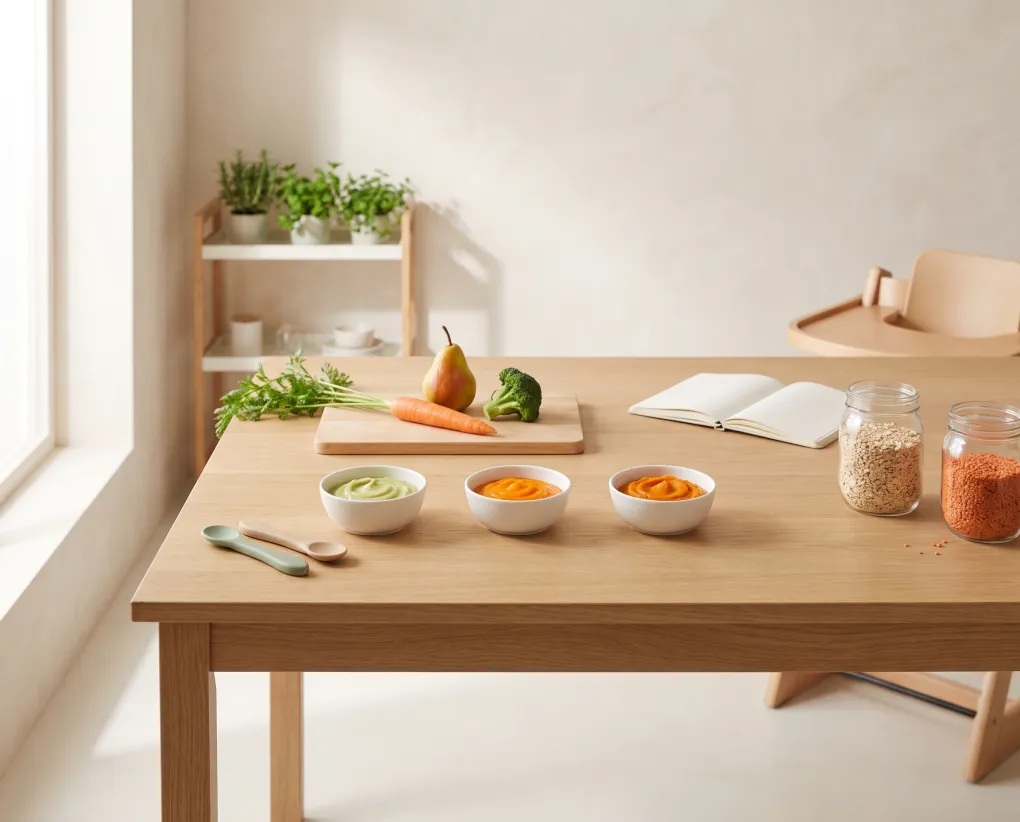
When we were choosing our baby's first food, we found dozens of different answers online. One place said 4 months, another said 6. Nobody clearly explained when and how to introduce allergens.
That's why we started Lokmini. We gathered well-sourced information in one place and turned it into a plan made for each baby. That way, you can focus on the best part: discovering food together.
Our mission
We want every baby's plate to be varied, safe and right for their age. To get there, we give families the right information on the right day. This goal also lines up with the United Nations Sustainable Development Goals.
Let's take a look at a baby's plate today.
Worldwide, 1 in 4 children under 5 get through the day on 2 food groups or fewer.1
UNICEF measures a child's day across 8 food groups. Eating from 2 groups or fewer counts as severe child food poverty. That's 181 million children.1
Plates with dashed edges hold 2 food groups or fewer. Tap a plate to see what's on it.
97 million of these children live in middle- and higher-income households.1
Money is only part of the story. Knowing what to offer, when and how changes the plate too.
In Türkiye
895,374
babies were born in 2025.2 Each one will take their first bite in the months ahead.
48%
Only this share of 6-8 month olds ate meat, fish, chicken or eggs the day before.3
After 6 months, a baby's iron needs are met through solid foods.4 Among 6-23 month olds, this rate is 81% for children whose mothers finished high school and 32% for children whose mothers never attended school.3
Month 11
The average age babies start eating whole eggs.5
A large study in Australia linked waiting until 10-12 months to introduce egg with a higher risk of egg allergy.6
Where we fit in the UN Sustainable Development Goals
- Direct
Target 2.2
End all forms of malnutrition
Indicator 2.2.4 under this target measures the variety of foods on a baby's plate. That's exactly what Lokmini tracks every day.7
- Indirect
Target 3.4
Prevent noncommunicable diseases
A love of vegetables starts to take root while babies start solids. In one study, 73% of children still liked a vegetable at age 3 that they had accepted over 8 meals as babies.8
- Indirect
Target 4.2
Early childhood development and care
Starting solids happens within the first 1,000 days. Our part is to walk alongside families with accurate information during this time.7
The world fell short of its 2025 nutrition targets, and the targets have been extended to 2030.9
Every number in this section is sourced at the bottom of the page, with the age group and year noted next to it. Lokmini shares information and does not diagnose.
What matters to us
Well-sourced information
Every piece of information comes with its source underneath. We create our content independently, based only on trusted sources.
A plan for every baby
Every baby is one of a kind. We build the plan around your baby's age and your own preferences.
Celebrating every bite
From the first taste to the 100th food, every step is a milestone. We celebrate these moments with you.
How we create our content
Every food and every article is checked against international guidelines. Sources are listed at the bottom of the page. When guidelines change, we update our content and note the date of the latest update.
- WHOWorld Health Organization
- AAPAmerican Academy of Pediatrics
- NHSNational Health Service
- ESPGHANEuropean Society for Paediatric Gastroenterology, Hepatology and Nutrition
- EAACIEuropean Academy of Allergy and Clinical Immunology
- TÜBERTurkey Dietary Guidelines
Our team
Lokmini is made by a small team of parents, designers and engineers.
Join our team
We're looking for people to work with us on content, design and software. Introduce yourself, and we'll reach out when a fitting role opens up.
We're building our Expert Board
We're building our Expert Board with health professionals in pediatrics and nutrition. If you'd like to contribute, we'd love to hear from you.
Sources
- 1. UNICEF. Child Food Poverty: Nutrition Deprivation in Early Childhood. Child Nutrition Report 2024. 2022 data, children under 5.
- 2. TurkStat. Birth Statistics 2025, bulletin 58018, May 21, 2026.
- 3. Hacettepe University Institute of Population Studies. 2018 Turkey Demographic and Health Survey, Table 11.7, consumption of iron-rich foods, 6-23 months.
- 4. Fewtrell M et al. Complementary Feeding: A Position Paper by the ESPGHAN Committee on Nutrition. J Pediatr Gastroenterol Nutr 2017, 64(1):119-132.
- 5. Turkish Ministry of Health. Turkey Nutrition and Health Survey 2010, Table 3.2.2.7, under 24 months. This is the most recent national measurement.
- 6. Koplin JJ et al. (HealthNuts). J Allergy Clin Immunol 2010, 126(4):807-13. Observational study.
- 7. United Nations. Sustainable Development Goals, target 2.2, indicator 2.2.4 and target 4.2.
- 8. Maier-Nöth A et al. PLoS One 2016, 11(3):e0151356. Study funded by Nestlé.
- 9. WHO. Global nutrition targets 2030, topical briefs, October 22, 2025.
Notes from the kitchen
On the blog, we'll share our team's experiences and what happens behind the scenes of First 50 Bites.
Read the blog


