Dietitian's view
Burrata is risky in terms of food safety.
Lokmini is not a healthcare provider and does not offer health services. For your baby's specific needs, talk to your doctor or a dietitian.
- Cow's milk allergen
- Dairy
- Not recommended for babies
- Medium choking risk
Can babies have Burrata?
Burrata is not recommended for babies. It carries a food safety risk.
- Protein
- Fat
- Calcium
- Selenium
- Zinc
- Vitamin A
 Allergen, day 1/3
About burrata
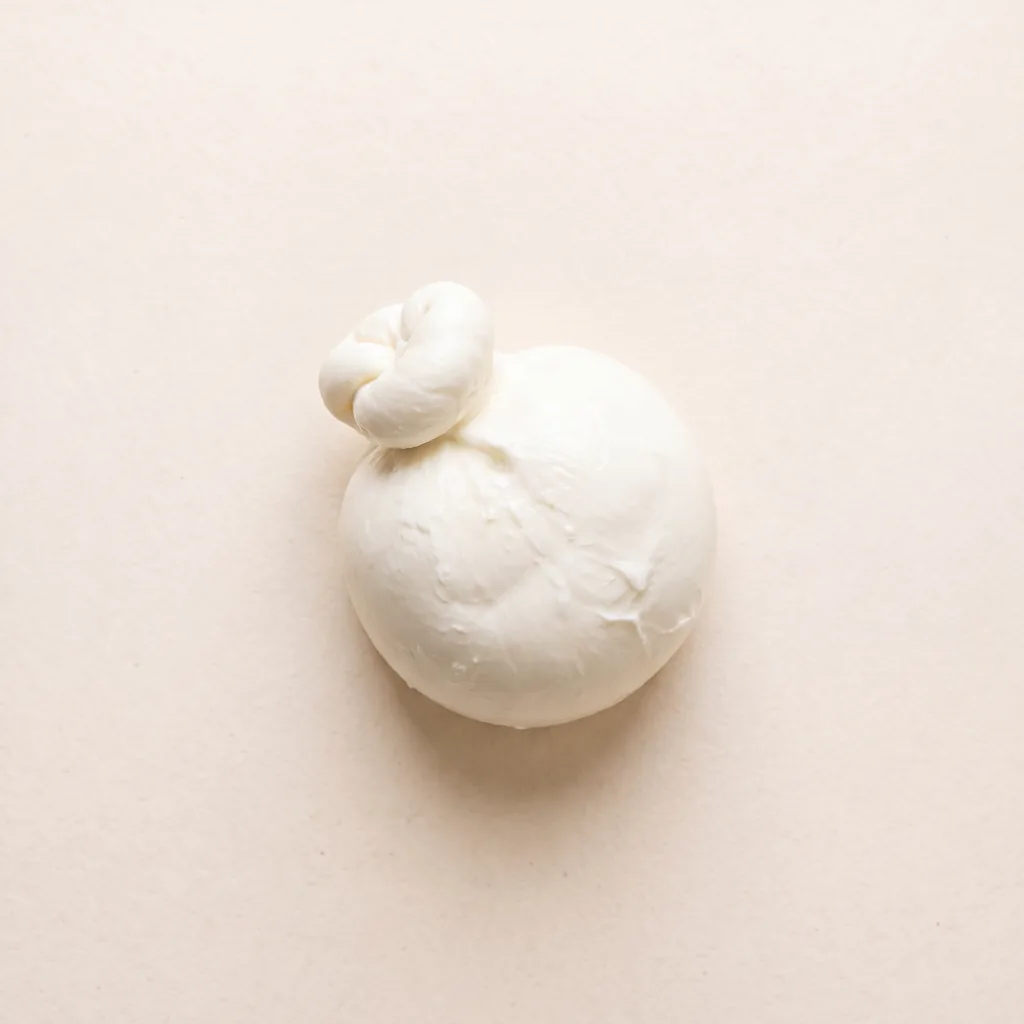
Burrata comes from southern Italy and is made from cow's milk. To make burrata, a ball of fresh mozzarella is stretched and filled with cream and stracciatella, which are shreds of the same cheese. The ball is stored in water or whey. It is usually served at room temperature. When the shell is opened, the creamy center flows out. Its mild, buttery taste goes well with bread, pasta and vegetables such as broccoli, fava beans, tomatoes and zucchini.
It contains protein, fat, calcium, selenium, zinc, vitamin A and vitamin B12.
Also known as: burrata peyniri, burata
- Gluten-free
- Vegetarian
- Contains dairy
Choking risk
- Low
- Medium
- High
The firm, springy outer shell of burrata raises the choking risk.
About burrata allergy
FPIES warning
It is one of the known triggers of FPIES (a delayed-onset food allergy). In this condition, repeated severe vomiting, pallor and lethargy may occur, usually 1-4 hours after the food is eaten. Diarrhea may appear later. These symptoms require urgent medical evaluation.
Burrata is mostly made from cow's milk, a common allergen. Milk accounts for about one in five childhood food allergies. Buffalo, goat and sheep milk products can cause similar reactions. Some burrata is made from buffalo milk.
Milk allergy often fades with time. Most children with cow's milk allergy outgrow it by age 6. Many babies with mild symptoms can reintroduce milk around their first birthday with a doctor's guidance.
Milk can cause food protein-induced enterocolitis syndrome (FPIES). It is a delayed allergy. A few hours after eating, repeated vomiting and diarrhea start suddenly. Left untreated, it can cause serious dehydration. FPIES that starts early usually fades by 3 to 5 years. Lactose intolerance can be mistaken for allergy, but it is a different condition.
Frequently asked questions
What age can babies eat burrata?
Is burrata a common allergen?
Is burrata a choking hazard for babies?
Can I serve burrata made from raw milk?
How much cheese can a baby eat?
Are lactose intolerance and milk allergy the same?
Sources
- American Academy of Pediatrics (AAP), Pediatrics 133(1), Consumption of Raw or Unpasteurized Milk and Milk Products by Pregnant Women and Children (2014)
- Food Safety and Quality Series No. 14, Risk Assessment of Food Allergens. Part 2: Review and establish threshold levels in foods for the priority allergens (2022)
- Annals of Allergy, Asthma and Immunology, The epidemiology of milk allergy in US children (2013)
- Small Ruminant Research, El-Agamy EI. The challenge of cow milk protein allergy (2007)
- Allergy and Asthma Proceedings, Nowak-Wegrzyn A. Food protein-induced enterocolitis syndrome and allergic proctocolitis (2015)
Prepared by the Lokmini team | Last updated November 17, 2026