Dietitian's view
Horseradish is not suitable for babies because of its taste.
Lokmini is not a healthcare provider and does not offer health services. For your baby's specific needs, talk to your doctor or a dietitian.
- Vegetables
- Not recommended for babies
- Medium choking risk
Can babies have Horseradish?
Horseradish is not recommended for babies. Its sharp taste makes it unsuitable for them.
- Fiber
- Vitamin C
- Folate
- Antioxidants
- Glucosinolates
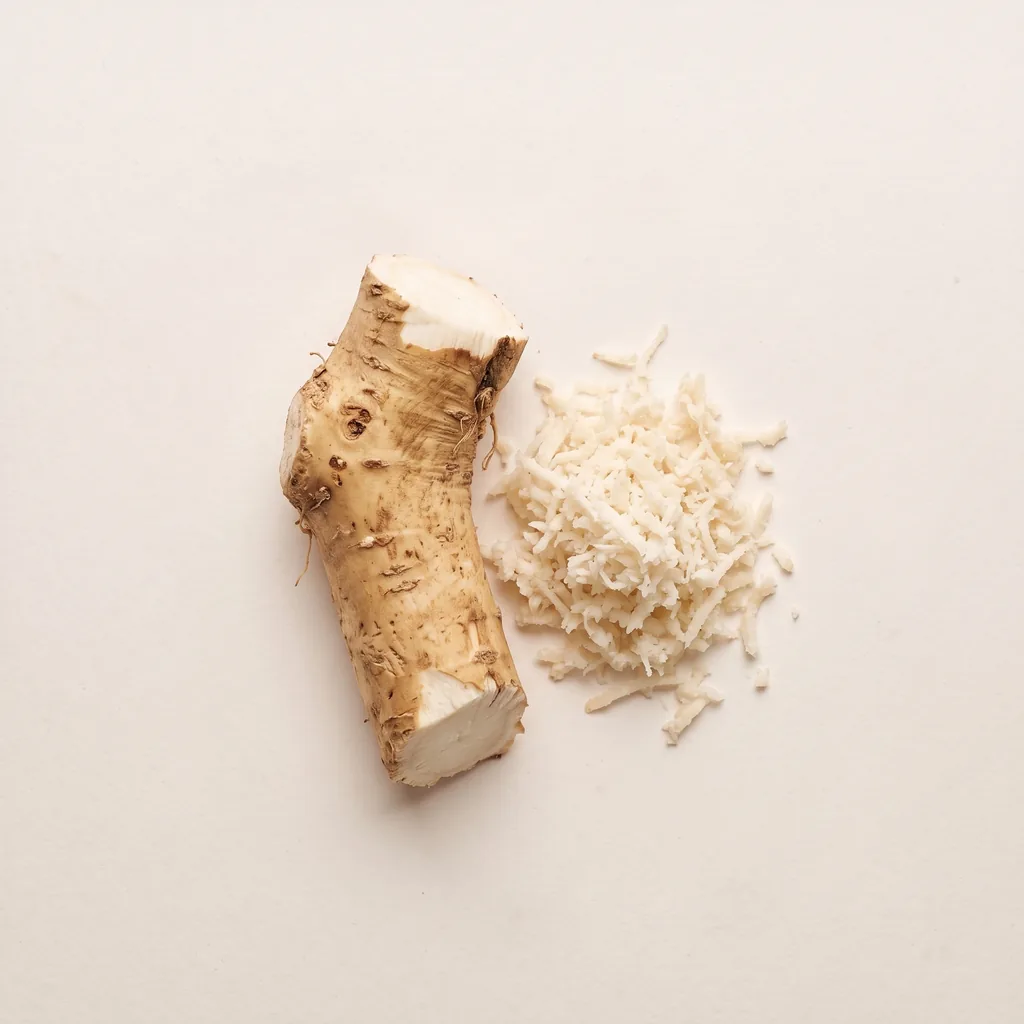
About horseradish
Is it suitable for babies?
Horseradish belongs to the Brassica family, alongside cabbage and turnip. It most likely comes from Eastern Europe and West Asia. The horse in its name is not the animal. In an older use it meant strong, a nod to its sharp taste. Because of the peppery bite, cooks usually keep the portion small or blend it with other ingredients in sauces, dips, and dressings. Chrain, khrenovina, and pepperrotsaus are some of these sauces.
Why it matters
Horseradish is usually not eaten in nutritionally meaningful amounts. Still, it has fiber, vitamin C, folate, and antioxidants. It also carries glucosinolates.
Also known as: acı turp, horseradish, yabani turp, rendelenmiş yaban turpu, chrain
- Gluten-free
- Vegan
Choking risk
- Low
- Medium
- High
Horseradish can pose a choking risk. Thick raw pieces are firm, round, and hard to chew, which raises the risk.
Allergen information
Horseradish is not a common allergen, though reactions have been reported. It belongs to the cruciferous (Brassica) family. Someone who reacts to a relative of horseradish, say mustard greens or broccoli, might in theory react to it as well.
Its sharp taste comes from a compound called allyl isothiocyanate. Wash your hands and any skin that touches it while grating. It can irritate skin and cause contact dermatitis. A harmless red ring can appear around the mouth after eating it. Larger amounts can add to diaper rash.
Sulfites are sometimes used to preserve processed horseradish products. People with asthma in particular can react to added sulfites in a way that looks like an allergy. When sulfites worry you, stay away from products that list sodium sulfite, sodium bisulfite, sodium metabisulfite, potassium bisulfite or sulfur dioxide.
Frequently asked questions
What age can babies eat horseradish?
Is horseradish a common allergen?
Is horseradish a choking hazard for babies?
Can babies enjoy heat?
How do I tone down the heat?
What portion should I serve?
Sources
- Allergy, Brassica oleracea pollen, a new source of occupational allergens (2006)
- Physiology and Behavior, Putting out the fire: Efficacy of common beverages in reducing oral burn from capsaicin (2019)
- Journal of Biomedicine and Biotechnology, The Safety of Cruciferous Plants in Humans: A Systematic Review (2012)
- Pediatric Allergy: Principles and Practice, Contact Dermatitis (2016)
Prepared by the Lokmini team | Last updated November 18, 2026