Walnut
- First taste
- 6 months
- Choking risk
- high
- Common allergen
- yes
- Iron
- low
Tree nut allergen · never whole
Contains allergens
Each new allergen is offered on its own and watched for two hours. Our allergen introduction guide is available in Turkish for now.
When can babies eat walnut?
Around 6 months, when your baby is ready for solids, you can offer walnut as a very finely ground powder or as walnut butter stirred into other foods. Whole walnuts, chopped walnuts and thick walnut butter are choking hazards.
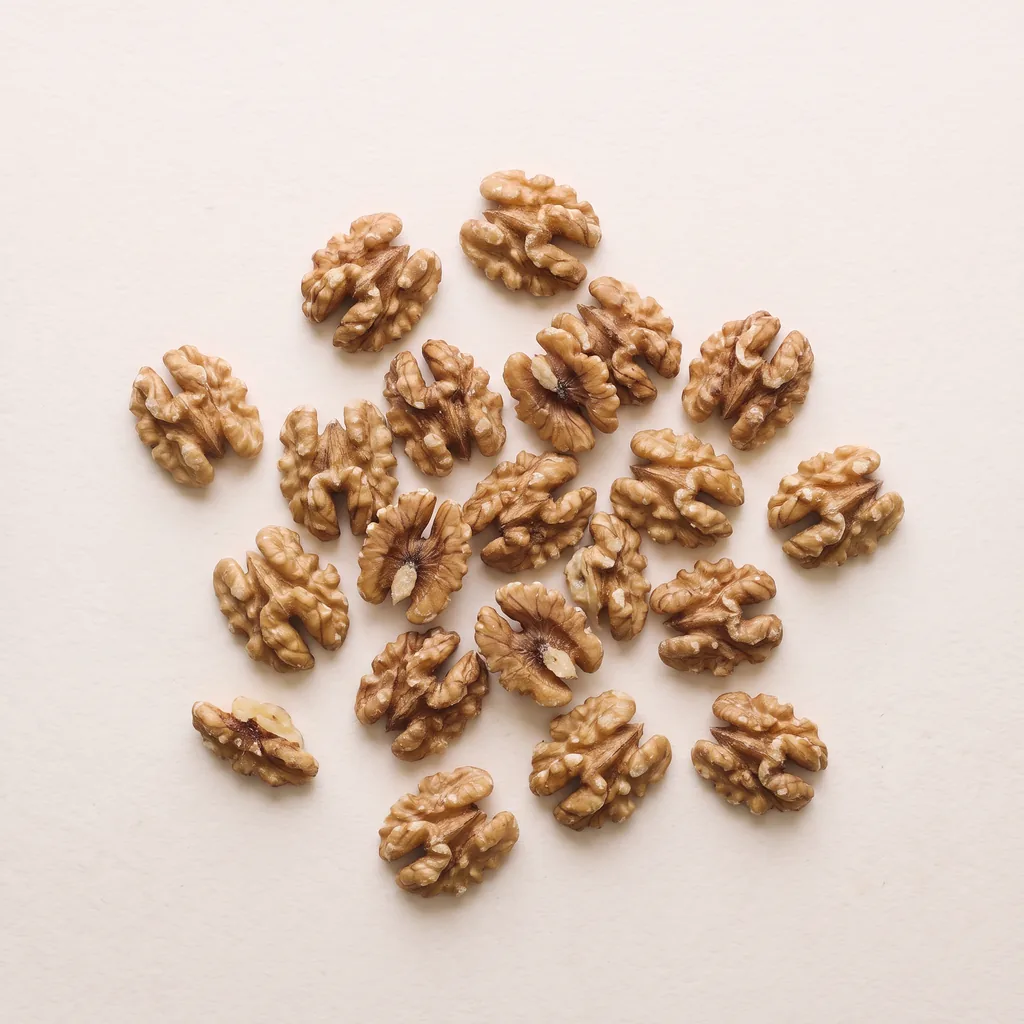
Walnuts are seeds of broadleaf trees that grow across the temperate world, in places as far apart as China, Iran and the US. Two kinds dominate the table. One is the American black walnut. The other is the English or Persian walnut from Southwest Asia, now a favorite nut around the world.
Walnuts supply healthy fats that help brain growth and heart health. Few whole foods contain as much ALA, a plant omega-3. They also provide fiber, folate, zinc and iron, which makes them useful in plant-based diets.
Storage
Walnuts turn rancid easily. Keep raw walnuts and opened walnut butter in the fridge, where they stay fresh up to 3 months, or in the freezer up to a year.
How do you prepare walnut for babies?
Grinding and thinning
Look for smooth walnut butter with no honey, or process walnuts until no big bits are left. Without a processor, pound them in a cloth with a mortar, hammer or bottle base. Sprinkle the powder over warm porridge or slippery fruit. Thin the butter with applesauce, water, breast milk or formula. Then smear a very thin coat on strips of bread. A drink from an open cup helps wash down sticky bits.
Whole walnuts
After 24 months, a child who chews well can start learning to eat whole walnuts. Medical bodies treat nuts and pieces as a choking risk until age 4 and beyond. Seat your child upright, attentive to the meal, and do not serve nuts while they talk, shout or sing. Skip nuts in the car, a stroller or when on the move. Model a small bite and chew first. Next, hold the nut firmly yourself and let your child bite it, without putting it in their mouth. Offer one or two at a time. If your child does not bite, try again in a few weeks. Make sure the mouth is empty at the end of the meal.
Walnut milk
Before 12 months, walnut milk is not a drink, though it can be an ingredient in food. After the first birthday, remember that most nut milks provide too little energy, fat and protein for a toddler. You will get more nutrition from fortified soy or pea milk.
Preparation by age
The same food is served differently at each age. What matters is how your baby sits, grasps and chews, more than the calendar.
Prep time: 5 min
6 months
6 months · How to prepare as a puréemash
Cut: Ground
Grind walnuts to a flour-like powder and stir it into yogurt, oatmeal or fruit purée. You can also thin smooth walnut butter with water. Whole and broken walnuts are not served until age 4. Tree nuts are a new allergen, so offer them alone for the first time, in the morning and in a small amount.
9 months
9 months · How to servemash
Cut: Ground
Sprinkle ground walnut over soft foods, or brush a whisper-thin film of walnut butter over pancakes and bread strips. Thick butter can stick in the mouth, so always thin it.
12 months
12 months · How to servemash
Cut: Ground
Keep using ground walnut and thinned walnut butter in meals. In walnut tarhana and vegetable dishes, the walnut should be ground. Whole walnuts are not served until age 4.
Is walnut a choking hazard for babies?
Choking risk: high
Whole walnuts, chopped pieces and thick butter are choking hazards. Use finely ground nut or thinned butter.
Babies and young children can choke on whole walnuts, nut pieces and thick walnut butter. Grind the nut finely or thin the butter. Stay close during meals.
Whole walnuts
Do not give whole or broken walnuts before age 4.
Is walnut a common allergen?
The World Health Organization lists walnut as a global priority allergen. It counts as a tree nut, though it is technically a seed. About 70 percent of children allergic to walnut are also allergic to pecan. An allergy to tree nuts affects 0.5 to 1.2 percent of people. It usually stays for life, and just about 9 percent of children outgrow it.
Walnut reactions can be severe. Walnut also causes oral allergy syndrome, especially in people allergic to birch pollen, which usually means brief itching, tingling or burning in the mouth.
A child allergic to walnut can cross-react to other tree nuts and seeds. That does not mean all nuts must go. Work with an allergist.
Most babies do not need allergy testing before trying walnut. If your baby has severe eczema, has reacted to food before, or may have a nut allergy, check with your pediatrician or an allergist before the first taste. Evidence for protection from early introduction keeps growing, so do not delay longer than needed.
First try
Start with one pinch of powder-fine nut, or an eighth of a teaspoon of smooth butter loosened with water, breast milk or formula. If there is no reaction, increase the amount. Your baby need not finish it. Once introduced, keep the allergen in the diet, ideally twice a week.
Key nutrients
Frequently asked questions about walnut
Can babies have walnut butter?
Yes, smooth butter without honey, thinned and spread very thinly. Thick butter is a choking hazard.
Can babies drink walnut milk?
Not as a drink before 12 months, though it can go into foods such as oatmeal. It may fall short on calories, fat and protein.
If my child is allergic to walnut, will other nuts cause reactions?
Cross-reactions can happen, but that does not mean every nut must go. An allergist can help decide which are safe.
How should I store walnuts?
Keep raw walnuts and opened walnut butter in the fridge, where they last up to 3 months, or in the freezer up to a year.
Sources for this page
- Dünya Sağlık Örgütü. (2023). Guideline for complementary feeding of infants and young children 6-23 months of age.
- NHS. (n.d.). Preparing food safely for babies.
- CDC, Infant and Toddler Nutrition. (n.d.). Choking Hazards.
- Halken S, Muraro A, de Silva D, Khaleva E, Angier E, Arasi S, et al. (2021). EAACI guideline: Preventing the development of food allergy in infants and young children (2020 update). European Academy of Allergy and Clinical Immunology. doi:10.1111/pai.13496
- Türkiye Ulusal Alerji ve Klinik İmmünoloji Derneği. (n.d.). Besin Alerjisi, öncelikli 10 besin.
- American Academy of Pediatrics, HealthyChildren. (n.d.). Choking Prevention for Babies and Children.
- Cox AL, Eigenmann PA, Sicherer SH. (2021). Clinical Relevance of Cross-Reactivity in Food Allergy. Journal of Allergy and Clinical Immunology: In Practice. doi:10.1016/j.jaip.2020.09.030
Guides on iron, allergen introduction, gagging and drinks. Read the starting solids guides
Medical note
This page is for information only and is not a substitute for medical advice, diagnosis or treatment. Talk to your pediatrician before any feeding decision, especially about allergen introduction and reactions.
The Lokmini app
Log walnut, reactions and your allergen journey in the app.
Open in LokminiLokmini is coming soon to the App Store.
Astro Tasarım Simay Yenice · Türkiye · merhaba@lokmini.com