Tofu
- First taste
- 6 months
- Choking risk
- low
- Common allergen
- yes
- Iron
- high
Soy allergen · iron source
Contains allergens
Each new allergen is offered on its own and watched for two hours. Our allergen introduction guide is available in Turkish for now.
When can babies eat tofu?
Tofu can be offered once your baby seems ready for solids, usually at 6 months. It contains soy, and some brands also hold other allergens such as sesame or wheat.
Tofu is a soy food native to Asia. The method resembles cheesemaking. It uses soy milk from cooked soybeans instead of cow's milk.
Nutrition
It is rich in protein, plant omega-3 fats, iron and zinc. These support growth, brain health, red blood cells and immunity. Some types are also high in calcium. For calcium, pick brands that list calcium sulfate in the ingredients. To boost iron absorption, serve it with vitamin C foods such as bell pepper, broccoli or citrus.
How do you prepare tofu for babies?
Every baby develops at their own pace. These tips are general guidance.
Silken tofu is smooth. Serve it alone or stir it into soft dishes. Firm and extra-firm tofu make a good finger food in long, thick strips. You can season it with spices for new tastes. Store-bought tofu is usually pasteurized, so it can be eaten straight from the package. Stinky tofu, and fermented tofu stored in brine or marinade, should wait until your child is older.
All types of tofu are nourishing. Silken tofu often has less protein and fewer micronutrients than firm and extra-firm. Sprouted tofu carries more protein and less fat than non-sprouted.
Preparation by age
The same food is served differently at each age. What matters is how your baby sits, grasps and chews, more than the calendar.
6 months
6 months · How to cut and serve for baby-led weaningstrip
Cut: Finger strip
Cut firm or extra-firm tofu into long, thick strips and let your baby suck and chew on them. Silken tofu is smooth, so serve it alone on a spoon or stir it into soft dishes. Should a piece snap off, stay calm and give your baby time to chew it, or to push it out with the tongue. Stinky and brined or marinated fermented tofu types are not served at this age.
9 months
9 months · How to cut and servecube
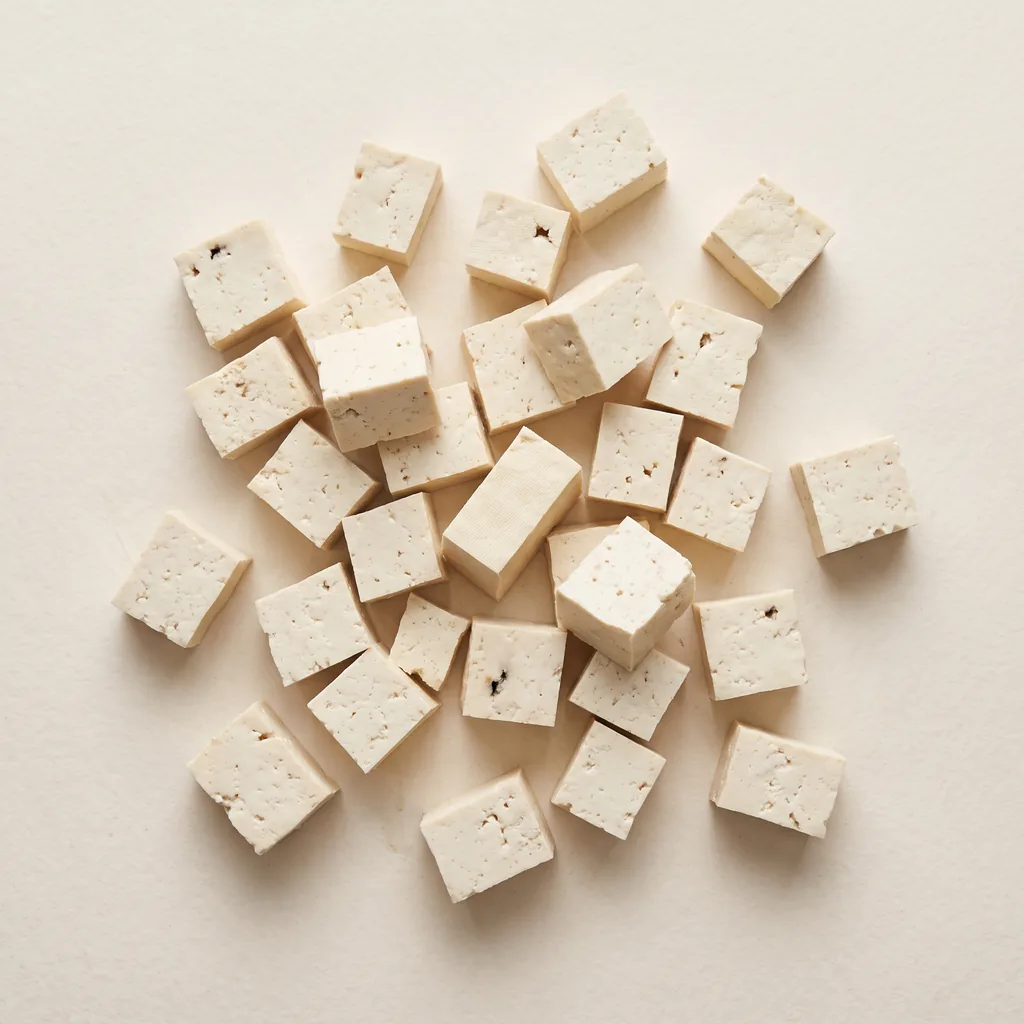
Cut: Bite sized piece
Once the pincer grasp develops, hand over firm tofu cut into small cubes, and strips for biting practice are still welcome. Silken tofu is a good choice for spoon practice now. Fill a spoon and let your baby reach for it.
12 months
12 months · How to cut and servecube
Cut: Bite sized piece
Give firm tofu in bite-sized cubes with a fork beside it. A spoon filled with silken tofu can lie beside the plate for your child to try. To boost iron absorption, serve tofu with vitamin C sources such as bell pepper, broccoli or citrus.
Is tofu a choking hazard for babies?
Choking risk: low
Tofu is low risk when prepared for the baby's age. Should a piece snap off, stay calm and give your baby time to chew it or spit it out.
Tofu is considered low risk when prepared for your baby's age and skills. Any food can still cause choking. Prepare it for your baby's age and stay close during meals. If a piece breaks off in the mouth, stay calm and let your baby chew it or push it forward and spit it out.
Is tofu a common allergen?
Tofu is made from soybeans. Soy is a common food allergen in infants. Fewer than 1 percent of children are allergic to soy, and reactions are usually mild, though severe ones have been reported. About 70 percent of children outgrow it by age 10. For these reasons the World Health Organization does not list soy as a Global Priority Allergen.
With a soy allergy, avoid soybeans and everything made from them, including edamame, tofu, tempeh, natto, miso, tamari, and soy sauce. Read labels.
Allergen label
This food contains soy. Some ready-made brands may also contain sesame and wheat.
Soy lecithin and heavily refined soy oil have almost no allergenic protein, which is why most people with soy allergy can tolerate them. Still, ask your provider before serving them.
Between 10 and 14 percent of people with cow's milk allergy also react to soy. This is more likely under 6 months. For babies with known milk allergy, many pediatricians suggest skipping cow's milk as well as soy until 6 months.
Soy is a known cause of FPIES, food protein-induced enterocolitis syndrome. Repeated vomiting and diarrhea start hours after eating. When soy is eaten regularly, the chronic form can look like reflux, weight loss and poor growth. FPIES that starts early usually clears by age 3 to 5.
People with birch pollen allergy may get brief itching, tingling or burning in the mouth. Serious reactions have been reported in these people, mostly when peanut allergy is also present.
FPIES
If repeated vomiting and diarrhea start hours after eating, see a doctor right away.
Soy products are often made with egg, fish, peanut and sesame. Introduce these allergens one at a time and rule out allergy before serving them together. To begin, pick a tofu and a recipe free of any other allergen. Give a small amount for the first servings and raise it slowly if there is no reaction. Once introduced, keep it in the diet twice a week if possible.
Soy and peanut can show sensitization together on tests, but this does not always mean true allergy. A child who eats peanut without trouble does not need to stop. A baby with peanut allergy who tolerates soy does not need to drop soy either.
Key nutrients
Frequently asked questions about tofu
Can tofu be eaten raw?
Yes. Store-bought tofu is usually pasteurized and can be eaten straight from the package.
Are phytoestrogens a concern for babies?
According to the source, there is no evidence that phytoestrogen intake needs limiting in babies and toddlers. A balanced diet of varied whole foods matters most.
Which tofu is best for babies?
All are nourishing. Firm and extra-firm give more protein, iron and zinc than silken. Silken works well stirred into soft foods.
Sources for this page
- Dünya Sağlık Örgütü. (2023). Guideline for complementary feeding of infants and young children 6-23 months of age.
- NHS. (n.d.). Preparing food safely for babies.
- CDC, Infant and Toddler Nutrition. (n.d.). Choking Hazards.
- Murugkar DA. (2014). Effect of sprouting of soybean on the chemical composition and quality of soymilk and tofu. Journal of Food Science and Technology. doi:10.1007/s13197-011-0576-9
- Savage JH, Kaeding AJ, Matsui EC, Wood RA. (2010). The natural history of soy allergy. Journal of Allergy and Clinical Immunology. doi:10.1016/j.jaci.2009.12.994
- Messina M, Duncan A, Messina V, Lynch H, Kiel J, Erdman JW. (2022). The health effects of soy: A reference guide for health professionals. Frontiers in Nutrition. doi:10.3389/fnut.2022.970364
Guides on iron, allergen introduction, gagging and drinks. Read the starting solids guides
Medical note
This page is for information only and is not a substitute for medical advice, diagnosis or treatment. Talk to your pediatrician before any feeding decision, especially about allergen introduction and reactions.
The Lokmini app
Log tofu, reactions and your allergen journey in the app.
Open in LokminiLokmini is coming soon to the App Store.
Astro Tasarım Simay Yenice · Türkiye · merhaba@lokmini.com