Tangerine
- First taste
- 6 months
- Choking risk
- medium
- Common allergen
- no
- Iron
- low
Never serve whole segments
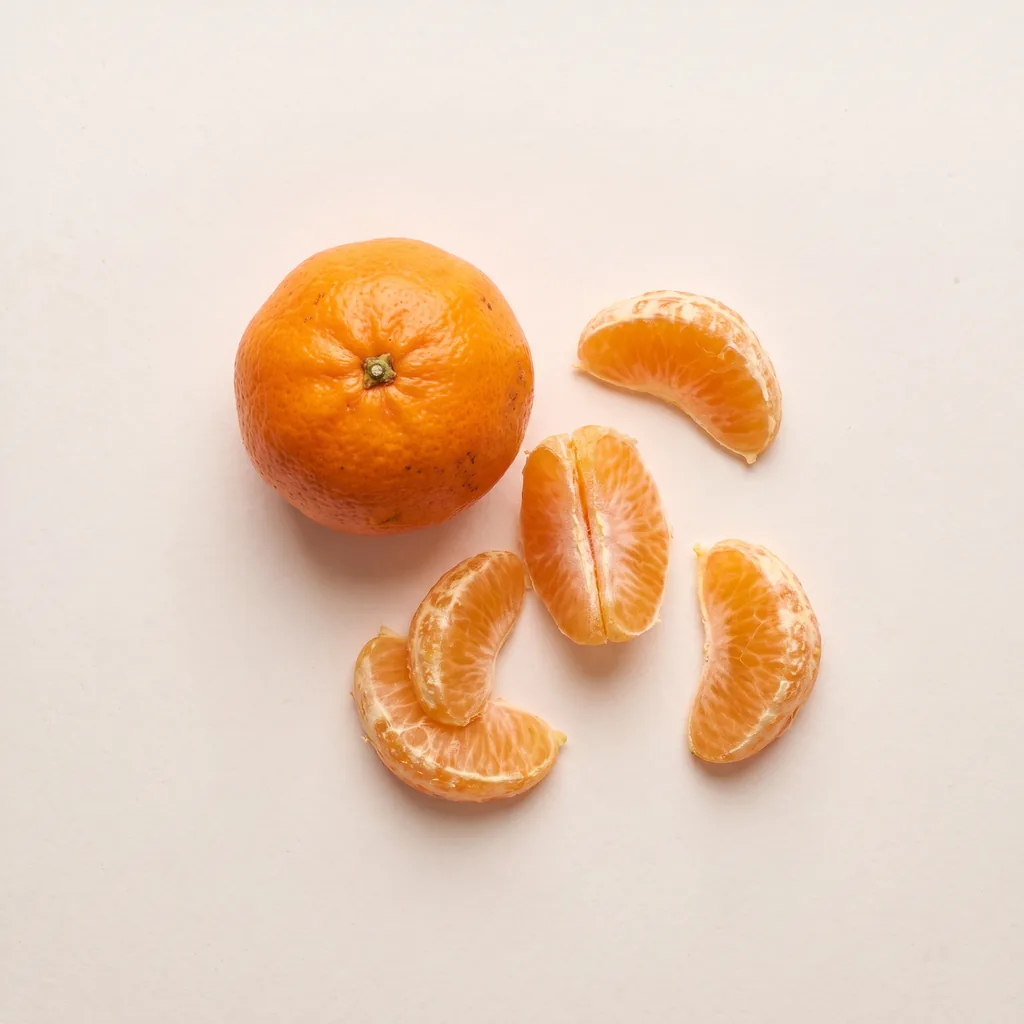
When can babies eat tangerine?
You can offer mandarin once baby is ready for solids, usually around 6 months.
Mandarin is a small, juicy, sweet citrus. It is less acidic than a typical navel orange. The skin is very thin and peels easily. The color ranges from red to orange, yellow and green. It comes from China. With citron and pomelo, it is counted among the wild ancestors of all cultivated citrus.
It holds carbohydrate, fiber and fluid. It supplies vitamins A, B6 and C, potassium, folate and antioxidants such as flavonoids. These support energy, digestion, vision and immunity.
How do you prepare tangerine for babies?
General tips
Small citrus segments left in their membrane are a choking hazard. When in doubt, take the fruit out of the membrane. Canned mandarin also works. Its membrane and seeds are mostly removed already. Spooning it over yogurt makes it easier to eat.
Medicines and juice
Like grapefruit, mandarin may interact with some medicines. If your child takes medicine, ask your doctor.
Small amounts of mandarin juice are fine after 12 months. For regular sweet drinks, wait until the child is older. Frequent juice raises the risk of cavities. It can also fill the belly and lower appetite for meals.
Preparation by age
The same food is served differently at each age. What matters is how your baby sits, grasps and chews, more than the calendar.
Prep time: 5 min
6 months
6 months · How to prepare as a puréemash
Cut: Fork mashed
Peel the membrane off the segments, mash the fruit with a fork and stir it into yogurt, porridge or soft vegetable purée. Pick out the seeds. Whole segments are not served at this age.
9 months
9 months · How to cut and servecube
Peel the membrane off the segments and split them lengthwise into halves or quarters. Choose a seedless kind, or pick out any seeds one by one. Whole segments are not served because they are round and slippery.
12 months
12 months · How to cut and servecube
Cut: Halved
Serve the segments cut in half. If the membranes are thin, you can leave them on. Choose whole fruit over juice.
12 months · How to prepare as larger pieces after 18 monthsslice
After 18 months, if your child chews and swallows well, move to halved segments with the membrane, then whole segments. Coach the child to bite instead of popping the segment in. Large pieces of orange still on the peel let a child practice biting and tearing. Around age 2, a child can learn to peel a mandarin, which builds fine motor skills.
Is tangerine a choking hazard for babies?
Choking risk: medium
A segment left in its membrane is small, tapered and slippery. Peel off the membrane, pick out seeds and cut the segment to suit baby's age.
Citrus segments left in their membrane have small, pointed ends. The texture is mixed and slippery. These traits raise choking risk.
Prepare mandarin to fit baby's age. Stay beside baby, within arm's reach, for the whole meal.
Is tangerine a common allergen?
Mandarin is not a common allergen. Still, sensitivity to citrus is often reported worldwide. People with pollen food allergy syndrome, especially those sensitive to grass and some tree pollens, may react. The sign is usually short itching in the mouth. A dangerous reaction is not expected.
Sometimes an allergy to orange proteins can cause a serious reaction. There is evidence that the main allergens behind serious reactions sit in the seed. Rarely, chewing a seed may set off a reaction. So pick out the seeds.
The acid in citrus can cause a harmless, short-lived red patch around the mouth.
Start with a small amount for the first servings. If there is no reaction, raise the amount slowly.
Key nutrients
Frequently asked questions about tangerine
What if my baby swallows a mandarin seed?
Allergens concentrate in the seed, and chewing it can rarely cause a reaction. Remove seeds ahead of time. If you see a reaction or choking, call emergency services.
When can I give mandarin juice?
A small amount is fine after 12 months. For regular servings, wait until the child is older. Whole fruit is always the better choice.
Sources for this page
- Dünya Sağlık Örgütü. (2023). Guideline for complementary feeding of infants and young children 6-23 months of age.
- NHS. (n.d.). Preparing food safely for babies.
- CDC, Infant and Toddler Nutrition. (n.d.). Choking Hazards.
- Iorio RA, Del Duca S, Calamelli E, Pula C, Lodolini M, Scamardella F, et al. (2013). Citrus Allergy from Pollen to Clinical Symptoms. PLoS One. doi:10.1371/journal.pone.0053680
- Theile D, Hohmann N, Kiemel D, Gattuso G, Barreca D, Mikus G, et al. (2017). Theile D ve ark. European Journal of Pharmaceutical Sciences 97:247-256. European Journal of Pharmaceutical Sciences. doi:10.1016/j.ejps.2016.11.021
- ESPGHAN Committee on Nutrition, Fidler Mis N, Braegger C, Bronsky J, Campoy C, Domellöf M, et al. (2017). Sugar in Infants, Children and Adolescents. Journal of Pediatric Gastroenterology and Nutrition. doi:10.1097/MPG.0000000000001733
Guides on iron, allergen introduction, gagging and drinks. Read the starting solids guides
Medical note
This page is for information only and is not a substitute for medical advice, diagnosis or treatment. Talk to your pediatrician before any feeding decision, especially about allergen introduction and reactions.
The Lokmini app
Log tangerine, reactions and your allergen journey in the app.
Open in LokminiLokmini is coming soon to the App Store.
Astro Tasarım Simay Yenice · Türkiye · merhaba@lokmini.com