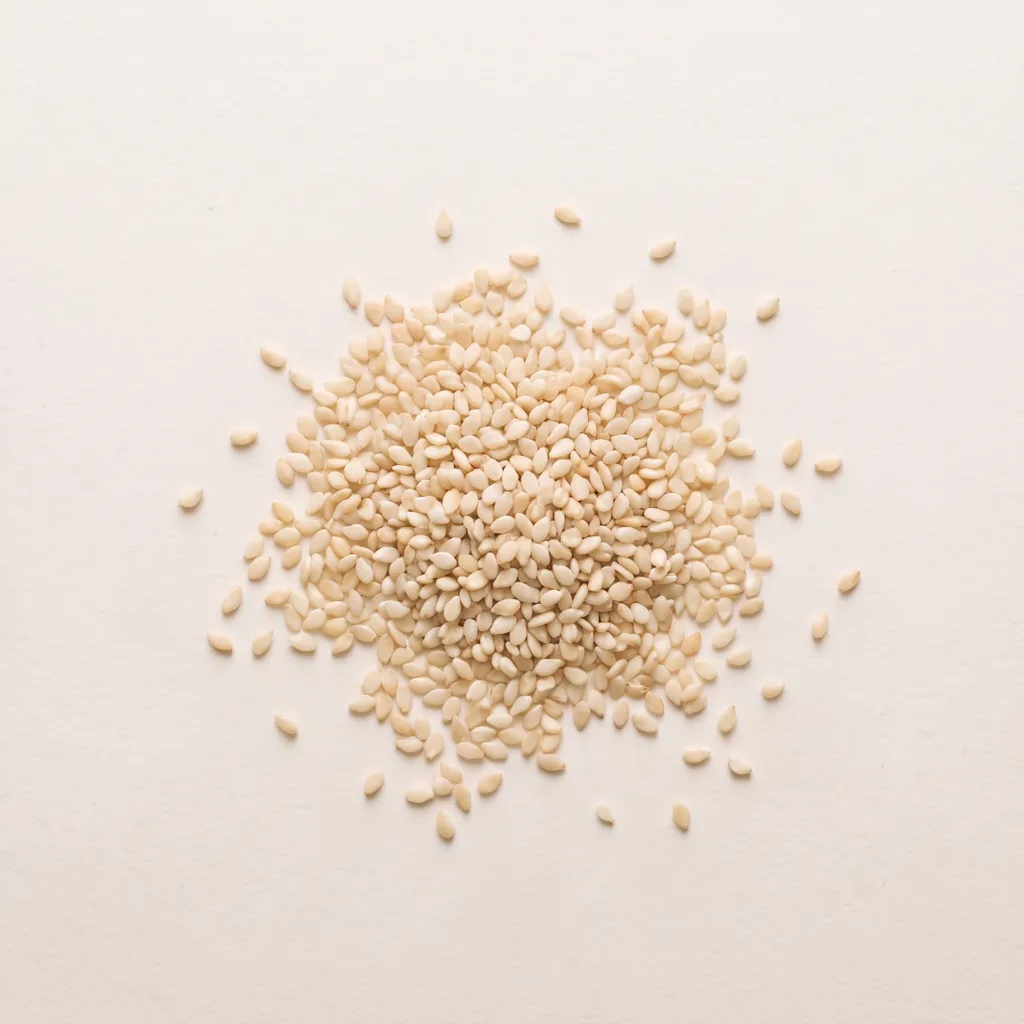
Sesame
- First taste
- 6 months
- Choking risk
- medium
- Common allergen
- yes
- Iron
- high
Sesame allergen · tahini can be sticky
Contains allergens
Each new allergen is offered on its own and watched for two hours. Our allergen introduction guide is available in Turkish for now.
When can babies eat sesame?
When can babies have sesame?
Sesame can be offered once baby is ready for solids, from about 6 months. It is a common allergen, so start with a small amount the first time.
Origin
The sesame plant was probably first grown in Asia. Its pods burst when ripe and release oil-rich seeds.
Nutrition
It supplies selenium, phosphorus, manganese, magnesium and copper, as well as folate and B vitamins. It is one of the oiliest seeds. It also has fiber, protein, calcium, iron and zinc, minerals that are often low in infant and toddler diets. Grinding the seeds into paste or powder makes the nutrients easier to absorb.
How do you prepare sesame for babies?
Preparation basics
For allergen introduction use ground sesame or tahini. Whole seeds often go unchewed, so the proteins do not reach the baby. When choosing tahini, look for one made from unhulled sesame. It has more protein and may expose baby to a wider range of allergenic proteins.
Sesame oil is not enough for allergen exposure. Its sesame protein is low and inconsistent. For regular exposure, foods with steadier protein such as sesame flour, sesame milk and tahini are better.
Read labels on every purchase. Sesame is widely used as a thickener and flavoring. Hummus contains tahini. Some breadcrumbs contain sesame. Some manufacturers deliberately add a little sesame flour to baked goods to avoid regulations.
Preparation by age
The same food is served differently at each age. What matters is how your baby sits, grasps and chews, more than the calendar.
6 months
6 months · Stir in ground sesame or tahinimash
Cut: Ground
Grind hulled sesame finely and sprinkle it on warm porridge. Stir tahini into applesauce, porridge or yogurt. For allergen introduction start with about 1/8 teaspoon of tahini. Whole seeds are not chewed well, so they are not the best choice for allergen introduction.
6 months · Hummus, spread thinstrip
Serve hummus on its own for hand scooping, or spread it thin on toast strips or whole-grain bread. Hummus and tahini can form sticky clumps in the mouth, so do not spread thickly.
12 months
12 months · Dips and sesame noodlescube
Toddlers love dipping. Offer hummus and simple tahini sauces with cucumber, bell pepper and fruit. Sesame noodles work well too.
Is sesame a choking hazard for babies?
Choking risk: medium
Seeds carry a low risk when prepared for the child's age. Tahini can form a sticky clump in the mouth. Spread it thinly or mix it into soft food.
Choking risk
Sesame seeds carry a low risk when prepared for the child's age and development. Tahini, however, can form a sticky clump in the mouth and raises the risk. Spread it thin or mix it into soft food. Stay within arm's reach during meals.
Is sesame a common allergen?
Allergen status
Sesame is counted as a common allergen by the World Health Organization. Studies in Southwest Asia and North Africa found it a frequent cause of anaphylaxis. It is the third most common food allergen in Israel and the ninth in the United States.
Start small, for example 1/8 teaspoon of tahini stirred into applesauce. If there is no reaction in the first few servings, increase gradually. If allergy runs in the family or there are risk factors such as eczema, ask your pediatrician or an allergist first.
Key nutrients
Frequently asked questions about sesame
Can babies have tahini?
Yes, from 6 months. It is sticky, so mix it into soft food or spread it thin.
Is sesame oil enough to prevent allergy?
No. The protein in the oil is low and inconsistent. Sesame flour, sesame milk or tahini are better.
Does hummus contain sesame?
Yes. Hummus contains tahini, which may be listed in the ingredients without an allergen call-out.
Sources for this page
- Wu MS, Aquino LBB, Barbaza MYU, Hsieh CL, De Castro-Cruz KA, Yang LL, et al. (2019). Anti-Inflammatory and Anticancer Properties of Bioactive Compounds from Sesamum indicum L.—A Review. Molecules. doi:10.3390/molecules24244426
- Beluska-Turkan K, Korczak R, Hartell B, Moskal K, Maukonen J, Alexander DE, et al. (2019). Nutritional Gaps and Supplementation in the First 1000 Days. Nutrients. doi:10.3390/nu11122891
- Bhat KV, Kumari R, Pathak N, Rai AK. (2014). Value addition in sesame: A perspective on bioactive components for enhancing utility and profitability. Pharmacognosy Reviews. doi:10.4103/0973-7847.134249
- Adatia A, Clarke A, Yanishevsky Y, Ben-Shoshan M. (2017). Sesame allergy: current perspectives. Journal of Asthma and Allergy. doi:10.2147/JAA.S113612
Guides on iron, allergen introduction, gagging and drinks. Read the starting solids guides
Medical note
This page is for information only and is not a substitute for medical advice, diagnosis or treatment. Talk to your pediatrician before any feeding decision, especially about allergen introduction and reactions.
The Lokmini app
Log sesame, reactions and your allergen journey in the app.
Open in LokminiLokmini is coming soon to the App Store.
Astro Tasarım Simay Yenice · Türkiye · merhaba@lokmini.com