Sardine
- First taste
- 6 months
- Choking risk
- medium
- Common allergen
- yes
- Iron
- medium
Fish allergen · bone fresh fish
Contains allergens
Each new allergen is offered on its own and watched for two hours. Our allergen introduction guide is available in Turkish for now.
When can babies eat sardine?
When can babies have sardines?
Well-cooked sardines can be offered once baby is ready for solids, from about 6 months. Their mercury level is usually lower than in other fish. Sardine is a shared name for small schooling fish. Its name is taken from Sardinia, an Italian island, although the fish does not come from there. Various small fish that swim in schools, both near the coast and in deep water, are sold as sardines around the world.
Nutrition
Besides protein and fat they provide omega-3 fatty acids. They also supply calcium, choline, iron, selenium, zinc and vitamins B6, B12, D, E and K. These give building blocks for growth, brain development, heart health, bones, red blood cells and immunity.
How do you prepare sardine for babies?
Preparation basics
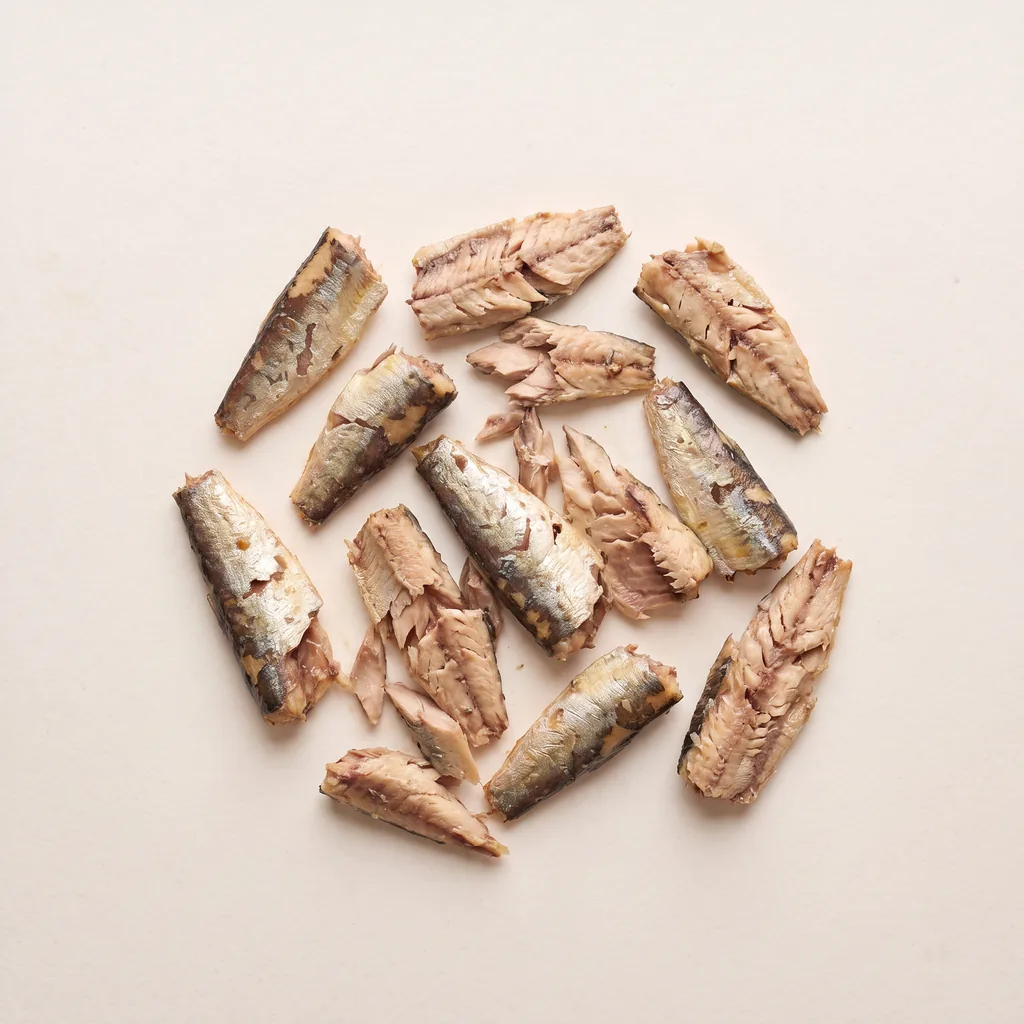
With fresh sardines, remove bones, cook and mash the flesh. Canned sardines packed in water, olive oil or salt can be given from 6 months. In cans the skin and bones are softened, so you do not need to remove them.
Some sardines are salty. While babies are learning, they eat little, so their sodium intake usually stays low, and sharing family meals has benefits. Choosing unsalted or low-salt is still a good choice.
Preparation by age
The same food is served differently at each age. What matters is how your baby sits, grasps and chews, more than the calendar.
Prep time: 20 min
6 months
6 months · How to prepare as a puréemash
Cut: Fork mashed
Bake or steam fresh sardines, remove the head, skin and the central spine, and check for small bones one by one with your fingers. Mash the flesh with a fork and stir it into mashed potato. For canned sardines, choose unsalted or low-salt ones and drain them. Fish is a new allergen, so introduce it alone and in the morning the first time.
6 months · Canned or boneless whole filletstrip
You can offer a whole, well-cooked, boneless sardine fillet or a canned sardine as finger food. In canned sardines the skin and bones are softened by canning and are edible. In freshly cooked fish the bones can lodge in the throat, so always remove them.
9 months
9 months · How to cut and servecube
Offer cooked, boned sardine flesh in small pieces, or mash it and work it into bulgur patties. Small bones soften during cooking, but the central spine must always be removed.
12 months
12 months · How to cut and servecube
Cut: Bite sized piece
Keep serving sardines in small boneless pieces. Set aside an unsalted portion of grilled sardines. Check for bones at every bite.
Is sardine a choking hazard for babies?
Choking risk: medium
Bones in freshly cooked fish can lodge in the mouth or throat. Remove the central spine and skin and press the flesh with your fingers to find bones. In canned sardines the bones are softened.
Choking risk
Cooked sardine with the skin and bones taken out poses a low risk. Bones in freshly cooked fish can get stuck in the throat, esophagus, or mouth, so take them out with care. Bones in canned sardines are softened and need not be removed. Stay within arm's reach during meals.
Is sardine a common allergen?
Allergen status
Finned fish are counted as a common allergen. An estimated 0.2 percent of people worldwide are allergic to finned fish, and children are affected even less than adults. About 40 percent of people with the allergy have their first reaction in adulthood. Most do not outgrow it.
Some people also react to proteins released into the air while fish cooks. About half of those allergic to one finned fish react to another, because beta-parvalbumin is in most fish. Allergists often advise avoiding all finned fish until the person has been seen.
Finned fish is a known FPIES trigger. Repeated vomiting and diarrhea start hours after eating. Fish FPIES can appear later in life and often lasts a lifetime. Histamine in fish that was not kept cold causes scombroid poisoning, which is mistaken for allergy but is not one.
If you suspect a fish allergy, ask an allergist before offering sardines. Start with a small amount. After a successful introduction, keep it in the diet, ideally twice a week. Rotating fish species is fine.
Key nutrients
Frequently asked questions about sardine
Do sardines contain mercury?
Sardines are generally low in mercury. Small fish build up less than big ones. Large fish like tuna are higher.
Should I worry about arsenic in sardines?
No. The main type of arsenic in seafood is generally regarded as safe in a varied diet. No food is perfect, so aim for variety.
Can I give canned sardines to babies?
Yes. Sardines packed in water, olive oil or salt can be given once baby is ready. The skin and bones are soft and edible.
Sources for this page
- Dünya Sağlık Örgütü. (2023). Guideline for complementary feeding of infants and young children 6-23 months of age.
- NHS. (n.d.). Preparing food safely for babies.
- CDC, Infant and Toddler Nutrition. (n.d.). Choking Hazards.
- Halken S, Muraro A, de Silva D, Khaleva E, Angier E, Arasi S, et al. (2021). EAACI guideline: Preventing the development of food allergy in infants and young children (2020 update). European Academy of Allergy and Clinical Immunology. doi:10.1111/pai.13496
- Türkiye Ulusal Alerji ve Klinik İmmünoloji Derneği. (n.d.). Besin Alerjisi, öncelikli 10 besin.
- Liem D. (2017). Liem DG. Nutrients 9(9):1011. Nutrients. doi:10.3390/nu9091011
- Tsabouri S, Triga M, Makris M, Kalogeromitros D, Church MK, Priftis KN. (2012). Fish and shellfish allergy in children: Review of a persistent food allergy. Pediatric Allergy and Immunology. doi:10.1111/j.1399-3038.2012.01275.x
- Moonesinghe H, Mackenzie H, Venter C, Kilburn S, Turner P, Weir K, et al. (2016). Prevalence of fish and shellfish allergy. Annals of Allergy, Asthma & Immunology. doi:10.1016/j.anai.2016.07.015
Guides on iron, allergen introduction, gagging and drinks. Read the starting solids guides
Medical note
This page is for information only and is not a substitute for medical advice, diagnosis or treatment. Talk to your pediatrician before any feeding decision, especially about allergen introduction and reactions.
The Lokmini app
Log sardine, reactions and your allergen journey in the app.
Open in LokminiLokmini is coming soon to the App Store.
Astro Tasarım Simay Yenice · Türkiye · merhaba@lokmini.com