Sapodilla
- First taste
- 6 months
- Choking risk
- medium
- Common allergen
- no
- Iron
- high
Iron-rich · always remove the seeds
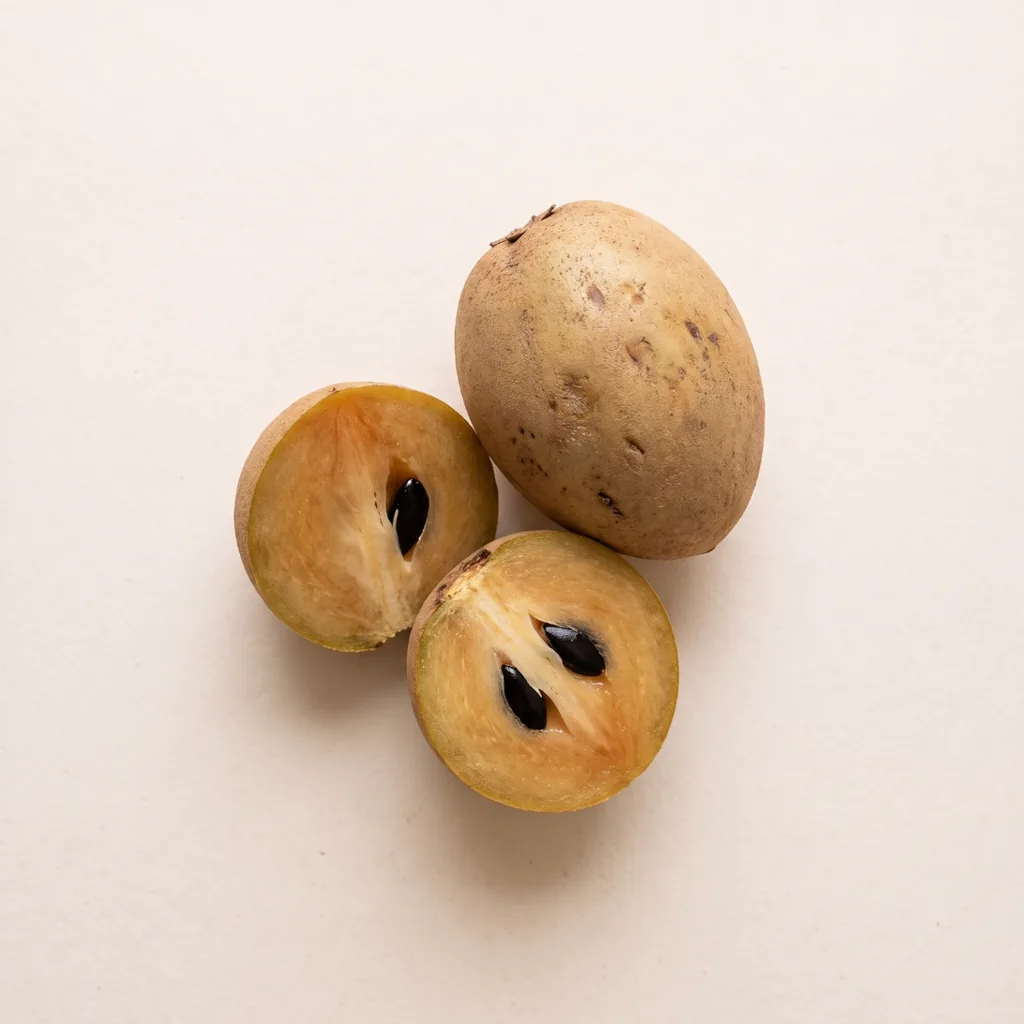
When can babies eat sapodilla?
When can babies have sapodilla?
Sapodilla can be offered once baby is ready for solids, from about 6 months. It is the fruit of an evergreen tree from Central American rainforests. The tree's resin is used to make a gum called chicle. It is known by many names in the Caribbean and tropical Asia. India grows the most today.
Nutrition
Rich in carbohydrates, fiber, folate, iron, magnesium, potassium and vitamins B6 and C. Vitamin C helps iron absorption.
How do you prepare sapodilla for babies?
Preparation basics
The fruit should be ripe, peeled and seedless. If you cannot find it fresh, canned sapodilla, often labeled 'chikkoo pulp', works. After 24 months you can blend smoothies with coconut milk and tart fruit. In some cultures it is eaten with the seeds, which are spat out. Try this only if you trust your child's chewing and ability to follow instructions.
Preparation by age
The same food is served differently at each age. What matters is how your baby sits, grasps and chews, more than the calendar.
6 months
6 months · Ripe, peeled, seedless wedgesstrip
Peel ripe sapodilla, remove every seed and cut into wedges or spears. The fruit can be slippery. Rolling it in finely ground nuts or coconut flakes gives grip. Be mindful of allergens when you use tree nuts.
6 months · Mash into porridge or battermash
Cut: Fork mashed
Mash the ripe fruit with a fork. Stir it into soft, spoonable foods such as oat porridge, or into muffin and pancake batter.
9 months
9 months · Bite-sized piecescube
Cut: Bite sized piece
Cut ripe, peeled and seedless fruit into small bite-sized pieces. This supports the pincer grasp. Because it is slippery, you can roll it in ground nuts or coconut flakes. You can keep offering peeled wedges as well. Baby learns to bite and to spit out a piece that is too big.
12 months
12 months · Small pieces with a forkcube
Cut: Bite sized piece
Offer ripe fruit in small pieces and show your child how to spear it with an age-appropriate fork.
12 months · Halves in the skin, eaten with a spoonslice
Cut: Halved
Serve ripe, seedless halves in their skin. The skin works as a natural cup. Show your child how to scoop the flesh with a spoon.
Is sapodilla a choking hazard for babies?
Choking risk: medium
Ripe sapodilla carries a low risk. Unripe fruit and the hard seeds are riskier. Always remove the seeds.
Choking risk
Ripe sapodilla carries a low risk. Unripe fruit and the hard seeds are riskier. Remove the seeds, prepare for the child's age and stay close during the meal.
Seeds
The seeds can block the airway, and swallowing them may poison the child. Never serve them to a baby.
Is sapodilla a common allergen?
Allergen status
Sapodilla allergy is not common. There are rare reports of mouth-limited allergy symptoms after fresh fruit. A reaction is likelier in people who already react to olives, grapes, kiwi, bell peppers or tobacco. Symptoms are usually brief itching, tingling or burning in the mouth. Cooking can reduce the reaction. Start with a small amount for the first few servings.
Key nutrients
Frequently asked questions about sapodilla
Why remove sapodilla seeds?
The seeds are hard, so they are a choking risk, and they may be toxic if swallowed. Always remove them.
Can I use canned sapodilla?
If you cannot find it fresh, canned sapodilla (chikkoo pulp) is a handy option. Check the label for added sugar.
Is sapodilla slippery for babies?
Yes, it can be. Rolling it in ground nuts or coconut flakes makes it easier to hold.
Sources for this page
- Singh PDA, Simon OR, West ME. (1984). Acute toxicity of seeds of the sapodilla (Achras sapota L.). Toxicon. doi:10.1016/0041-0101(84)90147-8
- Ashok Kumar HG, Hegde VL, Shetty SM, Venkatesh YP. (2013). Characterization and Gene Cloning of an Acidic Thaumatin-Like Protein (TLP 1), an Allergen from Sapodilla Fruit (Manilkara zapota). Allergology International. doi:10.2332/allergolint.12-OA-0522
- Hegde VL, Ashok Kumar HG, Sreenath K, Hegde ML, Venkatesh YP. (2014). Identification and characterization of a basic thaumatin‐like protein (TLP 2) as an allergen in sapodilla plum (Manilkara zapota). Molecular Nutrition & Food Research. doi:10.1002/mnfr.201300261
- Sussman G, Sussman A, Sussman D. (2010). Oral allergy syndrome. Canadian Medical Association Journal. doi:10.1503/cmaj.090314
Guides on iron, allergen introduction, gagging and drinks. Read the starting solids guides
Medical note
This page is for information only and is not a substitute for medical advice, diagnosis or treatment. Talk to your pediatrician before any feeding decision, especially about allergen introduction and reactions.
The Lokmini app
Log sapodilla, reactions and your allergen journey in the app.
Open in LokminiLokmini is coming soon to the App Store.
Astro Tasarım Simay Yenice · Türkiye · merhaba@lokmini.com