Romaine
- First taste
- 6 months
- Choking risk
- medium
- Common allergen
- no
- Iron
- low
Not an allergen · leaves can cling in the mouth
When can babies eat romaine?
When can babies have romaine?
Romaine can be offered once baby is ready for solids, from about 6 months. Chewing and swallowing lettuce is hard for the youngest eaters, so follow the age-based preparation tips. Offering green foods early and often may help reduce picky eating later.
Nutrition and origin
It gives plenty of water plus vitamin A, potassium, vitamin K and fiber. These support vision, heart health, blood and digestion. It is also called cos lettuce. The name comes from Italian lattuga romana and French laitue romaine. Compared with other lettuces it is sturdier, and its ribs are crunchy while its leaves taste a little bitter.
How do you prepare romaine for babies?
Preparation basics
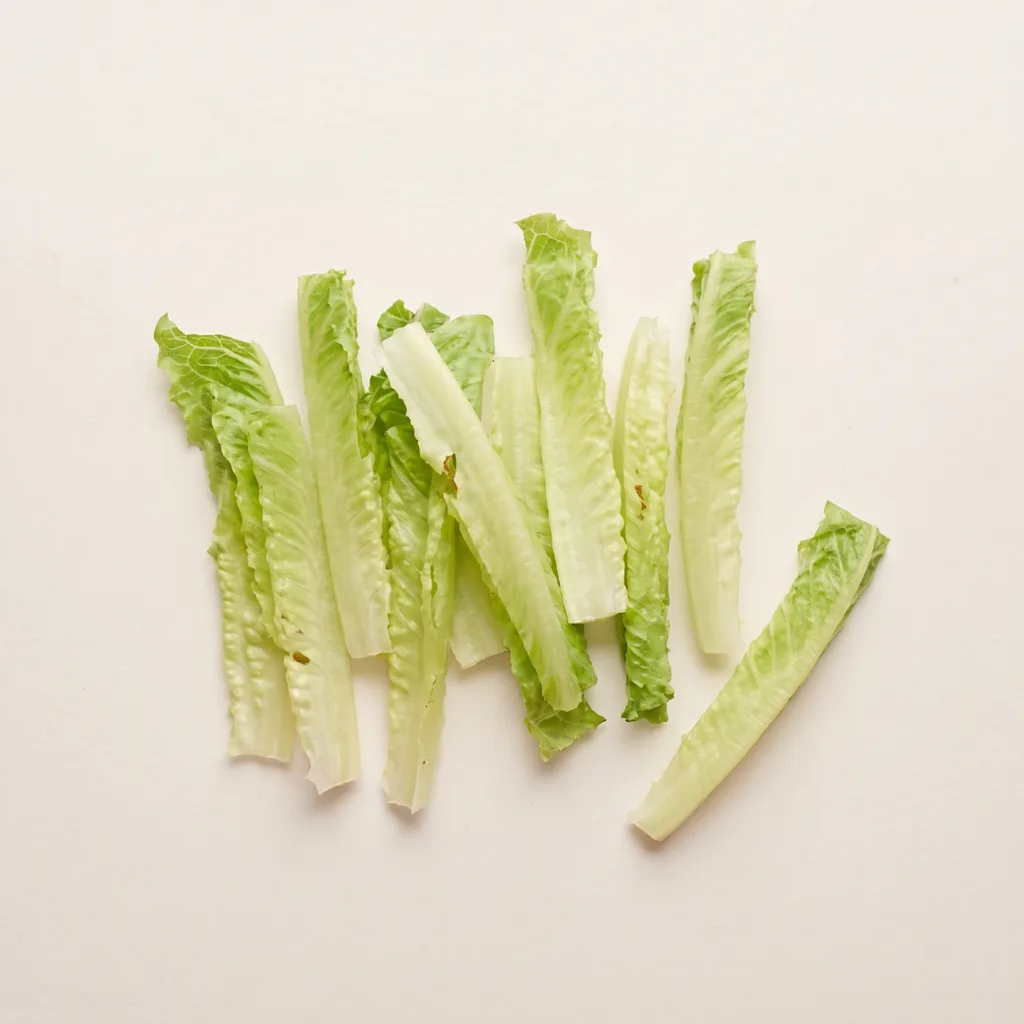
In the early months offer the thick rib as strips, or cook the lettuce and shred it finely. Later try finely chopped leaf and rib. Leaves can cling to the roof of the mouth, so keep water nearby.
Wash lettuce well under cold running water, vinegar is not needed. Lettuce can carry germs such as E. coli, Salmonella and Listeria. Throw away anything recalled by health authorities.
To store, wrap in a towel and keep in a loosely covered container in the fridge. This can add a week or two of shelf life.
Preparation by age
The same food is served differently at each age. What matters is how your baby sits, grasps and chews, more than the calendar.
6 months
6 months · Thick rib strips to munchstrip
Cut: Finger strip
Cut the thick, firm midrib of the leaf into strips and remove the thin leafy part. Baby will gnaw and mouth it rather than swallow it, which builds oral skills.
6 months · Finely shredded cooked lettucemash
Cut: Finely chopped
Cook the lettuce, shred it very finely and stir it into a spoonable food such as yogurt, mash or porridge. It encourages self-feeding.
9 months
9 months · Finely chopped lettucecube
Cut: Finely chopped
Chop the rib or leaf finely. This supports the pincer grasp. Leaves tend to cling to the roof of the mouth. A homemade dressing on them helps the pieces slip down. You can offer a little water in an open cup. Whole large leaves are still fine for practicing biting and tearing.
12 months
12 months · Bite-sized piecescube
Cut: Bite sized piece
Cut rib or leaf into bite-sized pieces and serve as finger food or with a fork. Eat with your child to set an example. If they refuse, do not push, but keep putting it on the table.
12 months · Whole leafslice
At this age you can offer a whole leaf for biting and tearing practice. Stay beside your child during the meal.
Is romaine a choking hazard for babies?
Choking risk: medium
Lettuce is not a common cause of choking. Small thin shreds can slip into the airway and cause gagging. Offer water in an open cup.
Choking risk
Lettuce rarely causes choking. Small, thin pieces can slip into the airway, though. If leaves cling to the tongue or palate, gagging and coughing can follow. Offer water in an open cup. Stay within arm's reach during meals.
Is romaine a common allergen?
Allergen status
Lettuce allergy is rare, but when it happens it can be severe. A lettuce allergy can go together with sensitivity to lipid transfer proteins found in other foods, walnut, peanut, hazelnut, corn, grape, carrot, cherry, and peach among them. Not everyone with a lettuce allergy reacts to all of these.
People with pollen food allergy syndrome, especially plane tree pollen sensitivity, may have brief itching and burning in the mouth. Cooking can reduce it. Start with a small amount, alone, the first few times.
Key nutrients
Frequently asked questions about romaine
Can lettuce help baby poop?
Lettuce is rich in fiber and fluid, which support digestion and regular stools. Babies differ a lot. If you are worried, talk to your pediatrician.
Why wash lettuce so carefully?
Lettuce can carry germs such as E. coli, Salmonella and Listeria. Rinse it well under cold running water.
What if my baby refuses lettuce?
Do not push, but keep offering it. Children cannot learn to like foods they never see. Eating it together sets an example.
Sources for this page
- Muñoz-García E, Luengo-Sánchez O, Moreno-Pérez N, Cuesta-Herranz J, Pastor-Vargas C, Cardona V. (2017). Lettuce Allergy Is a Lipid Transfer Syndrome-Related Food Allergy With a High Risk of Severe Reactions. Journal of Investigational Allergology and Clinical Immunology. doi:10.18176/jiaci.0110
- Helbling A, Schwartz HJ, Lopez M, Lehrer SB. (1994). Lettuce and Carrot Allergy: Are They Related? Allergy Proceedings. doi:10.2500/108854194778816652
- Canela L. (2015). Oral allergy syndrome. World Allergy Organization Journal. doi:10.1186/1939-4551-8-S1-A191
- Kashyap RR, Kashyap RS. (2015). Kashyap RR, Kashyap RS. J Allergy 2015:543928. Journal of Allergy. doi:10.1155/2015/543928
Guides on iron, allergen introduction, gagging and drinks. Read the starting solids guides
Medical note
This page is for information only and is not a substitute for medical advice, diagnosis or treatment. Talk to your pediatrician before any feeding decision, especially about allergen introduction and reactions.
The Lokmini app
Log romaine, reactions and your allergen journey in the app.
Open in LokminiLokmini is coming soon to the App Store.
Astro Tasarım Simay Yenice · Türkiye · merhaba@lokmini.com