Radish
- First taste
- 6 months
- Choking risk
- medium
- Common allergen
- no
- Iron
- low
Not an allergen · raw form is a choking risk
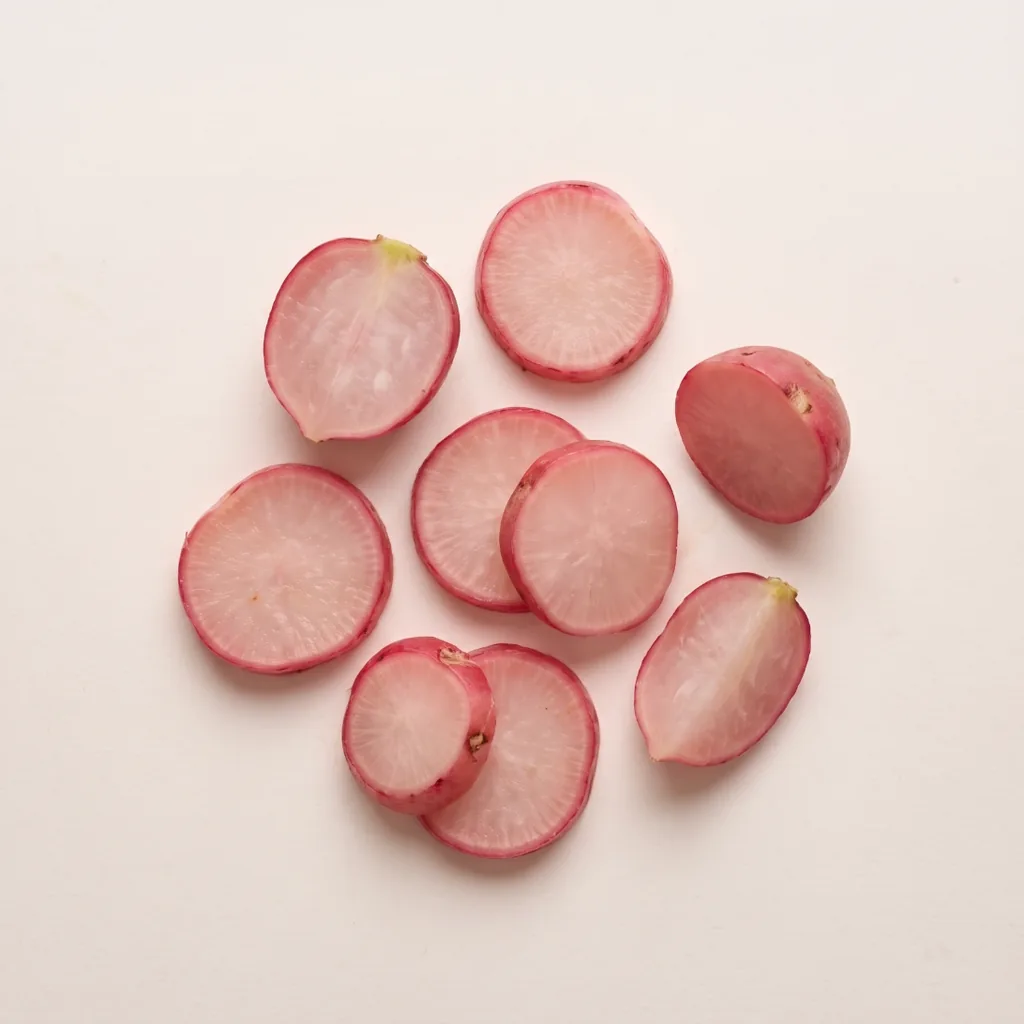
When can babies eat radish?
When can babies have radish?
Radish can be offered once baby is ready for solids, around 6 months. Cooked and mashed is the best way to start.
Radish gives potassium, some vitamin C, B vitamins, folate and calcium. Red and purple types carry extra antioxidants. The leaves are edible too and provide protein, fiber, vitamin C and calcium.
Where it comes from
Radish grows in many parts of the world and most likely began in Asia. Long white types such as daikon appear in Asian pickles, breads and stews.
How do you prepare radish for babies?
Preparation basics
In the early months always cook and mash radish. Later you can offer finely grated raw radish. Pickled radish and kimchi can hold more salt than a baby needs, so rinse them before serving.
Cooked radish leaves, finely chopped, can be stirred into mashes. Roots keep 10 to 14 days in the fridge in a paper bag, while the leaves last only a few days.
Preparation by age
The same food is served differently at each age. What matters is how your baby sits, grasps and chews, more than the calendar.
6 months
6 months · Cook and mashmash
Cut: Fork mashed
Cook the radish until a fork slides in easily. Mash it and place it in a bowl so baby can scoop it with their hands. You can add a tiny amount of finely grated raw radish, or some minced pickled radish, over the top to introduce the peppery taste. Finely chop cooked radish leaves and stir them into the mash or into yogurt.
6 months · Finely grate raw radishcube
Cut: Grated
Grate raw radish finely and add a pinch to baby's food. Make sure no long or hard pieces remain. Start with a small amount.
9 months
9 months · Cooked quartersstrip
Once baby starts picking up small pieces with the fingertips, offer soft cooked radish cut into quarters or thin slices. You can also add grated raw radish and chopped cooked radish leaves. Pieces should be soft enough to squash between your fingers.
12 months
12 months · Bite-sized cooked piecescube
Cut: Bite sized piece
Chop cooked radish into bite-sized pieces and serve with a fork or spoon. Do not push if your child prefers fingers. Steady utensil use usually settles between 18 and 24 months.
12 months · Thinly sliced raw radishslice
Slice raw radish paper thin or grate it. Stay next to your child while eating and keep them seated.
Is radish a choking hazard for babies?
Choking risk: medium
Raw radish is a hard vegetable and can cause choking. Cook it until soft and mash it, or grate raw radish finely.
Choking risk
Raw, hard vegetables are a choking hazard. Cook radish roots until soft and mash them, or grate raw radish. Make sure baby sits safely and stays within arm's reach during meals.
No whole raw pieces
Raw radish slices or sticks are not suitable for young babies.
Is radish a common allergen?
Allergen status
Radish is not a common allergen. Allergy has been reported, though rarely. Radish may also cause a reaction in people allergic to cruciferous vegetables, for example broccoli and mustard greens.
People with pollen food allergy syndrome, mugwort pollen sensitivity in particular, can get a brief itch or burn inside the mouth from cruciferous vegetables. Cooking can reduce this. Start with a small amount for the first few servings.
Key nutrients
Frequently asked questions about radish
Can radish help baby poop?
Radish has fiber, glucosinolates and phenolic compounds, which support digestive health. Stool patterns differ a lot between children. Talk to your pediatrician if you are worried.
Can I give pickled radish?
Fermented pickles can support gut bacteria, but they may be high in salt. Rinse them first and serve only a little.
Are radish leaves edible?
Yes. Cook and finely chop them, then mix into a mash or yogurt.
Sources for this page
- Dimidi E, Cox S, Rossi M, Whelan K. (2019). Fermented Foods: Definitions and Characteristics, Impact on the Gut Microbiota and Effects on Gastrointestinal Health and Disease. Nutrients. doi:10.3390/nu11081806
- Abe S, Ito J, Harada S, Sasano H, Ueda S, Sandhu Y, et al. (2021). A case of hand urticaria, lip angioedema, and oropharyngeal pruritus induced by Japanese radish through IgE-mediated immediate allergic reaction. Allergy, Asthma & Clinical Immunology. doi:10.1186/s13223-021-00538-1
- Lee YH, Lee JH, Kang HR, Ha JH, Lee BH, Kim SH. (2015). A Case of Anaphylaxis Induced by Contact with Young Radish (Raphanus sativus L). Allergy, Asthma & Immunology Research. doi:10.4168/aair.2015.7.1.95
- Sikorska-Zimny K, Beneduce L. (2021). The Metabolism of Glucosinolates by Gut Microbiota. Nutrients. doi:10.3390/nu13082750
- Godlewska K, Pacyga P, Michalak I, Biesiada A, Szumny A, Pachura N, et al. (2021). Systematic Investigation of the Effects of Seven Plant Extracts on the Physiological Parameters, Yield, and Nutritional Quality of Radish (Raphanus sativus var. sativus). Frontiers in Plant Science. doi:10.3389/fpls.2021.651152
Guides on iron, allergen introduction, gagging and drinks. Read the starting solids guides
Medical note
This page is for information only and is not a substitute for medical advice, diagnosis or treatment. Talk to your pediatrician before any feeding decision, especially about allergen introduction and reactions.
The Lokmini app
Log radish, reactions and your allergen journey in the app.
Open in LokminiLokmini is coming soon to the App Store.
Astro Tasarım Simay Yenice · Türkiye · merhaba@lokmini.com