Quince
- First taste
- 6 months
- Choking risk
- high
- Common allergen
- no
- Iron
- low
Never raw · serve cooked
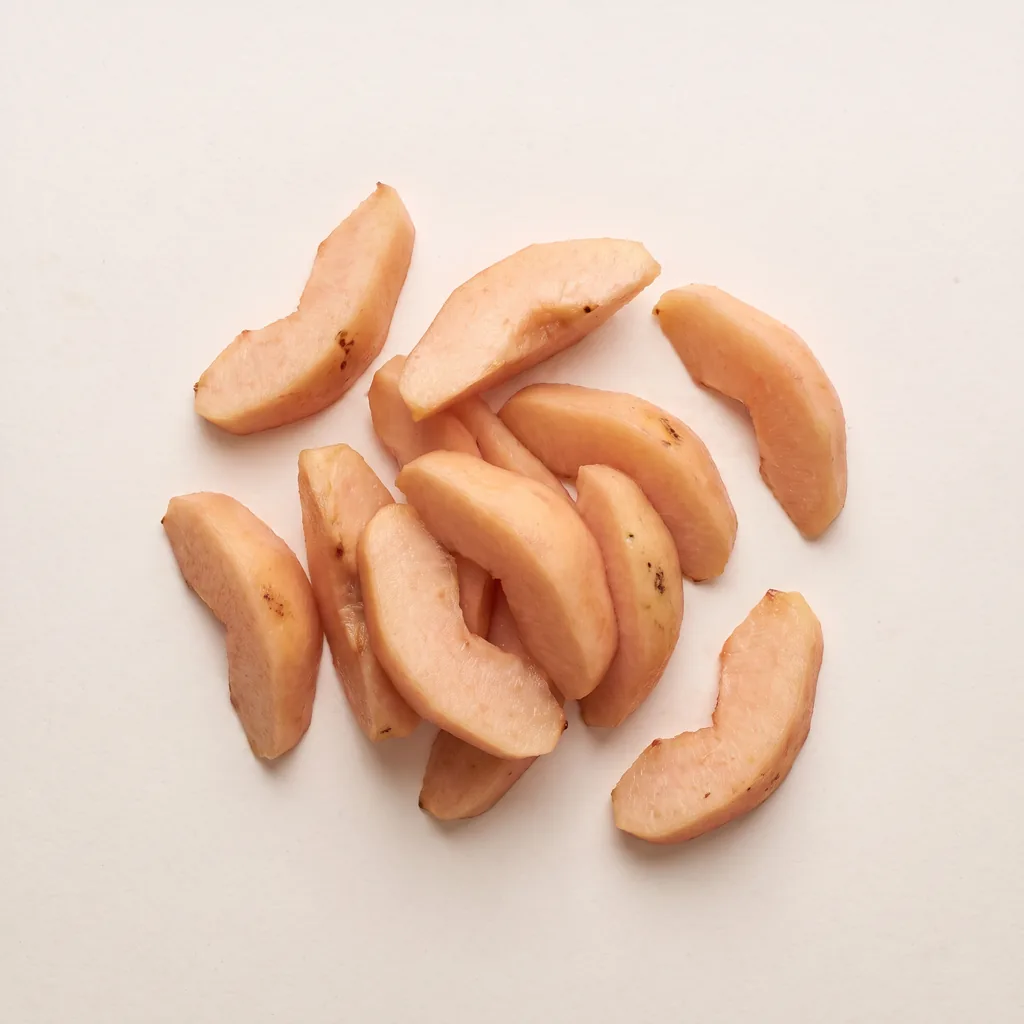
When can babies eat quince?
Quince cooked until soft can be offered once baby is ready for solids, around 6 months. A few types can be eaten raw, but most are very firm even when ripe. To be safe for a baby it must be cooked.
Quince is related to the apple and comes from a region between the Black Sea and the Caspian Sea. Most types are astringent and hard when raw, then soften and sweeten with cooking. Today it is eaten as jam, jelly and paste. It also serves as a sweet partner to savory dishes such as meat stews and tagines.
Nutrition
Quince stands out for its vitamin B6 and zinc. These help heart health, thinking skills and healthy growth. It also gives small amounts of iron, potassium, carotenoids and polyphenols. It is high in fiber, mainly pectin, which aids digestion. It carries strong antioxidants.
How do you prepare quince for babies?
Peel the quince, take out every seed and cook it until soft. At 6 months give big pieces, quarters or a mash. Bigger is better at this age. If baby bites off a piece that is too big, stay calm and let baby work it forward before you step in. At 9 months, once the pincer grasp develops, add bite-sized pieces. At 12 months pre-load a fork and leave it on the table.
Quince jam and jelly hold added sugar. Wait until closer to age 2. An occasional taste is fine.
Seeds
The seeds contain a substance which the body can convert to cyanide. In large amounts it is harmful. Some cultures use the seeds as medicine, but remove every seed before serving to a baby.
Seeds
Remove all quince seeds before serving to a baby.
Digestion
Quince gives fluid and fiber, mainly pectin. Pectin feeds gut bacteria, softens stool and aids digestion. Every baby's bowel pattern differs. Ask your pediatrician if you are concerned.
Preparation by age
The same food is served differently at each age. What matters is how your baby sits, grasps and chews, more than the calendar.
Prep time: 30 min
6 months
6 months · How to prepare as a puréemash
Peel the quince, remove the core, cut into small pieces and simmer in a little water until a fork goes in easily. Mash with a fork or blend; stir into yogurt or oat porridge. Raw quince is hard and astringent, so it is not given.
9 months
9 months · How to cut and servecube
Cut: Bite sized piece
Give cooked, softened quince in small bite-sized cubes. A piece should squash between two fingers. Cook without sugar; quince dessert and syrup are not suitable at this age.
12 months
12 months · How to cut and servecube
Keep serving cooked quince as cubes or thin slices. You can set aside portions from sugar-free baked quince. Raw quince is too hard and is not suitable until age 4.
Is quince a choking hazard for babies?
Choking risk: high
Raw quince is hard and astringent like an apple and is not given raw until age 4. Cook it until it squashes between two fingers; purée at 6 months, soft cubes from 9 months.
Raw quince is very firm, so choking risk is high. Take out the seeds and cook the quince until soft.
You can eat the skin and it adds little choking risk, but it may be hard to chew. Peel it if baby struggles. Stay beside baby during meals.
Raw quince
No raw quince. Cook it until it squashes between two fingers.
Is quince a common allergen?
Quince rarely causes allergy, although some cases have been reported. Information is limited. People sensitive to other fruits of the rose family (Rosaceae), such as apple, apricot, almond and plum, may react to quince in a similar way. Those with oral allergy syndrome to these fruits, especially birch pollen allergy, could in theory be sensitive to quince. This syndrome gives a short spell of itching, tingling or burning around the mouth, and a dangerous reaction is not expected. Cooking or peeling the fruit may reduce the reaction.
Give a small amount at the first servings and watch baby closely. If there is no reaction, raise it slowly.
Key nutrients
Frequently asked questions about quince
Can I give raw quince?
No. Raw quince is hard and astringent. Cooking lowers choking risk and softens the sharp taste.
Why remove quince seeds?
The seeds hold a substance that may change into cyanide inside the body. Take out every one as a precaution.
Does quince help constipation?
Yes, its fluid and pectin fiber help soften stool. Babies differ, so ask your pediatrician if you are worried.
Is quince jam allowed?
Wait until closer to age 2 because of added sugar. A taste now and then is fine.
Sources for this page
- Dünya Sağlık Örgütü. (2023). Guideline for complementary feeding of infants and young children 6-23 months of age.
- NHS. (n.d.). Preparing food safely for babies.
- CDC, Infant and Toddler Nutrition. (n.d.). Choking Hazards.
- American Academy of Pediatrics, HealthyChildren. (n.d.). Choking Prevention for Babies and Children.
- Fattouch S, Caboni P, Coroneo V, Tuberoso CIG, Angioni A, Dessi S, et al. (2007). Antimicrobial Activity of Tunisian Quince (Cydonia oblonga Miller) Pulp and Peel Polyphenolic Extracts. Journal of Agricultural and Food Chemistry. doi:10.1021/jf062614e
- Iranian Journal of Pharmaceutical Research. (2020). Protective Effects of Cydonia oblonga Mill. Fruit on Carbon Tetrachloride-induced Hepatotoxicity Mediated through Mitochondria and Restoration of Cellular Energy Content.
- Panche AN, Diwan AD, Chandra SR. (2016). Flavonoids: an overview. Journal of Nutritional Science. doi:10.1017/jns.2016.41
- Thomas M, Crépeau MJ, Rumpunen K, Thibault JF. (2000). Dietary fibre and cell-wall polysaccharides in the fruits of Japanese quince (Chaenomeles japonica). LWT Food Science and Technology. doi:10.1006/fstl.1999.0628
Guides on iron, allergen introduction, gagging and drinks. Read the starting solids guides
Medical note
This page is for information only and is not a substitute for medical advice, diagnosis or treatment. Talk to your pediatrician before any feeding decision, especially about allergen introduction and reactions.
The Lokmini app
Log quince, reactions and your allergen journey in the app.
Open in LokminiLokmini is coming soon to the App Store.
Astro Tasarım Simay Yenice · Türkiye · merhaba@lokmini.com