Pomegranate
- First taste
- 9 months
- Choking risk
- high
- Common allergen
- no
- Iron
- low
No whole seeds · crush first
When can babies eat pomegranate?
Pomegranate can go to baby when it is prepared safely. We suggest starting from 9 months with crushed seeds. Some sources also accept crushed seeds stirred into yogurt or porridge at 6 months.
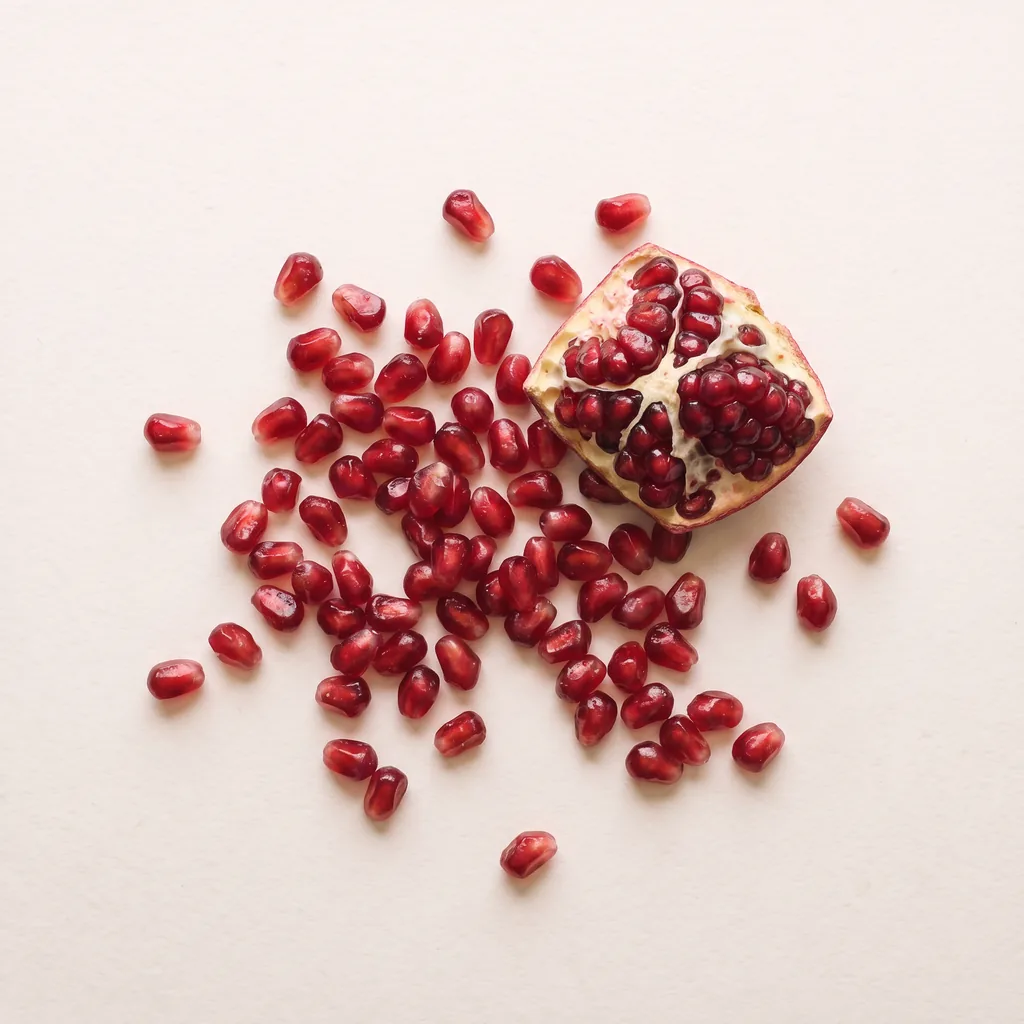
Pomegranate comes from Southwest Asia. Inside the red skin sit an inedible white tissue and hundreds of glossy seeds. The taste is sweet, tart and slightly astringent. Turkish cooking uses it in salads, molasses, sauces and drinks.
Nutrition
Pomegranate gives carbohydrates, fiber and water. It holds folate, potassium and zinc, plus vitamins C, K and B6. It is also rich in antioxidants. These nutrients support energy, digestion and fluid balance.
Diaper rash note
Acidic fruits such as pomegranate can start or worsen diaper rash.
How do you prepare pomegranate for babies?
Crush the seeds with a fork or flatten them fully. Stir the crushed seeds into yogurt, porridge or a sauce. As baby learns to pinch, you can offer the crushed seeds alone.
Pomegranate juice is not a drink before 12 months. After that, give small amounts, ideally diluted. Regular juice raises the risk of cavities and can reduce appetite.
Pomegranate molasses
Dishes made with pomegranate molasses can be shared once baby is ready for solids. Keep an eye on the salt and sugar in the dish.
Preparation by age
The same food is served differently at each age. What matters is how your baby sits, grasps and chews, more than the calendar.
Prep time: 10 min
9 months
9 months · How to prepare as a puréemash
Cut: Fork mashed
Crush the pomegranate seeds well with a fork and stir them into yogurt or oat porridge. The small hard kernels stay in the mash and are harmless to swallow. A whole seed is round and slippery, so it is not served alone at this age. Do not give pomegranate juice.
12 months
12 months · How to servemash
Serve crushed or lightly pressed seeds inside food. Whole seeds are not offered freely one by one until age 4. You can fold crushed seeds into a low-salt bulgur salad or into yogurt.
Is pomegranate a choking hazard for babies?
Choking risk: high
Whole pomegranate seeds are tiny, round, hard and slick, so they are not served. Crush them with a fork and stir them into food.
Whole pomegranate seeds are tiny, round, hard and slick. These four traits raise the choking risk. Do not give whole seeds to a baby.
After 12 months, a few whole seeds can be tried if the child chews well and does not overfill the mouth. We still suggest staying with crushed seeds until age 4. Stay beside your child during meals.
Safe preparation
Crush or flatten the seeds. Do not fold whole seeds into mixed dishes either.
Is pomegranate a common allergen?
Pomegranate is not a common allergen. Allergy to it is rare, though some cases have been reported. Those who have oral allergy syndrome can react to it.
Acidic fruits can redden skin where they touch. This often shows around the mouth, on the cheeks and under the chin. Dab with a cold cloth and do not rub. It fades in a few minutes.
Start with a spoonful served alone at the earliest meals. Raise the portion step by step if baby shows no reaction.
Key nutrients
Frequently asked questions about pomegranate
At what age can I offer pomegranate?
We suggest crushed seeds from 9 months. Whole seeds are risky for young children.
Can I give pomegranate juice?
Not before 12 months. After that, give it only now and then in small amounts.
Is pomegranate molasses fine for babies?
Yes. Once baby is ready for solids, you can share dishes made with it. Watch the salt and sugar.
Baby's face turned red after pomegranate. Is it an allergy?
Usually the acid irritates the skin. Dab with a cold cloth. See a doctor if there is trouble breathing, swelling or vomiting.
Sources for this page
- Dünya Sağlık Örgütü. (2023). Guideline for complementary feeding of infants and young children 6-23 months of age.
- NHS. (n.d.). Preparing food safely for babies.
- CDC, Infant and Toddler Nutrition. (n.d.). Choking Hazards.
- American Academy of Pediatrics, HealthyChildren. (n.d.). Choking Prevention for Babies and Children.
- Solid Starts. (n.d.). First Foods Database.
- ESPGHAN Committee on Nutrition, Fidler Mis N, Braegger C, Bronsky J, Campoy C, Domellöf M, et al. (2017). Sugar in Infants, Children and Adolescents. Journal of Pediatric Gastroenterology and Nutrition. doi:10.1097/MPG.0000000000001733
- Petersen A, Kleinheinz A, Jappe U. (2011). Anaphylactic reactions to pomegranate: identification and characterization of eliciting IgE-reactive components. Clinical and Translational Allergy. doi:10.1186/2045-7022-1-S1-P88
Guides on iron, allergen introduction, gagging and drinks. Read the starting solids guides
Medical note
This page is for information only and is not a substitute for medical advice, diagnosis or treatment. Talk to your pediatrician before any feeding decision, especially about allergen introduction and reactions.
The Lokmini app
Log pomegranate, reactions and your allergen journey in the app.
Open in LokminiLokmini is coming soon to the App Store.
Astro Tasarım Simay Yenice · Türkiye · merhaba@lokmini.com