Pickles
- First taste
- 6 months
- Choking risk
- medium
- Common allergen
- no
- Iron
- low
An occasional taste · high in salt
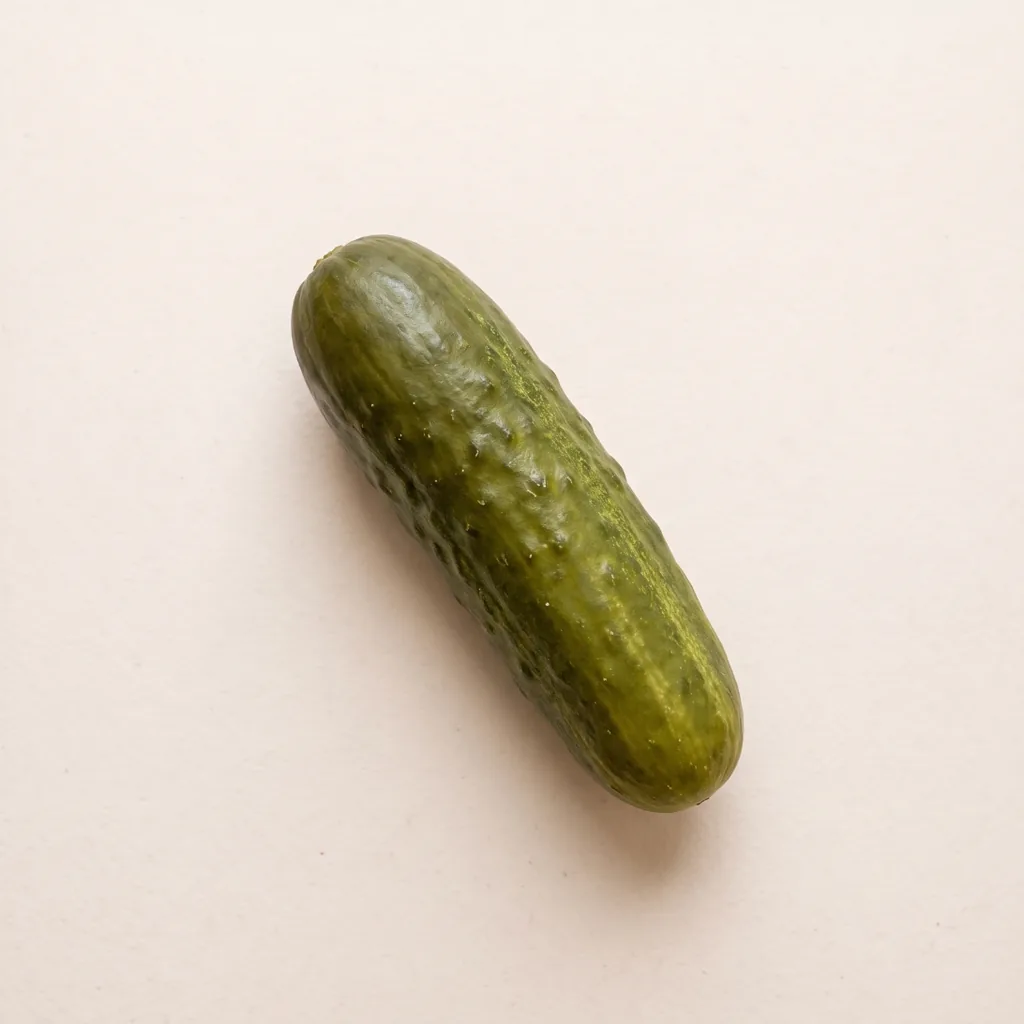
When can babies eat pickles?
You can offer pickles as an occasional taste once your baby is ready for solids, usually around 6 months.
Pickling vegetables is an old way of keeping food, used all over the world. Cucumbers are pickled in Eastern Europe, radish in Korea (kkakdugi), mango in India (achar), and sauerkraut comes from German cabbage. The cucumber pickle, the most common in Western cooking, is made in vinegar or fermented in salty water. Pickles have deep cultural roots in many food traditions.
A cucumber pickle has lots of water and fiber, and a little potassium and vitamin K. Naturally fermented pickles can also give probiotics that help gut health. Vinegar pickles have no live probiotics, but both kinds are nutritious.
Salt
Some pickles carry a lot of sodium, sugar or both. An occasional taste in a varied diet is fine. You can rinse them before serving if you like.
How do you prepare pickles for babies?
Fermented or vinegar
Neither is necessarily healthier than the other. Fermented pickles can give probiotics, vinegar pickles do not. Both are usually high in sodium, so keep portions modest within a varied diet.
Pickled cabbage, peppers or mixed pickles in Turkish cooking can be very salty. Read the label, and still give them only as a taste.
Read the label
Pickles use herbs and seasonings such as garlic, mustard seed and dill. They are not common allergens worldwide but may be counted as allergens in some regions. Check the label first, and confirm that any common allergens inside have already been introduced safely.
Preparation by age
The same food is served differently at each age. What matters is how your baby sits, grasps and chews, more than the calendar.
6 months
6 months · How to prepare as a large pickle or flat slicestrip
Offer a large whole pickle with the pointed ends cut off for your baby to hold and gnaw. It should be too big for your baby to fit in the mouth all at once. Little food reaches the belly this way, but the shape and sharp taste give the mouth plenty of sensory feedback. Large flat slices work too. You can also offer finely chopped pickle on its own or stirred into a soft, scoopable food.
9 months
9 months · How to prepare as flat slicesstrip
Cut: Finely chopped
Offer large flat slices to practice biting, or small ones to pick up with a developing pincer grasp. Finely chopped pickle still goes well in yogurt dips, egg salad, or mashed beans. No cubes or chunks, as they raise the choking risk.
12 months
12 months · How to prepare as long flat slicesslice
Keep serving long or bite-size flat slices and chopped pickle. A large whole pickle or half is fine for biting practice. After 18 months, small pickles such as gherkins and long spears can also be offered. Your child should be seated safely and encouraged to take bites.
Is pickles a choking hazard for babies?
Choking risk: medium
Pickles are often firm and slick, and slicing them into rounds adds to the risk. No cubes or chunks. Serve flat slices or finely chopped.
Pickles carry a choking risk. Many are hard, slick and sliced into rounds. Firmness varies with how they were made.
Prepare pickles to suit your baby's age: a large whole pickle, flat slices or finely chopped. No cubes or chunks. Stay close while your baby eats and keep them upright.
Is pickles a common allergen?
Pickles are not a common allergen. Cucumber allergy is rare. People with oral allergy syndrome from ragweed pollen may be sensitive to cucumber. The mouth itches, tingles or burns for a short time, which is not dangerous.
Vinegar allergy is rare too. However, vinegars are often preserved with sulfites. True sulfite allergy is uncommon. Even so, some people, asthma sufferers in particular, react to added sulfites with symptoms that resemble allergy. If sulfites are a worry, skip products listing additives such as sulfur dioxide, potassium metabisulfite, sodium bisulfite and sodium sulfite.
Vinegar naturally holds plenty of histamine and can push white blood cells in the tissues to release more. In sensitive people, a large intake may bring rashes and stomach upset. If your baby is sensitive, give small amounts.
Acidic foods can cause a contact rash on the skin, which is not an allergy. If it happens, put a thin barrier such as pure petroleum jelly around the mouth before meals and clean up afterwards. Too much can cause or worsen diaper rash. If so, apply a thick barrier cream and avoid long contact with a wet diaper.
Sulfites
For babies with asthma, avoid vinegar products with sulfites on the label.
Key nutrients
Frequently asked questions about pickles
Can babies eat pickles?
Yes, around 6 months once ready for solids, as an occasional taste and prepared properly. They are salty, so keep portions small.
Do I need to rinse pickles?
Not needed, but you can rinse them before serving if you want to cut the salt.
Is a fermented pickle a better choice than one made with vinegar?
Not necessarily. Fermented ones can give probiotics, and both are salty. Keep portions modest.
Sources for this page
- Dünya Sağlık Örgütü. (2023). Guideline for complementary feeding of infants and young children 6-23 months of age.
- NHS. (n.d.). Preparing food safely for babies.
- CDC, Infant and Toddler Nutrition. (n.d.). Choking Hazards.
- Kacik J, Wróblewska B, Lewicki S, Zdanowski R, Kalicki B. (2018). Serum Diamine Oxidase in Pseudoallergy in the Pediatric Population. Advances in Experimental Medicine and Biology. doi:10.1007/5584_2017_81
Guides on iron, allergen introduction, gagging and drinks. Read the starting solids guides
Medical note
This page is for information only and is not a substitute for medical advice, diagnosis or treatment. Talk to your pediatrician before any feeding decision, especially about allergen introduction and reactions.
The Lokmini app
Log pickles, reactions and your allergen journey in the app.
Open in LokminiLokmini is coming soon to the App Store.
Astro Tasarım Simay Yenice · Türkiye · merhaba@lokmini.com