Pear
- First taste
- 6 months
- Choking risk
- low
- Common allergen
- no
- Iron
- low
Very soft or cooked · no core or seeds
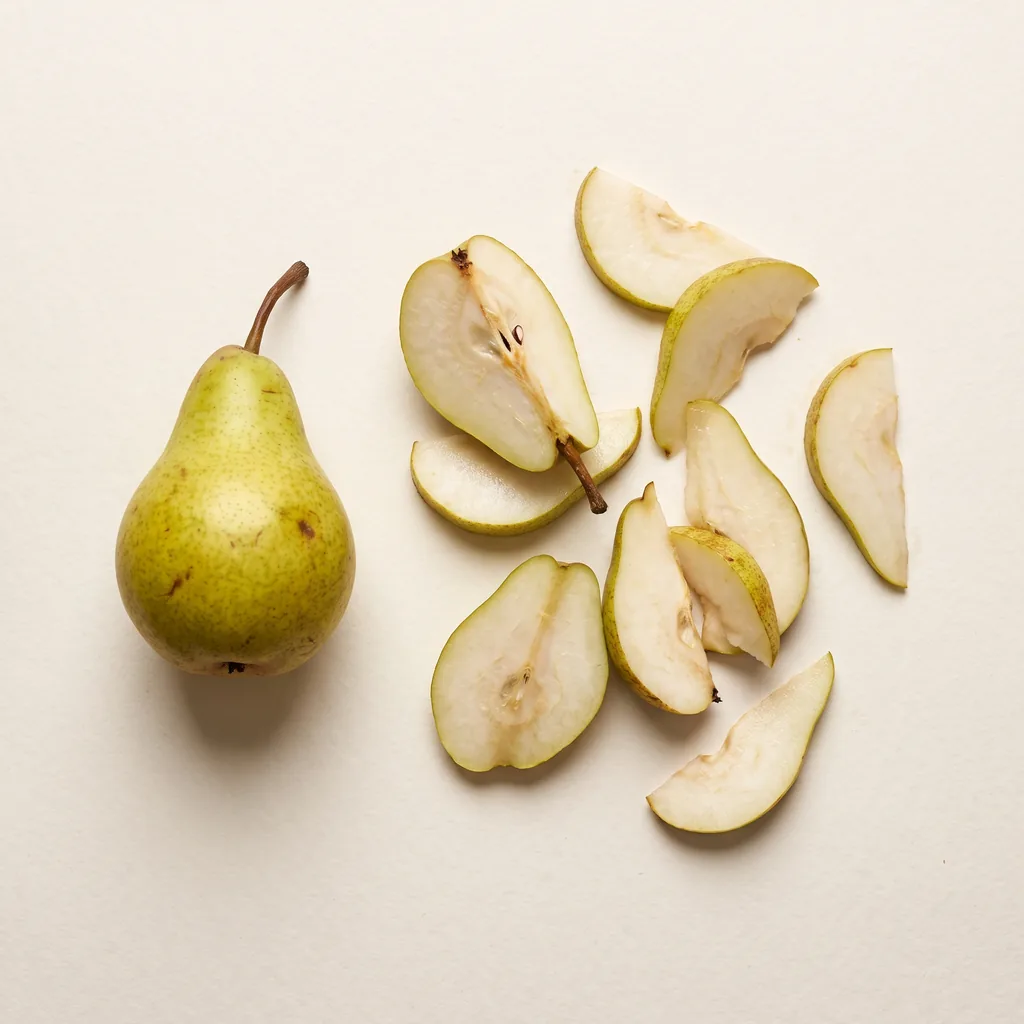
When can babies eat pear?
You can offer pear once your baby is ready for solids, usually around 6 months. The fruit should be very ripe and soft, or cooked until tender.
Pear is a fruit native to Asia. There are thousands of kinds. Some varieties are eaten fresh. Others go into cooking or into perry, a drink.
Pear gives carbohydrates, fiber and fluid. It also supplies copper and potassium, along with vitamins C and K. These support energy, digestion, fluid balance, iron absorption, immunity and blood clotting. It is one of the fruits that can help with constipation.
No firm pears
Firm or underripe pear is slippery and hard. Do not serve it without softening it first.
How do you prepare pear for babies?
Does it need cooking
Yes, as long as the pear is firm. Halve it and poach in water, steam it, or bake it until soft. A very ripe pear that mashes with gentle pressure needs no cooking. Cut big pieces your child can hold easily.
You can hold a cooked pear half in the air and let your baby take it from you. The skin can be on or off.
If you cannot find fresh
Canned or frozen pear is an easy alternative.
Juice
No pear juice as a drink before 12 months. Leaving regular juice for an older age is wise. Regular juice raises the risk of cavities and can reduce appetite for meals.
Preparation by age
The same food is served differently at each age. What matters is how your baby sits, grasps and chews, more than the calendar.
6 months
6 months · How to cut and serve for baby-led weaningstrip
Cut: Thick wedge
A ripe pear should be soft enough to leave a mark when pressed lightly with a finger. At that softness, raw pear is an ideal early finger food for baby-led weaning. Cut thick, palm-length slices from the stem down to the base. Firm, underripe pears are hard to bite, and hard pieces that break off carry a choking risk. Do not serve such pears until they have been lightly poached and softened.
6 months · How to prepare grated or mashedmash
Grate or mash the pear and stir it into a soft, scoopable food such as warm porridge or yogurt. If the pear is firm, first poach the halves in water, steam them or bake them until soft.
9 months
9 months · How to prepare as small flat piecescube
Cut: Bite sized piece
Once your baby starts picking things up with two fingers, offer soft, ripe pear as small, flat, bite-size pieces. Avoid cubes. You can keep giving thin slices, cored halves or cooked halves. The skin can be on or off.
12 months
12 months · How to prepare as quarters and whole fruitslice
Soft, ripe pear can be served almost any way at this age. Serve quarters without the core and seeds, or cut bite-size pieces. Once your child is ready, hand over the whole fruit with its skin on. Expect your child to spit out much of the skin. This is normal and fades between 18 and 24 months as they learn to grind with the molars.
Is pear a choking hazard for babies?
Choking risk: low
Pear, especially underripe, is firm and slippery, which raises choking risk. Cook it if it is firm. Remove the core and seeds.
Pear carries a choking risk. Underripe pear especially is firm and slippery, which raises the risk.
Prepare the fruit to suit your baby's age. Always remove the core and seeds. Cut small pieces flat, not as cubes. Stay close while your baby eats and keep them upright.
Is pear a common allergen?
Pear is not a common allergen. Pear allergy is uncommon but has been reported. People with oral allergy syndrome, especially those sensitive to birch pollen, may react to pear. People sensitive to other foods in the rose family, such as apricot, almond and plum, may react the same way.
This syndrome only makes the mouth itch, tingle or sting briefly, and it is not dangerous. Cooking, canning or peeling pear can reduce or remove the reaction.
Give a small amount on its own the first few times. If there is no reaction, increase the portion.
Key nutrients
Frequently asked questions about pear
Should pear be cooked for babies?
Yes, as long as the pear is firm. If it is very ripe and mashes under light pressure, you can serve it uncooked.
Does pear help with constipation?
Pear has fiber and fluid and is among the fruits that can help with constipation. If it continues, ask your pediatrician.
Why does my child spit out pear skin?
It is normal at this age. It fades between 18 and 24 months, once your child learns to grind skins with the molars.
Sources for this page
- Dünya Sağlık Örgütü. (2023). Guideline for complementary feeding of infants and young children 6-23 months of age.
- NHS. (n.d.). Preparing food safely for babies.
- CDC, Infant and Toddler Nutrition. (n.d.). Choking Hazards.
- de Jong NW, Terlouw S, van Boven FE, van Maaren MS, Schreurs MWJ, van den Berg-Somhorst DBPM, et al. (2021). Birch Pollen Related Pear Allergy: A Single-Blind Oral Challenge TRIAL with 2 Pear Cultivars. Nutrients. doi:10.3390/nu13041355
- Kim JH, Kim SH, Park HW, Cho SH, Chang YS. (2018). Oral Allergy Syndrome in Birch Pollen-Sensitized Patients from a Korean University Hospital. Journal of Korean Medical Science. doi:10.3346/jkms.2018.33.e218
- Rodriguez J, Crespo JF, Lopez-Rubio A, de la Cruz-Bertolo J, Ferrando-Vivas P, Vives R, et al. (2000). Clinical cross-reactivity among foods of the Rosaceae family. Journal of Allergy and Clinical Immunology. doi:10.1067/mai.2000.106927
Guides on iron, allergen introduction, gagging and drinks. Read the starting solids guides
Medical note
This page is for information only and is not a substitute for medical advice, diagnosis or treatment. Talk to your pediatrician before any feeding decision, especially about allergen introduction and reactions.
The Lokmini app
Log pear, reactions and your allergen journey in the app.
Open in LokminiLokmini is coming soon to the App Store.
Astro Tasarım Simay Yenice · Türkiye · merhaba@lokmini.com