Peanut
- First taste
- 6 months
- Choking risk
- high
- Common allergen
- yes
- Iron
- medium
Peanut allergen · never whole
Contains allergens
Each new allergen is offered on its own and watched for two hours. Our allergen introduction guide is available in Turkish for now.
When can babies eat peanut?
You can offer peanut once your baby is ready for solids, usually around 6 months. Whole, broken or chopped peanuts and thick peanut butter are choking risks, so learn how to prepare them safely.
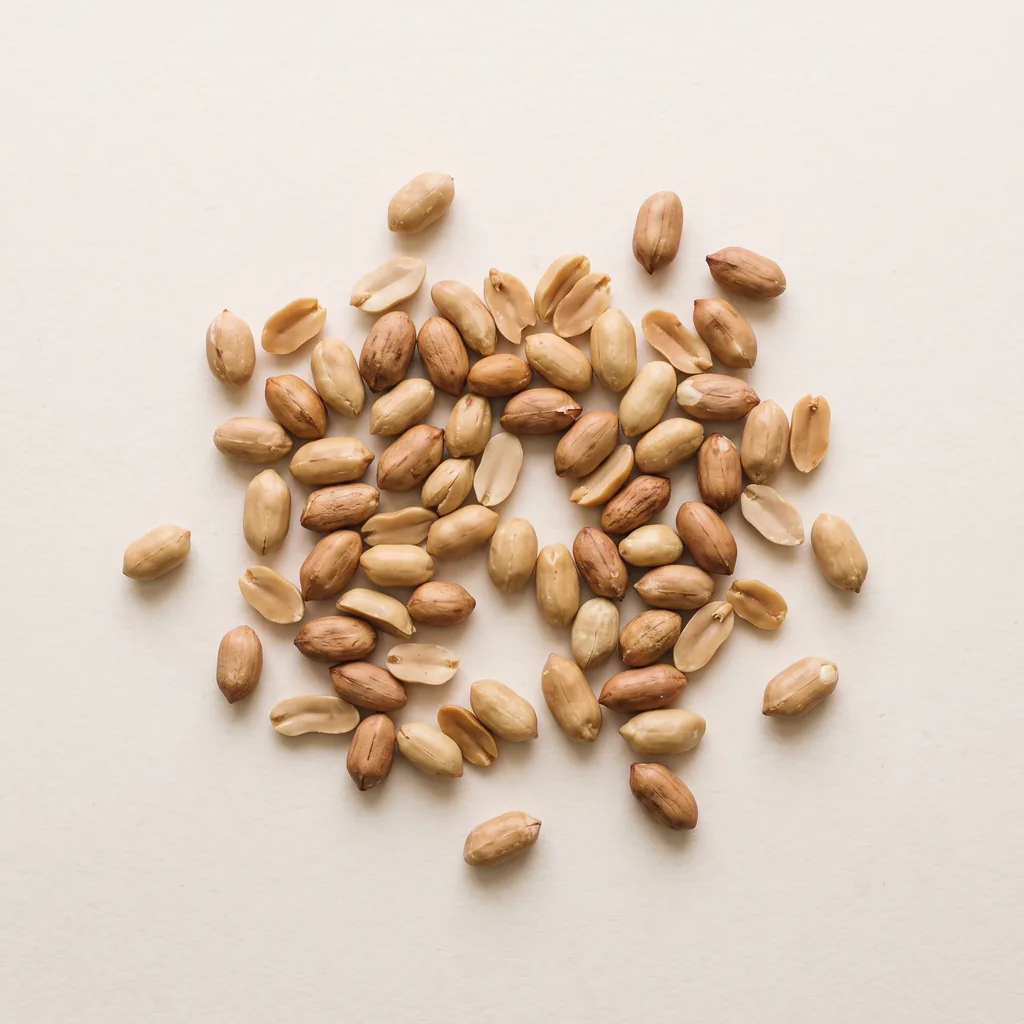
Technically the peanut is not a nut. It is a seed from a legume plant that develops underground, and people eat it. It is native to South America. Food authorities count peanut as a major allergen.
Peanut is high in fat and protein, and it has plenty of fiber. It carries iron, magnesium, zinc, folate, B6 and vitamin E. It provides lasting energy, building blocks for growth and fuel for gut bacteria.
Choking warning
Whole peanuts are among the leading causes of fatal choking in young children. Do not give whole or broken peanuts before age 4.
How do you prepare peanut for babies?
Thin the peanut butter
Loosen smooth peanut butter without honey using applesauce, formula, breast milk, or water. Serve it alone or stir it into porridge or yogurt. You can spread it very thinly on toast strips. A sip from an open cup can wash down sticky bites.
Or grind peanuts very fine and sprinkle a pinch over soft foods. Slippery fruits such as avocado, banana and mango can be rolled in ground peanut.
First try
On the first try, a tiny pinch of ground peanut will do, or roughly 1/8 teaspoon of thinned peanut butter. Hold it on your fingertip or a spoon in front of your baby's mouth and offer it once your baby looks ready (mouth open, leaning forward). Wait 10 minutes. If there is no reaction, keep offering small tastes while your baby stays interested. Watch for another 30 minutes after the meal. If a reaction happens, stop feeding and call your doctor right away, or emergency services if it is severe.
If your baby has marked facial eczema or irritable skin, you can put a barrier cream such as pure petroleum jelly around the mouth. If you mix peanut with a purée, offer that purée alone a few times first so you know the cause if there is a reaction.
Keep it regular
If your baby tolerates peanut, keep offering it about twice a week. Regular intake is important for protection against peanut allergy. About 2 grams of peanut protein a week through the toddler years is thought to be enough for lasting tolerance.
Peanut oil can be used for cooking, but it does not keep allergen exposure going, since it carries little allergenic protein. Peanut flour also supplies fiber, protein, zinc, B6 and folate.
Peanut butter for babies must not contain honey. Store an opened jar in the fridge.
Preparation by age
The same food is served differently at each age. What matters is how your baby sits, grasps and chews, more than the calendar.
6 months
6 months · How to prepare as a puréemash
Cut: Smooth puree
Use applesauce, formula, breast milk, or water to loosen smooth peanut butter without honey until it is thin. Serve it on its own or stir it into porridge or yogurt. Another option is to grind peanuts to a flour-fine powder and sprinkle it on soft foods. The first time, give about a quarter teaspoon and watch for 10 minutes. Do not offer thick paste by the spoon, as it creates a choking risk.
12 months
12 months · How to servemash
Keep stirring thinned peanut butter into yogurt, warm cereal or batter. You can spread a very thin layer on toast. Roll slippery fruits in finely ground peanut to help them stay in the hand. Offer water or milk to wash down sticky bites. Whole peanuts are not given before age 4.
12 months · How to prepare on toast and sandwichesslice
Cut: Smooth puree
Spread smooth peanut butter in a thin layer on a slice of toast. After 18 months you can also spread chunky butter very thinly. It is normal if your child pulls the sandwich apart and eats each part alone. Never leave peanut butter in a thick layer or a lump.
Is peanut a choking hazard for babies?
Choking risk: high
Whole or broken peanuts are not given before age 4. Thin smooth peanut butter with warm water or breast milk, and never offer a spoonful of thick paste.
Any nut, nut piece or nut butter can choke a baby or child, and peanut is near the top of that list.
To lessen the risk, loosen the peanut butter with applesauce, formula, breast milk, or water. Grind peanuts to a powder and sprinkle them over food. Do not offer thick paste by the spoon or in a lump.
Whole or broken peanuts are not given before age 4. Stay within arm's reach while your baby eats and keep them seated upright.
Whole peanuts
Whole peanuts are among the leading foods in fatal and non-fatal choking in children under 3. Do not give them before age 4 unless a doctor or allergist who knows your child advises otherwise.
Is peanut a common allergen?
Peanut is a common allergen. Peanut allergy in children is on the rise. Risk is higher in babies with severe eczema or egg allergy. If you think your baby may have peanut allergy, or your baby has severe eczema, speak with a pediatric allergist or your pediatrician before you give peanut.
A key study showed that giving peanut early cuts the chance of developing peanut allergy later. Following that study, NIAID, the US agency for allergy and infectious disease research, advises starting peanut before the first birthday, with risk factors in mind. For babies with eczema, earlier introduction, ideally between 4 and 6 months, is advised, but only on the decision of a doctor or allergist.
When peanut allergy develops it usually lasts for life. About 20 percent of children outgrow it. A child with peanut allergy has a 25 to 40 percent chance of reacting to at least one tree nut as well. Highly refined peanut oil is usually tolerated because processing removes the allergenic proteins. Unrefined oil is still a risk.
If a reaction happens
If you see swelling of the lips, face or tongue, trouble breathing, widespread hives or repeated vomiting, stop feeding and call for emergency help right away.
Key nutrients
Frequently asked questions about peanut
When can babies eat peanut?
Most babies can start around 6 months, once ready for solids. Babies with eczema or food allergy may benefit from earlier introduction between 4 and 6 months, but talk to your doctor first.
How do I serve peanut butter to a baby?
Loosen smooth butter that has no honey with applesauce, formula, breast milk, or water. Offer it alone or stir it into yogurt or porridge. Never offer thick butter by the spoon.
Can a baby with peanut allergy have peanut oil?
Highly refined oil is usually tolerated, while unrefined oil stays risky. Ask an allergist before giving it to an allergic baby.
Is peanut flour a good choice for babies?
Yes. Even with the fat removed it still holds fiber, protein, zinc, vitamin B6 and folate. You can sprinkle it on soft foods.
Sources for this page
- Dünya Sağlık Örgütü. (2023). Guideline for complementary feeding of infants and young children 6-23 months of age.
- NHS. (n.d.). Preparing food safely for babies.
- CDC, Infant and Toddler Nutrition. (n.d.). Choking Hazards.
- Halken S, Muraro A, de Silva D, Khaleva E, Angier E, Arasi S, et al. (2021). EAACI guideline: Preventing the development of food allergy in infants and young children (2020 update). European Academy of Allergy and Clinical Immunology. doi:10.1111/pai.13496
- American Academy of Pediatrics, HealthyChildren. (n.d.). Choking Prevention for Babies and Children.
- Roberts G, Bahnson HT, Du Toit G, O’Rourke C, Sever ML, Brittain E, et al. (2023). Defining the window of opportunity and target populations to prevent peanut allergy. Journal of Allergy and Clinical Immunology. doi:10.1016/j.jaci.2022.09.042
- Kusari A, Han A, Eichenfield L. (2018). Recent advances in understanding and preventing peanut and tree nut hypersensitivity. F1000Research. doi:10.12688/f1000research.14450.1
- Breuss JM, Atanasov AG, Uhrin P. (2019). Resveratrol and Its Effects on the Vascular System. International Journal of Molecular Sciences. doi:10.3390/ijms20071523
Guides on iron, allergen introduction, gagging and drinks. Read the starting solids guides
Medical note
This page is for information only and is not a substitute for medical advice, diagnosis or treatment. Talk to your pediatrician before any feeding decision, especially about allergen introduction and reactions.
The Lokmini app
Log peanut, reactions and your allergen journey in the app.
Open in LokminiLokmini is coming soon to the App Store.
Astro Tasarım Simay Yenice · Türkiye · merhaba@lokmini.com