Orange
- First taste
- 6 months
- Choking risk
- medium
- Common allergen
- no
- Iron
- low
No whole segments · no juice
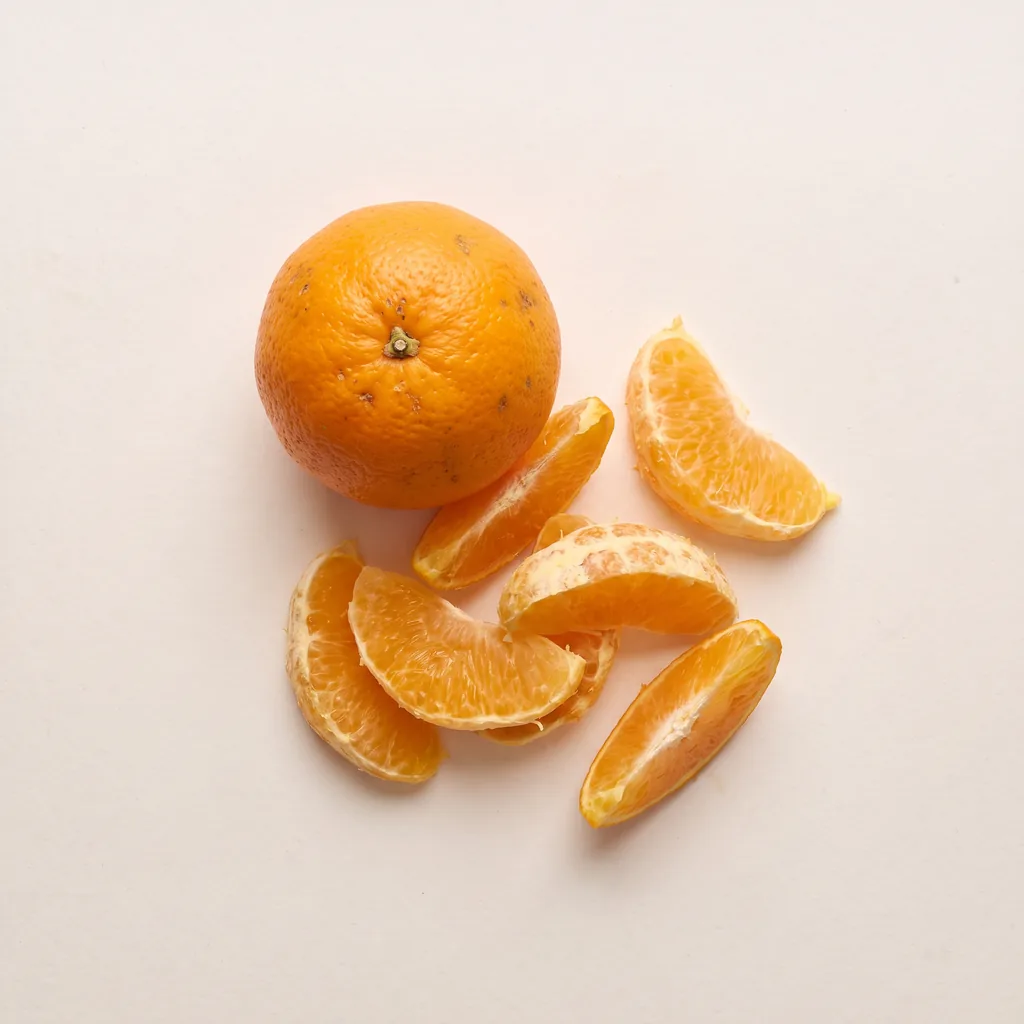
When can babies eat orange?
Oranges can be offered once baby is about 6 months old and ready for solids. Sweet oranges come from a cross between a mandarin and a pomelo. The orange is native to Southeast Asia. Today hundreds of varieties are grown where the climate is warm and humid. The taste ranges from bitter to sweet.
Oranges give carbohydrate, fiber and fluid. Inside are potassium, folate, vitamins A, B6, and C, and antioxidants such as flavonoids. These help with energy, digestion, hydration, vision, immunity and repair. The flavonoids in the peel have anti-inflammatory and antioxidant effects.
Acid can redden the skin
Oranges are acidic. They can cause a temporary, harmless redness around the mouth and can worsen diaper rash.
How do you prepare orange for babies?
At 6 months, wash the orange and cut it into large pieces with the peel on, seeds removed. The peel helps baby hold on. Stay calm if baby bites into the rind. Baby can chew it or spit it out, and you can stick out your tongue to show spitting. The airway is as wide as a drinking straw, so a big piece of rind is unlikely to lodge in it, even if unchewed.
Another way is to supreme the orange, cutting each segment free of its membrane. After 9 months give small pieces without membrane. After 18 months, if you trust your child's chewing, you can try large segments with the membrane.
Orange juice as a drink should wait until after 12 months, and only in small amounts. Regular juice raises the risk of cavities and fills the belly, which can lower interest in other foods.
Preparation by age
The same food is served differently at each age. What matters is how your baby sits, grasps and chews, more than the calendar.
Prep time: 5 min
6 months
6 months · How to cut and serve for baby-led weaningstrip
Cut: Halved
Wash the orange and cut it into thick rings with the peel on, take out the seeds and halve each ring. Baby holds the peel and sucks the fruit. Biting off the tough peel is hard for baby. Choose a variety with thin membranes. The acid can cause redness around the mouth.
9 months
9 months · How to cut and servecube
Cut: Bite sized piece
Peel the membrane off the segments and break the flesh into small pieces. A whole segment is round and slippery, so do not serve one without quartering it. Skip orange juice, since the fruit with its pulp is enough.
12 months
12 months · How to cut and servecube
Serve segments with or without the membrane, halved or quartered. Keep preferring whole fruit to juice.
Is orange a choking hazard for babies?
Choking risk: medium
Segments in their membrane are small, tapered and slippery. Prepare them without the membrane (supreme the fruit) and take out the seeds. Do not give small mandarin segments left in their membrane to babies.
Citrus segments still wrapped in their membrane have small pointed ends, and the texture is slippery and uneven. That raises the choking risk. Serve the orange without membrane (supremed) or in large wedges. Do not give babies small citrus like mandarins and clementines in membrane-covered segments.
Stay within arm's reach of your baby during meals.
Is orange a common allergen?
Orange does not count among the major food allergens in the United States. Even so, medical papers often describe citrus sensitivity reported by patients themselves. Citrus fruit like oranges may bother people with pollen food syndrome, particularly those allergic to certain tree pollens and grass. The result is a short itch in the mouth, which is usually not dangerous.
In some cases, allergy to orange proteins can lead to serious reactions. The main allergens behind serious reactions are thought to be concentrated in the seed. Though uncommon, chewing the seeds may cause a reaction.
Eating oranges has also been reported to contribute to eczema flares. The acid can leave a harmless redness around the mouth too.
Start with a small amount at the first few meals.
Key nutrients
Frequently asked questions about orange
Can babies drink orange juice?
After 12 months, small amounts as a drink are fine. Regular juice raises the risk of cavities. The whole fruit with its pulp is enough.
Why does orange redden the skin around the mouth?
Orange is acidic and can cause a temporary, harmless redness around the mouth. It usually fades soon.
Can I serve orange segments in their membrane?
Do not serve small segments in membrane, as they are a choking risk. Serve without membrane or as large wedges. After 18 months, if you trust your child's chewing, try a large segment with membrane.
Sources for this page
- Dünya Sağlık Örgütü. (2023). Guideline for complementary feeding of infants and young children 6-23 months of age.
- NHS. (n.d.). Preparing food safely for babies.
- CDC, Infant and Toddler Nutrition. (n.d.). Choking Hazards.
- Iorio RA, Del Duca S, Calamelli E, Pula C, Lodolini M, Scamardella F, et al. (2013). Citrus Allergy from Pollen to Clinical Symptoms. PLoS One. doi:10.1371/journal.pone.0053680
- ESPGHAN Committee on Nutrition, Fidler Mis N, Braegger C, Bronsky J, Campoy C, Domellöf M, et al. (2017). Sugar in Infants, Children and Adolescents. Journal of Pediatric Gastroenterology and Nutrition. doi:10.1097/MPG.0000000000001733
Guides on iron, allergen introduction, gagging and drinks. Read the starting solids guides
Medical note
This page is for information only and is not a substitute for medical advice, diagnosis or treatment. Talk to your pediatrician before any feeding decision, especially about allergen introduction and reactions.
The Lokmini app
Log orange, reactions and your allergen journey in the app.
Open in LokminiLokmini is coming soon to the App Store.
Astro Tasarım Simay Yenice · Türkiye · merhaba@lokmini.com