Olive
- First taste
- 6 months
- Choking risk
- high
- Common allergen
- no
- Iron
- low
Pit removed · watch the salt
When can babies eat olive?
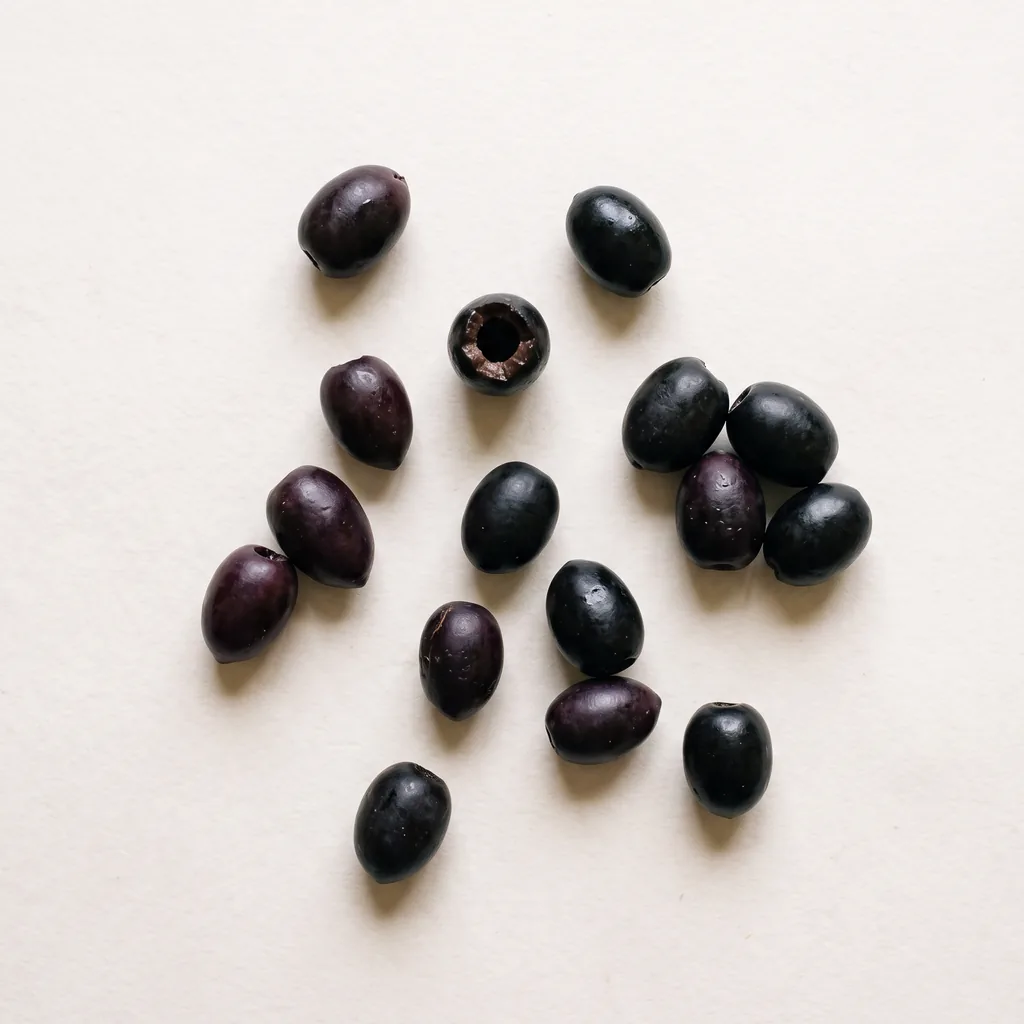
Olives can be offered once baby is about 6 months old and ready for solids. They are a fruit native to the lands around the Mediterranean. Many varieties grow today in sunny, warm regions across the world. Spain's Arbequina is fruity, Morocco's Beldi is meaty, Italy's Castelvetrano is buttery and Greece's Kalamata is dark. Colors go through brown, green and black, which depends on ripeness and how the olive is processed. Fresh olives are very bitter, so they are cured to take the bitterness out.
Olives supply healthy fats, omega-3 and omega-6, fiber, plus calcium, iron, vitamin E and vitamin K. They also hold plant compounds with antioxidant effects. These support energy, gut health, brain growth, immunity and bone density.
How do you prepare olive for babies?
Remove the pit. For babies, spread olive paste on toast strips or stir it into vegetable purée. Finely chopped olives mix well into soft, spoonable meals. After 9 months, thin rings work. After 12 months, you can cut olives lengthwise into halves or quarters.
Sodium can be high in olives. Babies eat little at first, so total sodium tends to stay low, and some sodium is needed for fluid balance and movement. Sharing family meals gives babies a wider range of tastes and textures. It still makes sense to begin with small portions of salty olives.
An opened jar of olives keeps in the fridge for about 4 weeks. Olives from a self-service counter follow the same rule.
Preparation by age
The same food is served differently at each age. What matters is how your baby sits, grasps and chews, more than the calendar.
6 months
6 months · How to prepare as a puréemash
Cut: Smooth puree
Purée pitted olives and spread them on toast strips, or stir them into vegetable purée. Another way is to chop olives very fine and mix them into soft, spoonable meals. Whole olives are round and slippery, so they are not served at this age. Check the pit of every olive you use.
9 months
9 months · How to cut and serveslice
Cut: Thin slice
Cut pitted olives into thin rings. This shape suits a baby who is learning the finger-and-thumb grasp. You can keep mixing finely chopped olives into meals or spreading olive paste on toast.
12 months
12 months · How to cut and serveslice
Offer thin rings, or olives cut lengthwise in halves or quarters. You can keep serving olive paste. Give it with an age-appropriate fork, loading the fork ahead of time and laying it on the rim of the bowl when needed. Even olives sold as pitless can have a pit, so check each one.
Is olive a choking hazard for babies?
Choking risk: high
Olives are round and slippery and can hide a hard pit. Remove the pit, and give olives to babies as a spread, thin rings or lengthwise pieces. Even olives sold as pitted can still hold a pit, so check each one.
Olives are round, slippery, sometimes firm or springy, and may hold a hard pit, so the choking risk is high. Always remove the pit. Even olives sold as pitted can still hold one, so check each olive.
Should a child get a pit in the mouth, stay calm. A pit may be swallowed, spat out, or pushed forward by a gag. Kneel in front of your child, stick out your tongue, calmly ask them to spit it out and cup a hand under the chin.
No whole olives
A whole olive is a choking hazard for young children. Serve a spread, thin rings or lengthwise pieces.
Is olive a common allergen?
Olives rarely cause allergy. In regions where olives are harvested, contact dermatitis and olive allergy have rarely been seen.
People allergic to olive tree pollen or with pollen food syndrome may be sensitive to olives. The olive's plant family also includes ash, privet, jasmine and forsythia. The reaction is a passing itch, burn, or tingle in the mouth, and it is not usually dangerous. In theory it could reach cold-pressed oil, but most people allergic to the fruit tolerate olive oil.
Give a small amount for the first few servings. If nothing happens, increase it slowly.
Key nutrients
Frequently asked questions about olive
Can babies eat olives?
Yes. From about 6 months, give pitted olive paste or finely chopped olives. Do not give whole olives.
Olives are salty. Are they OK for babies?
They can be high in sodium, but babies eat little. Start with small portions. You can pick a lower-salt kind.
Can pitted olives still have pits?
Yes. Even olives sold as pitted may keep a pit, so check each one.
How long does an open jar of olives keep?
About 4 weeks in the fridge. Olives from a self-service counter follow the same rule.
Sources for this page
- Dünya Sağlık Örgütü. (2023). Guideline for complementary feeding of infants and young children 6-23 months of age.
- NHS. (n.d.). Preparing food safely for babies.
- CDC, Infant and Toddler Nutrition. (n.d.). Choking Hazards.
- American Academy of Pediatrics, HealthyChildren. (n.d.). Choking Prevention for Babies and Children.
- Romani A, Ieri F, Urciuoli S, Noce A, Marrone G, Nediani C, et al. (2019). Health Effects of Phenolic Compounds Found in Extra-Virgin Olive Oil, By-Products, and Leaf of Olea europaea L. Nutrients. doi:10.3390/nu11081776
- Liem D. (2017). Liem DG, Nutrients, 2017. Nutrients. doi:10.3390/nu9091011
- Strazzullo P, Campanozzi A, Avallone S. (2012). Strazzullo P, Campanozzi A, Avallone S, Nutrition, Metabolism and Cardiovascular Diseases, 2012. Nutrition, Metabolism and Cardiovascular Diseases. doi:10.1016/j.numecd.2012.04.003
Guides on iron, allergen introduction, gagging and drinks. Read the starting solids guides
Medical note
This page is for information only and is not a substitute for medical advice, diagnosis or treatment. Talk to your pediatrician before any feeding decision, especially about allergen introduction and reactions.
The Lokmini app
Log olive, reactions and your allergen journey in the app.
Open in LokminiLokmini is coming soon to the App Store.
Astro Tasarım Simay Yenice · Türkiye · merhaba@lokmini.com