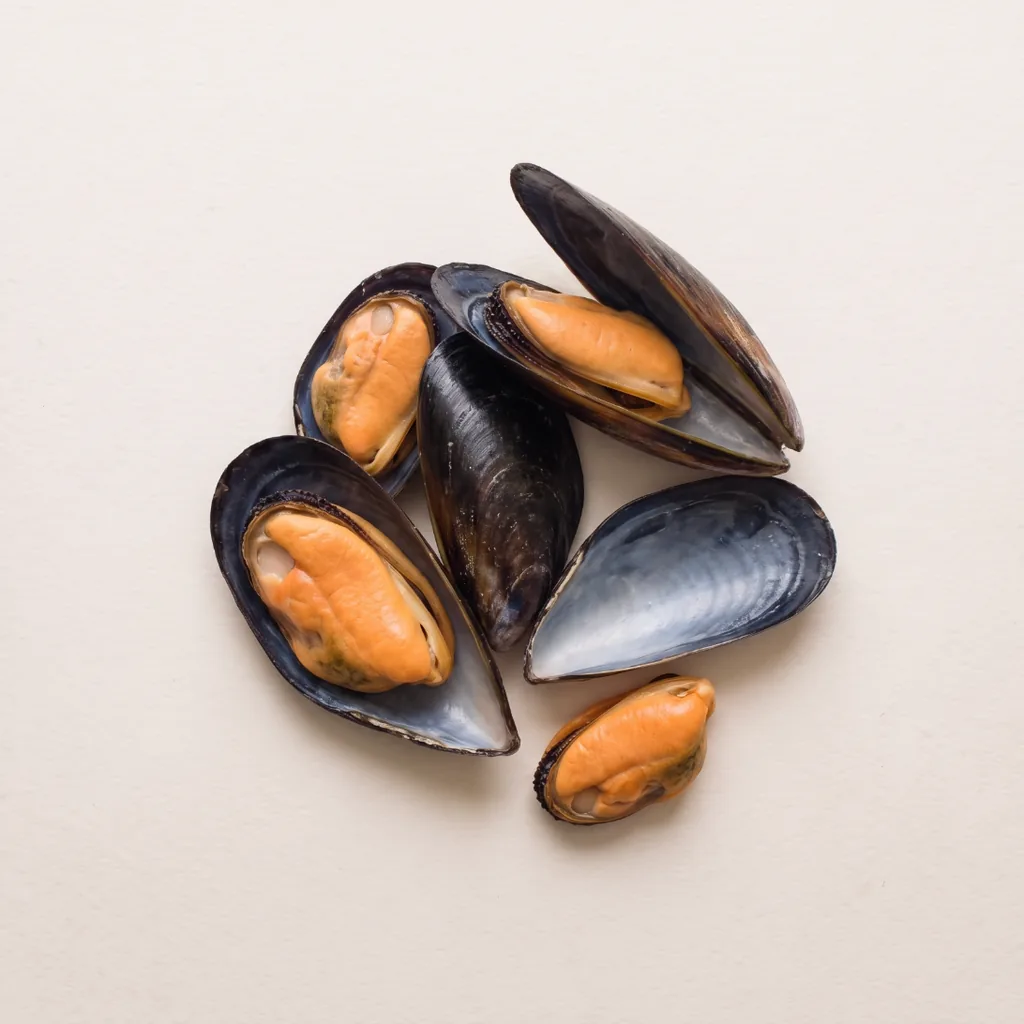
Mussels
- First taste
- 6 months
- Choking risk
- high
- Common allergen
- yes
- Iron
- high
Mollusk allergen · iron-rich · cook well
Contains allergens
Each new allergen is offered on its own and watched for two hours. Our allergen introduction guide is available in Turkish for now.
When can babies eat mussels?
Mussels can join your baby's meals once baby is about 6 months old and ready for solids. Protein is the main draw. You also get omega-3 fats, folate, and minerals such as zinc, iron and selenium, along with B-group vitamins.
Mussels grow in freshwater and in tidal areas along the coast. Most on the market come from sea farms, where they grow on long ropes. In Turkey, stuffed mussels filled with spiced rice are a street food favorite.
Cook them well
Food poisoning is a real concern with mussels, and infants tend to get sicker than adults. Serve mussels fully cooked.
How do you prepare mussels for babies?
Buy mussels fresh and cook them until the inside reaches 145 F (63 C). Chop them fine after cooking.
Canned mussels also work. They are fine from about 6 months as long as they are finely chopped. Choose a no-salt-added or low-sodium product when you can.
Raw mussels are never completely safe at any age. Vibrio bacteria can cause watery diarrhea, and the risk is higher for people who take stomach acid medicines or have a weak immune system. We suggest not giving raw mussels to a baby.
Preparation by age
The same food is served differently at each age. What matters is how your baby sits, grasps and chews, more than the calendar.
6 months
6 months · How to prepare as a puréemash
Cut: Finely chopped
Cook the mussels all the way through or use canned ones. Chop them very fine. Stir them into something soft and spoonable, such as vegetable purée or yogurt. If you buy canned, pick a no-salt-added or low-sodium kind.
9 months
9 months · How to prepare as small piecescube
Finely chop or thinly slice fully cooked mussels. Serve them on their own. If your baby has trouble picking up the slippery bits, mix them into pasta, rice or a stew.
12 months
12 months · How to prepare as bite-sized piecescube
Offer cooked mussels as small bites or thin slices, alone or in a meal. You can also chop them fine and stir them into a spoonable dish. Try whole mussels only when your child can and will chew with the back teeth.
Is mussels a choking hazard for babies?
Choking risk: high
Their texture is firm, rubbery and slippery. Offer them finely chopped or thinly sliced for babies. Hold off on whole mussels until a child chews well with the molars.
The texture is firm, rubbery and slippery, so the choking risk is high. Give them to a baby finely chopped or thinly sliced.
Whole mussels need a lot of chewing. Try them only when you are sure your child can and wants to chew with the molars. Show the motion first. Open your mouth, put the food on your back teeth and chew where your child can watch.
Spitting out is normal
Toddlers often spit out bites while they learn tough textures. It does not mean they dislike the food.
Is mussels a common allergen?
Mussels are mollusks. The World Health Organization counts only crustaceans, such as shrimp and crab, as priority allergens. Many countries do label mollusks as allergens too. In this app we treat mussels as a shellfish allergen.
Someone allergic to mussels may also react to other mollusks, such as oysters, octopus, squid and snails. The chance of reacting to crustaceans like shrimp and crab is above 70 percent. Shellfish allergy is uncommon in early childhood and usually starts in adulthood. When it starts in childhood, it often lasts.
If you suspect your baby may be allergic, talk to an allergist before offering mussels. For the first try, give a very small amount and watch closely.
Cross-contact
A shellfish allergy does not mean a fish allergy. Still, products prepared in the same kitchen with shared tools can pick up traces.
Key nutrients
Frequently asked questions about mussels
Can babies eat canned mussels?
Yes. They are fine once baby starts solids, around 6 months, as long as they are finely chopped. Pick a no-salt-added or low-sodium product when possible.
Can babies eat raw mussels?
We suggest not giving them. Raw mussels carry a high risk of illness from bacteria such as Vibrio. Cooking should bring the inside to 145 F (63 C).
Do mussels contain heavy metals?
The amount of cadmium in them varies with where they were harvested. Too much can harm nervous system development. Offer mussels as one part of a varied diet.
Can babies have stuffed mussels?
You can give cooked stuffed mussels chopped fine. Watch the salt and spice. Skip street-bought ones if you cannot be sure about hygiene and the cold chain.
Sources for this page
- CDC. (2019). Vibrio and food safety.
- Chandravanshi L, Shiv K, Kumar S. (2021). Developmental toxicity of cadmium in infants and children: a review. Environ Anal Health Toxicol. doi:10.5620/eaht.2021003
- Lopata AL, O'Hehir RE, Lehrer SB. (2010). Shellfish allergy. Clinical and Experimental Allergy. doi:10.1111/j.1365-2222.2010.03513.x
- Food Allergy Research & Education. (n.d.). Shellfish allergy.
Guides on iron, allergen introduction, gagging and drinks. Read the starting solids guides
Medical note
This page is for information only and is not a substitute for medical advice, diagnosis or treatment. Talk to your pediatrician before any feeding decision, especially about allergen introduction and reactions.
The Lokmini app
Log mussels, reactions and your allergen journey in the app.
Open in LokminiLokmini is coming soon to the App Store.
Astro Tasarım Simay Yenice · Türkiye · merhaba@lokmini.com