Kiwi
- First taste
- 6 months
- Choking risk
- low
- Common allergen
- no
- Iron
- low
Pick ripe and soft fruit
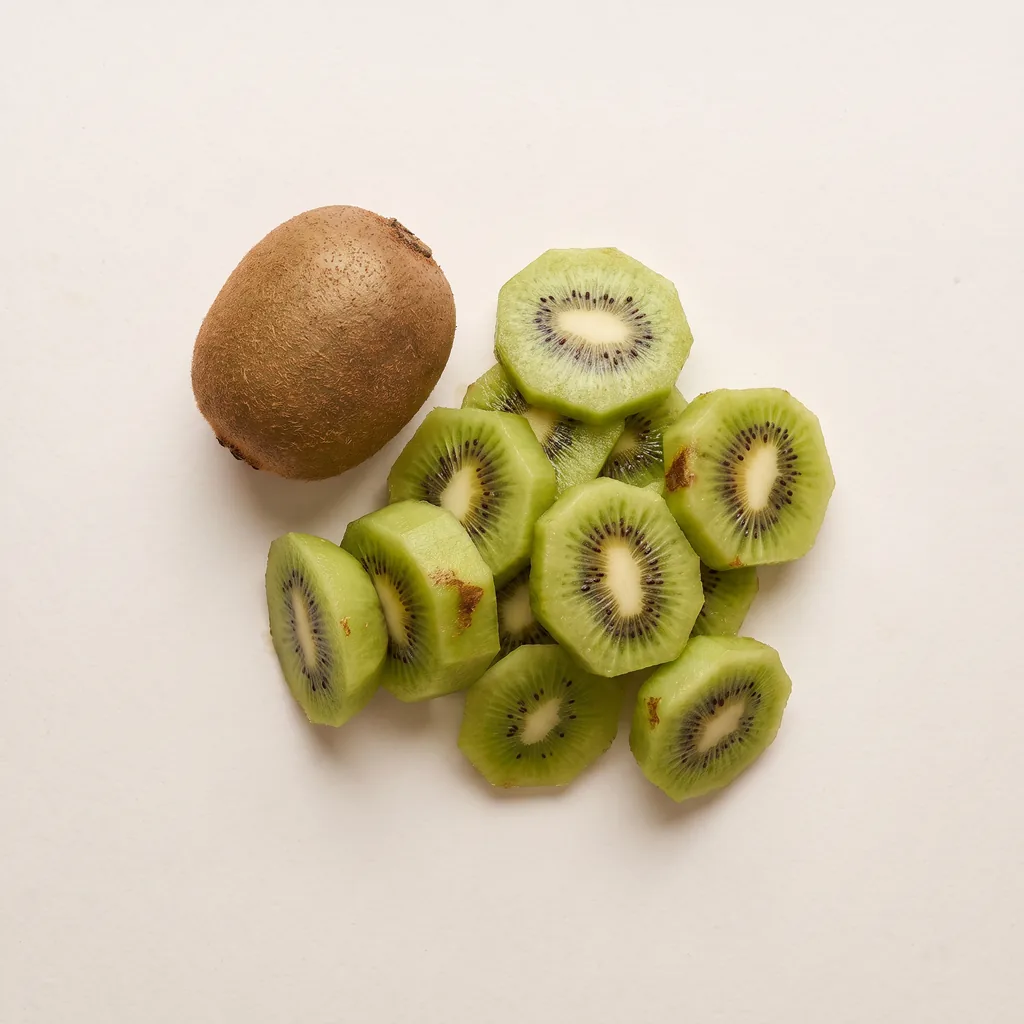
When can babies eat kiwi?
Kiwi can start when your baby is ready for solids, usually around 6 months. It comes from East Asia and is widely grown in New Zealand. There the fruit used to be called gooseberry. It was later sold as kiwifruit, after the small brown flightless bird of New Zealand.
It gives carbohydrate, fiber and water. Minerals and vitamins include potassium, magnesium, calcium, folate, and vitamins K, C and B6. Vitamin C helps iron absorption and immunity. These nutrients support the gut microbiome, bone density and brain development.
How do you prepare kiwi for babies?
Ripeness
Kiwi should be ripe, soft and mash under light pressure. Unripe kiwi can irritate the mouth. Serve a modest amount at a time and together with other foods.
Skin
The skin of every kiwi variety is edible and rich in fiber and antioxidants. Wash it well, since it may hold pesticide residue. Half-peeled kiwi is easier for a baby to hold.
Slippery pieces
After 9 months, try large bite-sized pieces or thin slices when kiwi gets slippery. If it slides too much, roll it in shredded coconut, breadcrumbs or finely ground nuts.
Kiwi juice
A small amount of kiwi juice can be given to drink once your child is past 12 months. For regular sweet drinks, waiting until the second birthday is better.
Preparation by age
The same food is served differently at each age. What matters is how your baby sits, grasps and chews, more than the calendar.
Prep time: 5 min
6 months
6 months · How to cut for baby-led weaningstrip
Cut: Finger strip
Peel ripe, soft kiwi and cut it lengthwise into finger-thick wedges. Firm kiwi is not suitable at this age. If it gives under a thumb press, it is ripe. The acid can redden the skin around the mouth, which is not an allergy. Kiwi rarely causes a true allergy, but offer it alone and in a small amount the first time.
6 months · How to prepare as a mashmash
Cut: Fork mashed
Peel ripe, soft kiwi and mash it with a fork. Serve it alone or stirred into a soft food such as yogurt or porridge. Start with a small amount the first time.
9 months
9 months · How to cutcube
Cut: Bite sized piece
Cut peeled, ripe kiwi into small bite-sized cubes. The tiny black seeds are harmless, so you do not need to remove them. If pieces are too slippery, coat them with a fine powdery food like shredded coconut or crushed cereal.
12 months
12 months · How to cutcube
Keep serving kiwi as cubes or half-moon slices. After 12 months, you can hand your child a peeled half kiwi to scrape with a spoon. Kiwi also works as a sweet topping on oatmeal, rice or yogurt.
Is kiwi a choking hazard for babies?
Choking risk: low
The flesh can be firm and slippery. Serve only ripe, soft kiwi. Keep pieces large or slice them thin.
Kiwi flesh can be firm and slippery. These two traits raise the choking risk. Pick ripe, soft fruit. Cut it in a way that suits your child's age. Stay close at meals, within arm's reach.
Firm kiwi
Do not give unripe, firm kiwi to a young baby.
Is kiwi a common allergen?
Kiwi is not counted as a common allergen. Even so, kiwi allergy is reported more and more often. Reactions range from mild to severe. Kiwi naturally contains an enzyme called actinidin, and some people are sensitive to it.
Kiwi can also be a problem for people with latex-fruit syndrome, meaning an allergy to avocado, banana, or chestnut. Proteins in kiwi can cross-react with those in stone fruits, peanut, and tree nuts. Still, most people with kiwi allergy can eat those foods safely. Birch or beech pollen allergy can lead to oral allergy syndrome, which commonly feels like a short itch, burn, or tingle around the mouth. Peeling or cooking can lessen the reaction.
Kiwi's acid may leave a harmless red patch near the mouth and may make diaper rash worse. This is not an allergy. A thin layer of barrier cream on the face before the meal can help. Start with a small amount the first time.
A common mix-up
A red patch around the mouth is most often an acid effect. If you see lip swelling, hives or vomiting, contact a doctor.
Key nutrients
Frequently asked questions about kiwi
When can a baby eat kiwi?
Once your baby is ready for solids, usually around 6 months. Choose ripe, soft kiwi.
Is kiwi skin edible?
Yes, it is edible and rich in fiber. Wash it well, since it may hold pesticide residue.
Why does kiwi redden the skin around the mouth?
Kiwi is acidic. This can be harmless irritation and is not an allergy. You can apply a barrier cream before the meal.
Can a child be allergic to kiwi?
Yes, it is reported more and more often. The chance is higher with latex-fruit syndrome or birch pollen allergy. Start with a small amount.
Can I give kiwi juice?
A little after 12 months. For regular sweet drinks, waiting until age 2 is better.
Sources for this page
- Dünya Sağlık Örgütü. (2023). Guideline for complementary feeding of infants and young children 6-23 months of age.
- NHS. (n.d.). Preparing food safely for babies.
- CDC, Infant and Toddler Nutrition. (n.d.). Choking Hazards.
- Kim YM, Abas F, Park YS, Park YK, Ham KS, Kang SG, et al. (2021). Bioactivities of Phenolic Compounds from Kiwifruit and Persimmon. Molecules. doi:10.3390/molecules26154405
- Lucas JSA, Grimshaw KEC, Collins K, Warner JO, Hourihane JO. (2004). Kiwi fruit is a significant allergen and is associated with differing patterns of reactivity in children and adults. Clinical and Experimental Allergy. doi:10.1111/j.1365-2222.2004.01982.x
- ESPGHAN Committee on Nutrition, Fidler Mis N, Braegger C, Bronsky J, Campoy C, Domellöf M, et al. (2017). Sugar in Infants, Children and Adolescents. Journal of Pediatric Gastroenterology and Nutrition. doi:10.1097/MPG.0000000000001733
- van Odijk J, Sjölander S, Brostedt P, Borres MP, Englund H. (2017). High frequency of IgE sensitization towards kiwi seed storage proteins among peanut allergic individuals also reporting allergy to kiwi. Clinical and Molecular Allergy. doi:10.1186/s12948-017-0073-4
Guides on iron, allergen introduction, gagging and drinks. Read the starting solids guides
Medical note
This page is for information only and is not a substitute for medical advice, diagnosis or treatment. Talk to your pediatrician before any feeding decision, especially about allergen introduction and reactions.
The Lokmini app
Log kiwi, reactions and your allergen journey in the app.
Open in LokminiLokmini is coming soon to the App Store.
Astro Tasarım Simay Yenice · Türkiye · merhaba@lokmini.com