Hazelnut
- First taste
- 6 months
- Choking risk
- high
- Common allergen
- yes
- Iron
- low
Tree nut allergen · never whole
Contains allergens
Each new allergen is offered on its own and watched for two hours. Our allergen introduction guide is available in Turkish for now.
When can babies eat hazelnut?
When to start
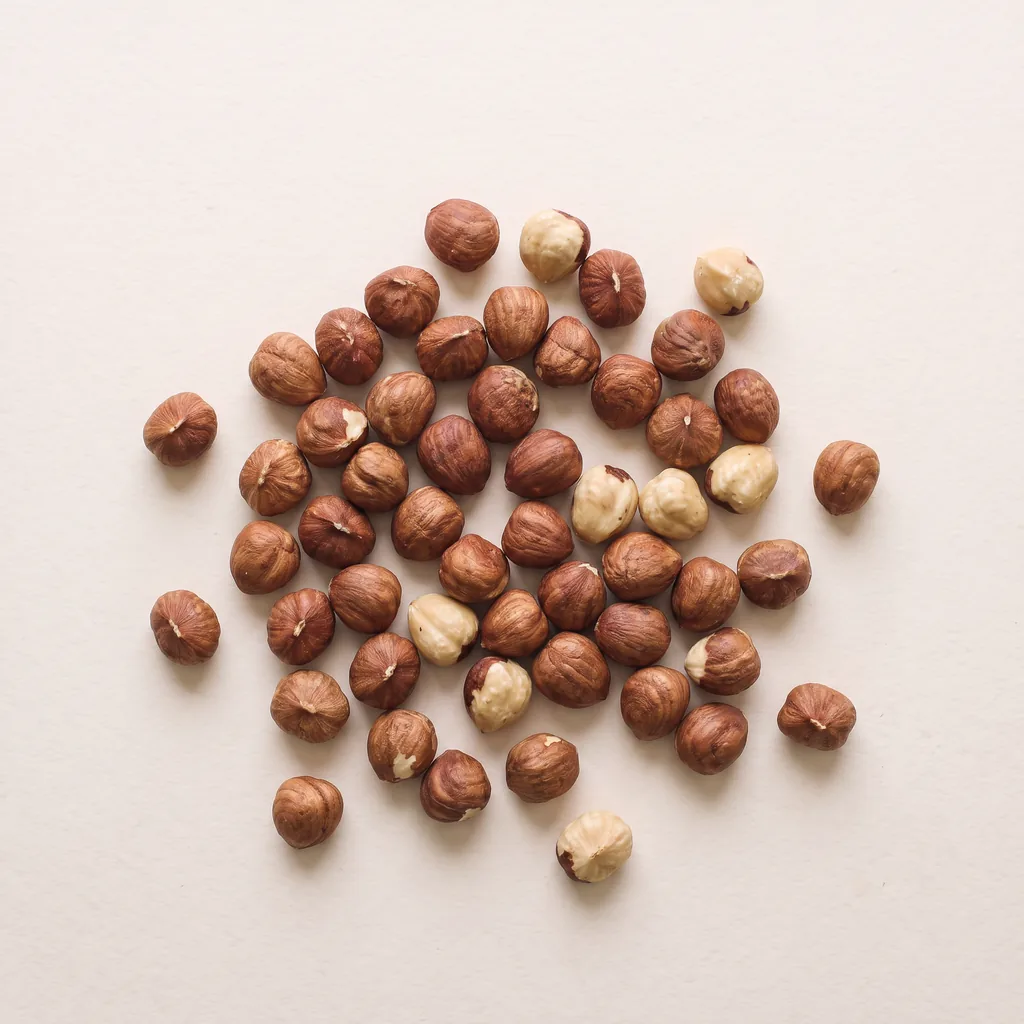
Hazelnut can be offered as a fine powder or a thinned butter once your baby is ready for solids, usually around 6 months. Whole hazelnuts, broken pieces, and thick blobs of nut butter are choking risks for babies.
Across the northern half of the globe, hazelnut trees grow wild and in orchards, stretching from the Americas through Europe into Asia. They are also called filbert and cobnut in English, nocciola in Italian, and noisette in French.
Why it matters
Hazelnut brings vitamin E, good fats, and fiber. These nutrients matter for the brain, heart, immunity, and digestion. It also gives iron and protein, which is especially useful for babies on mostly plant-based diets. It contains vitamin K too, which the blood needs to clot.
How do you prepare hazelnut for babies?
Run hazelnuts through a food processor until no big pieces are left. Lacking a processor, crush them with a hammer inside a cloth, grind them in a mortar, or press them with the base of a bottle. Dust the ground nut over yogurt, rice, quinoa, mashed squash, or hot porridge.
For a hazelnut butter, let the processor run until the nuts turn into a paste. Then add water, yogurt, or another baby-friendly liquid. Aim for a smooth, non-sticky spread with no clumps. Spread it very thinly over other foods.
No sweet hazelnut spreads
Store-bought sweet and cocoa hazelnut spreads are not for babies. Thin a plain, smooth butter instead.
Hazelnut milk
Hazelnut milk is not given as a drink before 12 months. Before that age, a baby drinks breast milk or formula, plus a few sips of water from an open cup once past 6 months. If hazelnut milk goes into a solid food such as oatmeal, it is fine before 12 months.
After 12 months it can be an occasional drink. Nut milks often lack enough calories, fat, and protein for a toddler. Soy or pea milk that is fortified is usually the more nourishing choice.
Storage
Hazelnuts, like other tree nuts, may turn rancid. They keep fresh for up to a year in the refrigerator and up to two years in the freezer.
Preparation by age
The same food is served differently at each age. What matters is how your baby sits, grasps and chews, more than the calendar.
Prep time: 5 min
6 months
6 months · How to prepare as a puréemash
Cut: Smooth puree
Thin smooth, unsweetened hazelnut butter with water, breast milk, or yogurt before serving. Or grind the hazelnuts to a flour-fine powder and stir it into mashed banana. Sweetened and cocoa hazelnut spreads are not given at this age. Tree nuts are a new allergen, so offer them the first time on their own and in the morning.
6 months · Fruit rolled in ground hazelnutstrip
Cut: Ground
Roll slippery fruit strips, such as banana or pear, in finely ground hazelnut. The powder adds texture to the surface and makes it easier for your baby to grip. Make sure the ground nut has no large pieces.
9 months
9 months · How to servemash
Cut: Ground
Spread thinned hazelnut butter very thinly on a soft strip of bread, or mix ground hazelnuts into oatmeal and yogurt. A thick blob of nut butter sticks in the mouth, so always thin it.
12 months
12 months · How to servemash
Cut: Ground
Keep going with ground hazelnuts and thinned unsweetened hazelnut butter. Whole, broken, or roasted hazelnuts are not given until age 4. In cakes and cookies, hazelnuts must be ground.
Is hazelnut a choking hazard for babies?
Choking risk: high
Whole hazelnuts, large pieces, and thick blobs of nut butter are choking risks for babies. Grind the nut to a fine powder and thin any nut butter. Do not give whole hazelnuts before age 4.
Whole hazelnuts, nut pieces, and thick blobs of nut butter are choking risks for babies and young children. Grind the nut to a powder and thin any nut butter.
Sit with your baby while they eat and stay within reach. Set up a safe eating space.
No whole hazelnuts before age 4
Whole or broken hazelnuts are not given before age 4. Medical bodies count nuts as a choking risk until age 4 and beyond.
Teaching whole hazelnuts
After age 3, if your child has mature eating skills, you can think about whole hazelnuts. Your child should bite with the teeth and chew well, moving the food over to one side of the mouth. Your child should avoid stuffing the mouth. They should spit out food that is poorly chewed and be able to eat softer nuts like walnut or pecan.
Hazelnuts are hard, small, and round, which makes them one of the riskiest nuts. Begin with softer nuts. First show your child how it is done. Put the nut between your front teeth, move it to your back teeth with your tongue, chew with your mouth open, and show the crushed nut. Then give your child a turn. Do not place the nut in their mouth yourself. Offer one or two nuts, never more. If your child does not use their teeth, have them spit out the nut and try again in a few weeks.
A child who talks, sings, or yells while eating nuts has a higher choking risk. Show that chewing is done quietly. Check that the mouth is empty before lifting your child out of the chair. Never let a child walk around with nuts in the mouth.
Is hazelnut a common allergen?
Hazelnut is on the World Health Organization's list of global priority allergens. Reactions range from mild itching of the mouth to anaphylaxis. Severe reactions occur more often in children younger than 5. Between 0.5 and 1.2 percent of people are allergic to tree nuts. It usually lasts for life. Only about 9 percent of children grow out of it.
Pollen allergy to birch, hazel, or alder trees often leads to oral allergy syndrome with hazelnut. The mouth itches, tingles, or stings for a short while. A dangerous reaction is not expected.
People allergic to hazelnut may also react to peanut and other tree nuts. That does not mean every nut must be dropped. Work out with an allergist which nuts are safe to give.
Talk to your doctor first
If your baby has severe eczema, has had an allergic reaction before, or you suspect a nut allergy, see your pediatrician or a pediatric allergist before offering hazelnut at home.
First try
Most babies do not need a test before nuts, even with a family history of food allergy. Evidence is growing that early introduction of allergens protects. So do not delay without a reason.
Offer a very small amount the first time. Start with a pinch of fine hazelnut powder, or an eighth of a teaspoon of smooth butter loosened with water, milk, or formula. If there is no reaction, raise the amount at later meals. It is fine if your baby does not finish the serving. After introduction, keep offering it about twice a week if you can. Do not stop unless there are signs of a reaction.
Key nutrients
Frequently asked questions about hazelnut
How do I serve hazelnut butter to my baby?
Thin plain, smooth butter with water, breast milk, or yogurt. Spread it in a very thin layer on another food or stir it into yogurt. Do not give it as a blob on a spoon.
Can babies have hazelnut milk?
Not as a drink before 12 months. It can go into a dish such as oatmeal. After 12 months it can be an occasional drink, though it may be short on calories, fat, and protein.
How much hazelnut should I give?
A pinch of finely ground hazelnut or 1/8 teaspoon of thinned butter is enough for the first try. If there is no reaction, raise it slowly. Keep offering it about twice a week if you can.
Sources for this page
- Dünya Sağlık Örgütü. (2023). Guideline for complementary feeding of infants and young children 6-23 months of age.
- NHS. (n.d.). Preparing food safely for babies.
- CDC, Infant and Toddler Nutrition. (n.d.). Choking Hazards.
- Halken S, Muraro A, de Silva D, Khaleva E, Angier E, Arasi S, et al. (2021). EAACI guideline: Preventing the development of food allergy in infants and young children (2020 update). European Academy of Allergy and Clinical Immunology. doi:10.1111/pai.13496
- Türkiye Ulusal Alerji ve Klinik İmmünoloji Derneği. (n.d.). Besin Alerjisi, öncelikli 10 besin.
- American Academy of Pediatrics, HealthyChildren. (n.d.). Choking Prevention for Babies and Children.
- Brough HA, Caubet JC, Mazon A, Haddad D, Bergmann MM, Wassenberg J, et al. (2020). Defining challenge-proven coexistent nut and sesame seed allergy: A prospective multicenter European study. Journal of Allergy and Clinical Immunology. doi:10.1016/j.jaci.2019.09.036
- Verduci E, D’Elios S, Cerrato L, Comberiati P, Calvani M, Palazzo S, et al. (2019). Cow's Milk Substitutes for Children: Nutritional Aspects of Milk from Different Mammalian Species, Special Formula and Plant-Based Beverages. Nutrients. doi:10.3390/nu11081739
Guides on iron, allergen introduction, gagging and drinks. Read the starting solids guides
Medical note
This page is for information only and is not a substitute for medical advice, diagnosis or treatment. Talk to your pediatrician before any feeding decision, especially about allergen introduction and reactions.
The Lokmini app
Log hazelnut, reactions and your allergen journey in the app.
Open in LokminiLokmini is coming soon to the App Store.
Astro Tasarım Simay Yenice · Türkiye · merhaba@lokmini.com