Ground beef
- First taste
- 6 months
- Choking risk
- medium
- Common allergen
- no
- Iron
- high
Iron-rich · serve soft and well cooked
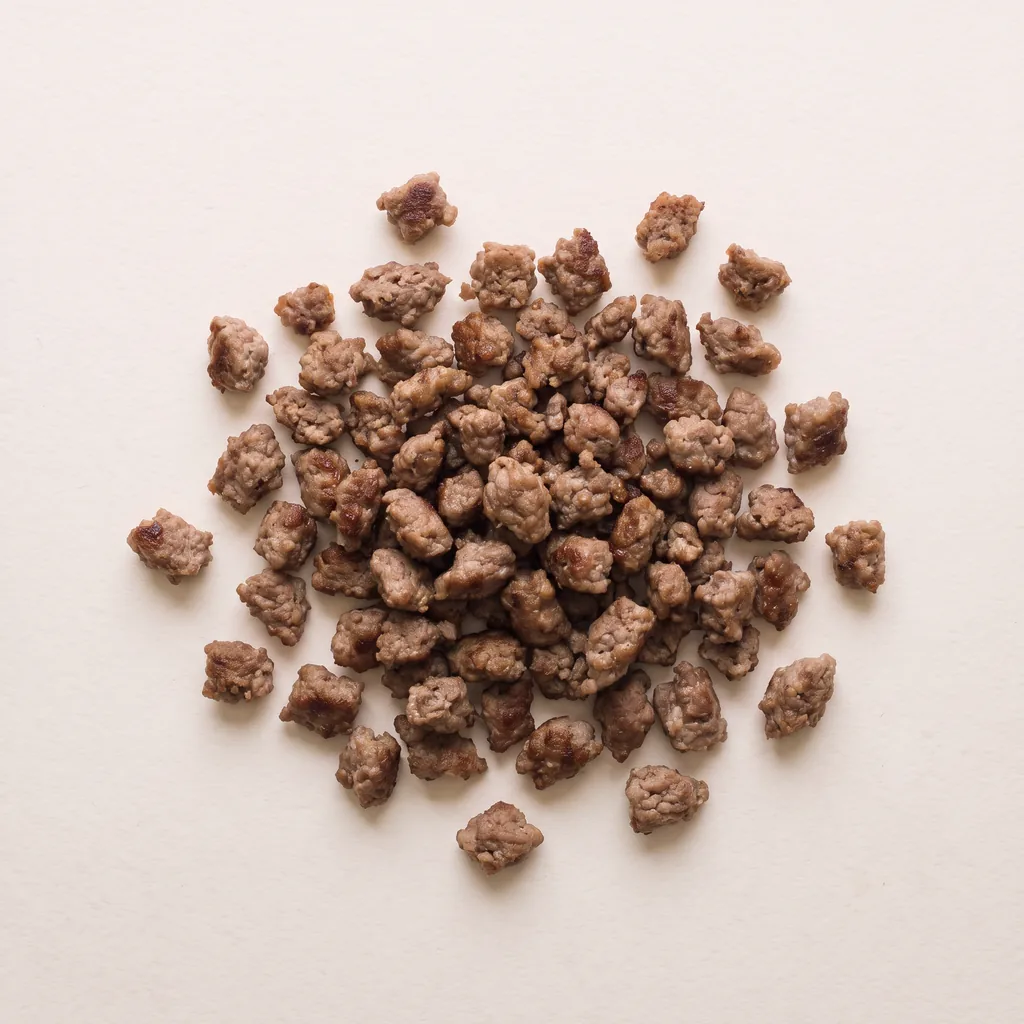
When can babies eat ground beef?
When to start
Well-cooked ground beef can be offered once your baby is ready for solids, which is usually around 6 months.
Ground beef is made from the leftover pieces after steaks and roasts are cut from the carcass. Fat content varies from one product to another. Packages commonly show a ratio like 80% lean to 20% fat.
Why it matters
Beef gives plenty of protein and fat to fuel fast growth. Selenium, choline, iron, zinc and vitamin B6 are included as well. A baby's iron needs rise after 6 months, and beef is a strong source at that stage.
How do you prepare ground beef for babies?
Always cook ground beef all the way through to 160 F (71 C). Undercooked ground meat can carry bacteria such as E. coli and Salmonella.
In the early months, the safest route is to mix the meat into a soft food you can scoop. A soft patty wider than 2 inches (5 cm) is another option. It is easy to grip and harder to pop whole into the mouth.
Keep patties soft
A patty turns softer if you simmer it in sauce or work nut or seed flour, cooked grains or breadcrumbs into the mixture. Store-bought frozen meatballs tend to be small and firm, so crumble them into a mash instead.
Store-bought meatballs and plant-based meat
Prepared meatballs may contain milk, egg, sesame, and wheat. Read the label, and introduce those allergens one at a time beforehand.
Plant-based ground meat can also supply iron and protein. Just make sure any allergens on the label have already been tried, and that it stays soft and mashable after cooking.
Preparation by age
The same food is served differently at each age. What matters is how your baby sits, grasps and chews, more than the calendar.
6 months
6 months · How to mix into a mashmash
Cook the beef all the way through until no pink remains. Stir it into mashed potato, mashed vegetables, or polenta. Your baby can scoop it by hand or try a pre-loaded spoon. Do not offer loose crumbles on their own.
6 months · Large, soft pattyslice
Cut: Large piece
Form a patty that is wider than 2 inches (5 cm), and cook it until a thermometer in the center shows 160 F (71 C). Press it gently between thumb and finger, and it should mash easily. A dip in applesauce or yogurt helps it go down. If it crumbles in the mouth, stay calm and let your baby push the bits forward with the tongue.
9 months
9 months · Bite-sized piecescube
Cut: Bite sized piece
Break the patty into small bites so your baby can practice picking them up. If your baby is not ready for small pieces, keep offering saucy ground beef or the larger patty. If a big piece breaks off in the mouth, show your baby how to spit it out.
12 months
12 months · Whole patty or burgerslice
Your toddler can have a whole patty or a burger in a bun. Many kids take it apart and eat the pieces one by one, which is fine. Cook the meat every time until the center reaches 160 F (71 C).
12 months · In sauce, stew, or crumbledcube
Serve the beef in sauce, stew, or pasta. As long as it stays soft, you can also offer it crumbled on its own.
Is ground beef a choking hazard for babies?
Choking risk: medium
Dry, loose crumbles of ground beef scatter in the mouth and can raise the risk of choking. Stir the meat into a soft mash, or shape it into large, soft patties.
Tough and firm, ground beef takes effort to chew. Dry, loose crumbles also scatter unpredictably in the mouth. Both qualities raise the risk of choking.
Keep the meat soft, prepare it in a way that fits your baby's age, and stay close for the whole meal. A patty that falls apart can cause gagging. Gagging is a normal reflex, so stay calm and give your baby time. Very dry meat may cling to the palate and make gagging stronger.
Teach spitting out
Tilt your baby slightly forward, hold a hand under the chin, and stick out your own tongue to show how. This helps them learn to release a piece that is too big.
Is ground beef a common allergen?
Beef is not a common allergen, though allergic reactions have been reported. Some tick bites, chiefly from the Lone Star tick, can lead to an allergy to a sugar called alpha-gal, which is found in the meat of non-primate mammals. The reaction shows up 3 to 8 hours after eating red meat. People with alpha-gal allergy may also react to dairy, gelatin, and organ meats such as liver.
Children with a dairy allergy have a slightly higher chance of being sensitive to beef. Among people with a confirmed beef allergy, many are also allergic to cow's milk.
Over the first few servings, give only a small portion and keep an eye on your baby. If all goes well, increase the portion slowly.
Key nutrients
Frequently asked questions about ground beef
When can babies eat meatballs?
From 6 months, as long as the meatball is fully cooked and soft, with a width of 2 inches (5 cm) or more. A large meatball is hard to pop whole into the mouth, and a soft one carries less risk.
What temperature should ground beef reach?
The inside should reach 160 F (71 C). A kitchen thermometer is the safest way to check. Do not serve any meat that is still pink.
Why is ground beef discouraged under age 5 in Argentina?
Health authorities in Argentina recommend no ground beef for children younger than 5. The reason is a bacterium called E. coli O157 that produces Shiga toxin and can lead to hemolytic uremic syndrome (HUS). This advice is specific to that region. In places like the United States, there is no advice to avoid cooked ground beef. Ask your pediatrician about the rules where you live.
Can babies eat plant-based meat burgers?
Yes, once any allergens listed on the label have been introduced. Follow the same age steps as for ground beef, and check that the product stays soft after cooking.
Sources for this page
- Centers for Disease Control and Prevention. (2022). Alpha-gal syndrome.
- Wilson JM, Platts-Mills TAE. (2018). Meat allergy and allergens. Molecular Immunology. doi:10.1016/j.molimm.2018.03.018
- Brusa V, Costa M, Padola NL, Etcheverría A, Sampedro F, Fernandez PS, et al. (2020). Quantitative risk assessment of haemolytic uremic syndrome associated with beef consumption in Argentina. PLOS ONE. doi:10.1371/journal.pone.0242317
Guides on iron, allergen introduction, gagging and drinks. Read the starting solids guides
Medical note
This page is for information only and is not a substitute for medical advice, diagnosis or treatment. Talk to your pediatrician before any feeding decision, especially about allergen introduction and reactions.
The Lokmini app
Log ground beef, reactions and your allergen journey in the app.
Open in LokminiLokmini is coming soon to the App Store.
Astro Tasarım Simay Yenice · Türkiye · merhaba@lokmini.com