Great northern bean
- First taste
- 6 months
- Choking risk
- medium
- Common allergen
- no
- Iron
- high
Iron-rich · cook soft, mash or flatten
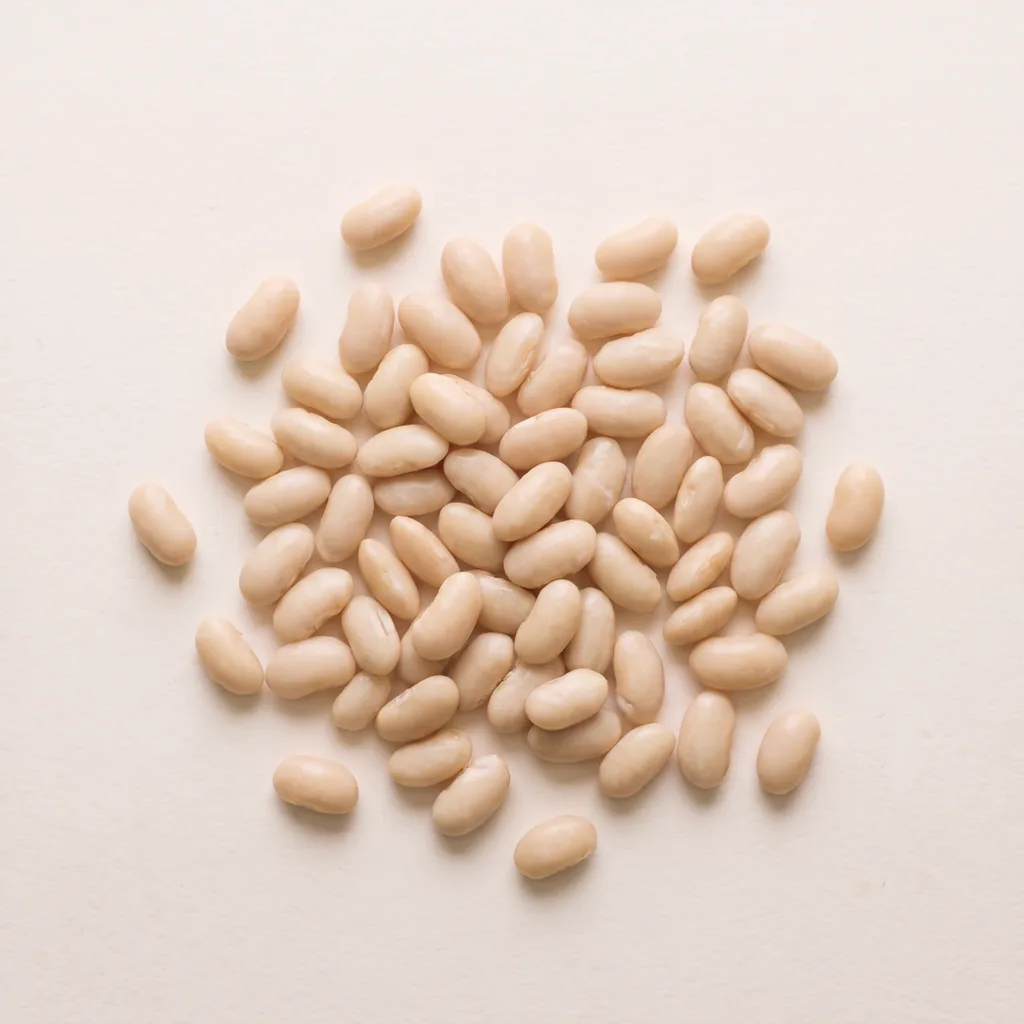
When can babies eat Great northern bean?
Great northern beans can be offered once your baby is about 6 months old and ready for solids.
Whatever the name suggests, the bean most likely comes from Central America. Today most of the world's great northern beans are grown commercially on the northern plains of North America.
It is rich in protein, carbohydrates and fiber. It has folate, choline, iron, zinc and vitamin B6. Young children often get too little of these. They support healthy blood, growth, development and the brain. It also has magnesium and potassium, which support heart and muscle function.
How do you prepare Great northern bean for babies?
At 6 months mash cooked beans or make a smooth paste. Because digestive discomfort is possible, begin with a small portion and increase it gradually. At 9 months give whole beans cooked soft and flattened. At 12 months whole cooked beans can be eaten by hand or with a fork.
Tip: Vitamin C boosts absorption of plant iron. Serve beans with foods high in vitamin C.
Canned beans are fine, and so are dried beans that have cooked all the way through.
Soaking and cooking break down plant compounds such as lectins, oxalates and phytates. In a balanced diet they are generally harmless for healthy people. Soaking before cooking is not required, but it shortens cooking time, lowers lectin and the gas-producing sugar raffinose, and makes the beans easier to digest. Overnight soak: put 454 g of dried beans in 2.5 liters of water. Leave them for 4 hours or more, or overnight, then drain and rinse. Hot soak: boil the beans in the same ratio of water for 2 to 3 minutes. Switch off the heat and let them sit a few hours, then drain and rinse.
Preparation by age
The same food is served differently at each age. What matters is how your baby sits, grasps and chews, more than the calendar.
6 months
6 months · How to prepare as a puréemash
Crush or purée the cooked beans to a chunky mash or a silky paste. You can stir in breast milk or formula for extra nutrition. To ease digestion, offer a little at first and raise the portion gradually. Let your baby scoop the mash. If needed, load the spoon ahead or spread a thin layer on a teething rusk or bread strip.
9 months
9 months · How to cut and servecube
Cut: Flattened
When your baby's pincer grasp is developing, serve whole beans that are cooked soft and then flattened, which lowers the choking risk. You can keep serving the mashed or puréed form too.
12 months
12 months · How to cut and servecube
By this age a toddler can handle whole well-cooked beans, as finger food or for fork practice.
Is Great northern bean a choking hazard for babies?
Choking risk: medium
Small, round and firm if raw or undercooked. Cook until very soft. Flatten at 9 months and mash at 6 months.
Great northern beans are small and round. They are firm when raw or undercooked. These traits can raise the choking risk.
Prepare them for the baby's age: mash at 6 months, cook soft and flatten at 9 months. Stay within arm's reach during meals.
Is Great northern bean a common allergen?
Great northern beans rarely cause allergy, although reactions to white beans have been described. More people are recognizing bean allergies, but white beans like great northern are usually well tolerated.
Some patients with allergy to other legumes, such as peanut and soy (both common allergens), have also shown bean allergy. Allergy to one legume does not mean allergy to the others, although having more than one legume allergy becomes somewhat more likely. Most people with peanut or soy allergy eat other legumes without trouble.
Anyone with a birch pollen allergy or oral allergy syndrome (pollen food allergy) may react to legumes including this bean. The reaction is generally a passing itch, tingle or sting in the mouth, not a dangerous one.
As with any new food, start with a small amount for the first meals and raise it over later meals if nothing happens.
Key nutrients
Frequently asked questions about Great northern bean
Is it OK for babies to eat canned great northern beans?
Yes. Both canned beans and dried beans that are fully cooked are fine.
Do the beans need soaking before cooking?
Not required. Soaking cuts cooking time, lectin and a gas-producing sugar, and eases digestion.
Are lectins safe for babies?
Yes. They break down in soaking and cooking and are generally harmless in a balanced diet.
Can a baby with peanut allergy eat great northern beans?
Most can, but the risk of other legume allergies can rise a little. Ask an allergist.
Sources for this page
- Dünya Sağlık Örgütü. (2023). Guideline for complementary feeding of infants and young children 6-23 months of age.
- CDC, Infant and Toddler Nutrition. (n.d.). Choking Hazards.
- Hilger J, Goerig T, Weber P, Hoeft B, Eggersdorfer M, Carvalho N, et al. (2015). Micronutrient Intake in Healthy Toddlers: A Multinational Perspective. Nutrients. doi:10.3390/nu7085316
- Mun JG, Legette LL, Ikonte CJ, Mitmesser SH. (2019). Choline and DHA in Maternal and Infant Nutrition: Synergistic Implications in Brain and Eye Health. Nutrients. doi:10.3390/nu11051125
- Martínez Alonso JC, Callejo Melgosa A, Fuentes Gonzalo Mª, Martín García C. (2005). Angioedema induced by inhalation of vapours from cooked white bean in a child. Allergologia et Immunopathologia. doi:10.1157/13077749
- San Ireneo MM, Ibáñez MD, Sánchez JJ, Carnés J, Fernández-Caldas E. (2008). Clinical features of legume allergy in children from a Mediterranean area. Annals of Allergy, Asthma & Immunology. doi:10.1016/s1081-1206(10)60207-4
- Chan ES, Greenhawt MJ, Fleischer DM, Caubet JC. (2019). Managing Cross-Reactivity in Those with Peanut Allergy. Journal of Allergy and Clinical Immunology: In Practice. doi:10.1016/j.jaip.2018.11.012
- Bublin M, Breiteneder H. (2014). Cross-Reactivity of Peanut Allergens. Current Allergy and Asthma Reports. doi:10.1007/s11882-014-0426-8
- Kashyap RR, Kashyap RS. (2015). Kashyap RR, Kashyap RS. Journal of Allergy 2015:543928. Journal of Allergy. doi:10.1155/2015/543928
- Singh B, Singh JP, Shevkani K, Singh N, Kaur A. (2017). Bioactive constituents in pulses and their health benefits. Journal of Food Science and Technology. doi:10.1007/s13197-016-2391-9
- QUEIROZ KDS, OLIVEIRA ACD, HELBIG E, REIS SMPM, CARRARO F. (2002). Soaking the Common Bean in a Domestic Preparation Reduced the Contents of Raffinose-Type Oligosaccharides but Did Not Interfere with Nutritive Value. Journal of Nutritional Science and Vitaminology. doi:10.3177/jnsv.48.283
Guides on iron, allergen introduction, gagging and drinks. Read the starting solids guides
Medical note
This page is for information only and is not a substitute for medical advice, diagnosis or treatment. Talk to your pediatrician before any feeding decision, especially about allergen introduction and reactions.
The Lokmini app
Log Great northern bean, reactions and your allergen journey in the app.
Open in LokminiLokmini is coming soon to the App Store.
Astro Tasarım Simay Yenice · Türkiye · merhaba@lokmini.com