Ghee
- First taste
- 6 months
- Choking risk
- low
- Common allergen
- yes
- Iron
- low
Milk allergen · energy-dense fat
Contains allergens
Each new allergen is offered on its own and watched for two hours. Our allergen introduction guide is available in Turkish for now.
When can babies eat ghee?
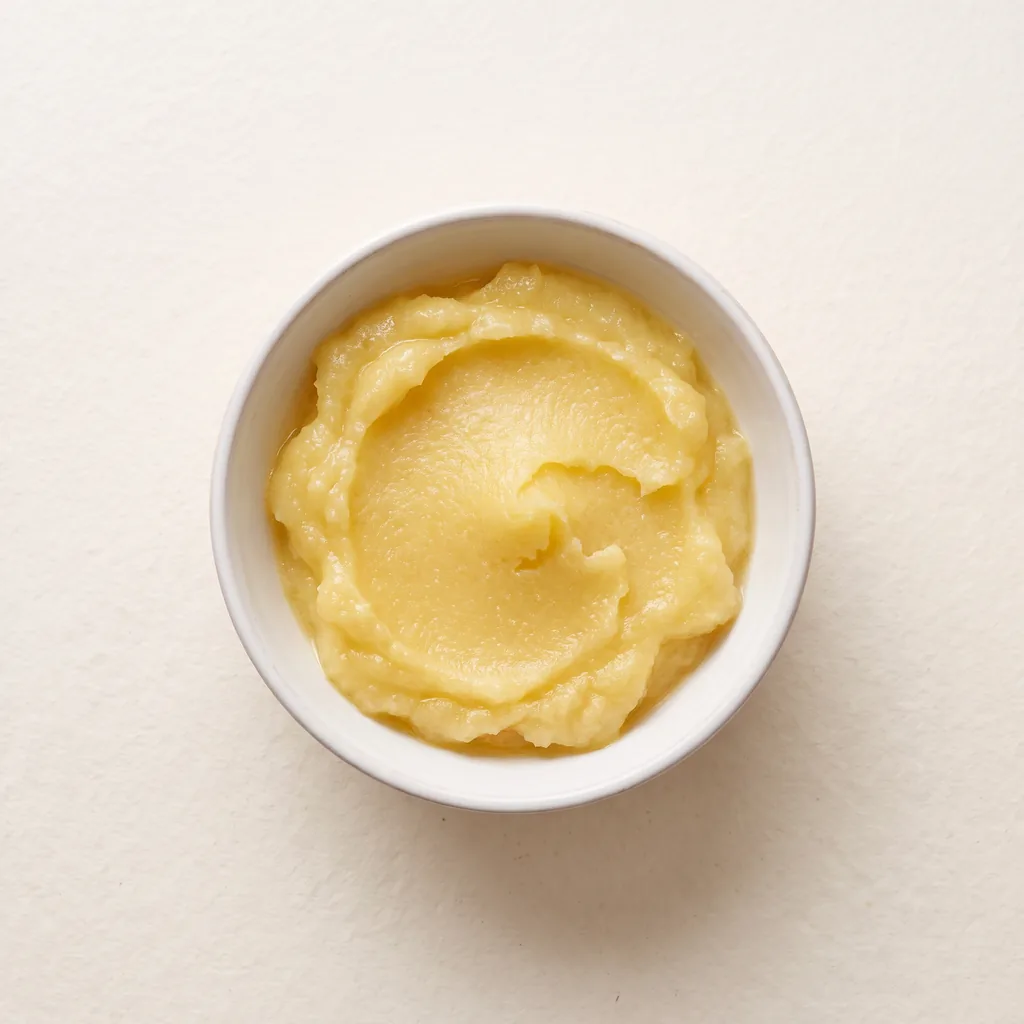
Ghee can be offered once your baby is about 6 months old and ready for solids. It is clarified butter, which means milk fat separated from milk solids and water. This step deepens the nutty taste and extends shelf life. It is widely used in South Asian cooking. India is the biggest producer.
It is rich in fat and gives concentrated energy for fast growth. Saturated fat is one of the main fat types in breast milk too. Ghee may also bring omega-3 fatty acids and vitamins K, E and A. These support brain development, skin, bones, immunity and blood clotting.
How do you prepare ghee for babies?
You can use ghee freely. Babies and toddlers do not need their ghee counted or capped. Fat supplies plenty of energy for brain and body growth.
It sets solid in the refrigerator and keeps for at least a year. In the pantry at room temperature it lasts up to 6 months.
Preparation by age
The same food is served differently at each age. What matters is how your baby sits, grasps and chews, more than the calendar.
6 months
6 months · How to prepare as a puréemash
Stir a little ghee into vegetable purée or porridge. You can cook fruit and vegetables in ghee. A thin layer on a strip of toast also works.
9 months
9 months · How to servemash
Keep adding ghee to meals. Fats give a growing baby concentrated energy. Spread it on suitable foods, cook vegetables in it, or mix it into grains.
12 months
12 months · How to servemash
Use it in dishes or spread it on suitable foods. You can also put melted ghee in a small dish so your child can dip bread or vegetables.
Is ghee a choking hazard for babies?
Choking risk: low
Choking risk is low. Stir it into food or spread it thinly.
Ghee carries low risk when prepared for your baby's age. In theory any food can cause choking. Stir it into food or spread a thin layer. Stay close to your baby during the meal.
Is ghee a common allergen?
Ghee is usually made from cow's milk. The World Health Organization counts cow's milk among its priority allergens. Milk allergy makes up about one in five childhood food allergies. Sheep, goat and buffalo milk can trigger similar reactions.
Ghee has the milk solids removed, and these hold the proteins that cause the allergy. So experts regard it as milder for allergy than the rest of dairy. Production methods differ, though, and a product may not be entirely free of milk solids. Ask an allergist about this.
Milk allergy often fades with time. Most children with cow's milk allergy outgrow it by age 6. Babies with mild symptoms may retry milk around the first birthday with a doctor's guidance.
Milk is a frequent cause of FPIES, a delayed allergy. The acute form brings repeated vomiting and diarrhea a few hours after eating. When milk is eaten regularly, the chronic form can show up as reflux, weight loss and poor growth. Symptoms ease once milk is removed. FPIES that starts early usually fades by ages 3 to 5.
Lactose intolerance can be confused with allergy. Ghee contains very little lactose, so children with lactose intolerance can usually eat it.
If you suspect a milk allergy, see an allergist before offering dairy. If you have already given milk and ruled out allergy, you can serve ghee without starting small. Otherwise, try a small amount alone for the first meals and raise it if nothing happens.
Key nutrients
Frequently asked questions about ghee
Can ghee be given to a baby with a milk allergy?
It is less allergenic because the milk solids are removed, but it may not be fully free of them. If milk allergy is suspected, ask an allergist first.
How much ghee can a baby have a day?
You do not have to count it or cap it. Fat supplies energy for brain and body growth at this stage.
How should ghee be stored?
In the refrigerator it keeps for at least a year, and in the pantry at room temperature up to 6 months.
Sources for this page
- Dünya Sağlık Örgütü. (2023). Guideline for complementary feeding of infants and young children 6-23 months of age.
- Warren CM, Jhaveri S, Warrier MR, Smith B, Gupta RS. (2013). The epidemiology of milk allergy in US children. Annals of Allergy, Asthma & Immunology. doi:10.1016/j.anai.2013.02.016
- Nazar W, Plata-Nazar K, Sznurkowska K, Szlagatys-Sidorkiewicz A. (2021). Histamine Intolerance in Children: A Narrative Review. Nutrients. doi:10.3390/nu13051486
- Uauy R, Dangour AD. (2009). Fat and Fatty Acid Requirements and Recommendations for Infants of 0–2 Years and Children of 2–18 Years. Annals of Nutrition & Metabolism. doi:10.1159/000228997
- CDC, Infant and Toddler Nutrition. (n.d.). Choking Hazards.
Guides on iron, allergen introduction, gagging and drinks. Read the starting solids guides
Medical note
This page is for information only and is not a substitute for medical advice, diagnosis or treatment. Talk to your pediatrician before any feeding decision, especially about allergen introduction and reactions.
The Lokmini app
Log ghee, reactions and your allergen journey in the app.
Open in LokminiLokmini is coming soon to the App Store.
Astro Tasarım Simay Yenice · Türkiye · merhaba@lokmini.com