Feta cheese
- First taste
- 6 months
- Choking risk
- medium
- Common allergen
- yes
- Iron
- low
Choose pasteurized · can be salty
Contains allergens
Each new allergen is offered on its own and watched for two hours. Our allergen introduction guide is available in Turkish for now.
When can babies eat Feta cheese?
Feta can be offered from about 6 months, once baby is ready for solids. Feta can be salty. An occasional taste within a varied diet is fine. To lower the risk of foodborne illness, choose pasteurized feta.
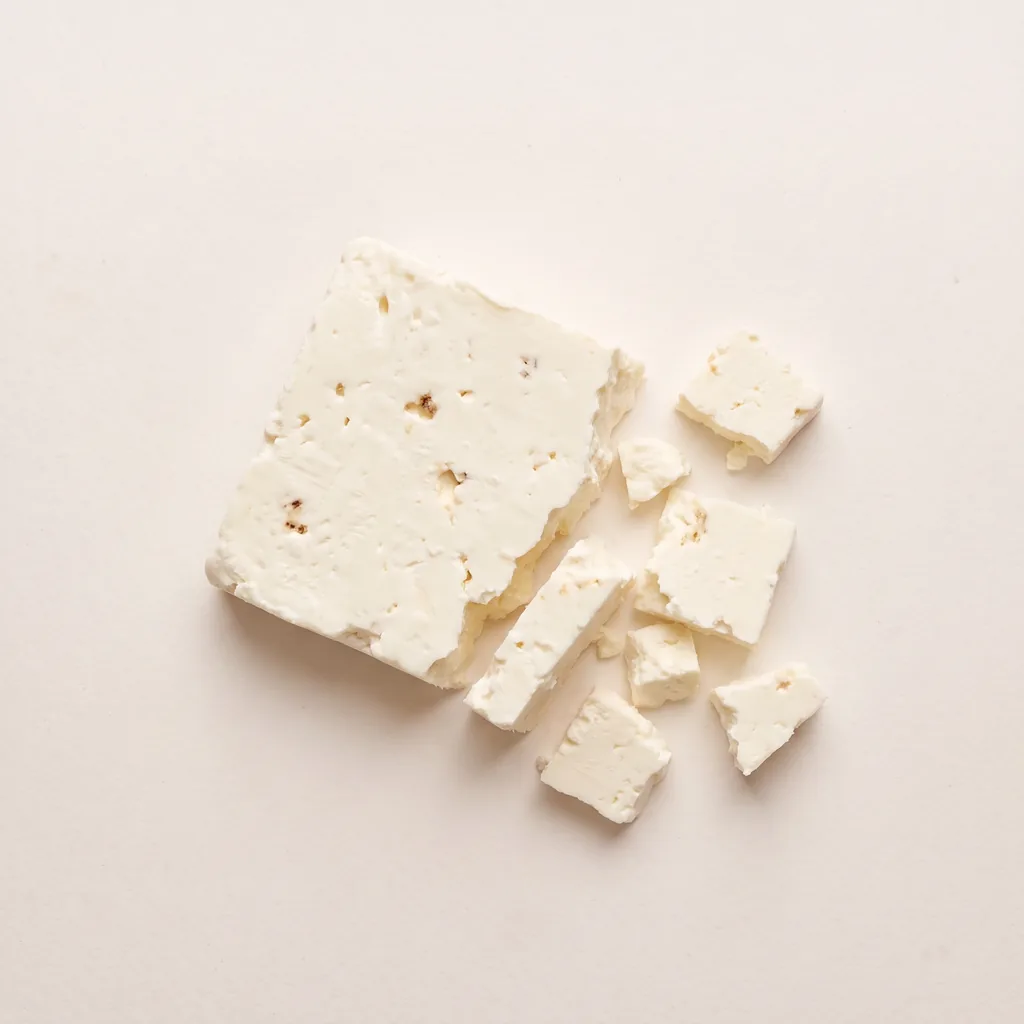
Feta is a white, soft cheese. It is made with sheep's milk, sometimes with goat's milk. The curd is cut into blocks and aged in brine. Feta holds Protected Designation of Origin in the European Union. Technically only cheese from certain regions of Greece may be sold under that name.
Nutrition
Feta supplies protein and fat along with calcium, selenium, zinc, plus the vitamins A, B6, and B12. These work as raw material for growing, developing, and thinking. They also help bones, taste, eyesight, energy, and immunity.
Salt
Feta is usually salty. A learning baby eats little, so the sodium stays low. Some sodium is needed for fluid balance and movement. Many groups advise cutting salt in baby food, but recent reviews say it may not be needed. Sharing family meals has value too. Baby meets a wider range of tastes and textures.
To cut the salt
Drain the brine. Soak the feta in fresh water. Take it out when you are ready to serve.
How do you prepare Feta cheese for babies?
At 6 months, offer pasteurized feta tastes now and then. Stir small crumbles into spoonable foods. Whip feta with plain yogurt and dip foods in it. After 9 months, serve crumbles on their own or a long flat slice. At 12 months, slices, small or large crumbles, and a dip all work.
There is no upper limit for cheese. You can give pasteurized cheese every day if you like. Do not fixate on how much baby eats. A baby may eat a lot at one meal and little at another. Both are normal when cheese is one part of a varied diet.
Preparation by age
The same food is served differently at each age. What matters is how your baby sits, grasps and chews, more than the calendar.
6 months
6 months · How to stir into foodmash
Offer tastes of pasteurized feta now and then. Stir small crumbles into spoonable foods. You can also whip feta with plain yogurt and dip age-appropriate foods in it.
9 months
9 months · How to serve crumbledcube
Serve small crumbles by themselves, or stir them into spoonable foods. Dipping foods in whipped feta and yogurt works too.
9 months · How to serve as a sliceslice
Cut: Finger strip
Hand over one long, wide slice. Wafer-thin ones can fall apart as baby grips. Either let baby try the pieces, or take them away if their size worries you.
12 months
12 months · How to cut and serveslice
Feta can be served as long flat slices or as crumbles, small or large. Offer it alone or in a dish. A dip of whipped feta and yogurt works too.
Is Feta cheese a choking hazard for babies?
Choking risk: medium
Feta can be chalky and hard to swallow. Crumble it or whip it with yogurt.
Feta can be chalky and hard for a baby to swallow. This raises the choking risk. Crumble it or whip it with yogurt. Stay with your child during meals.
Is Feta cheese a common allergen?
Feta contains a common allergen. It is usually made from sheep, goat, or cow's milk. Cow's milk is a common allergen. Milk causes about one fifth of childhood food allergies in young children. Sheep, goat, and buffalo milk products can cause reactions like cow's milk. The good news: milk allergy often passes with time. Most children with cow's milk allergy outgrow it by age 6. Many babies with mild milk protein allergy can try milk again around the first birthday with a doctor's guidance. Aged cheeses hold histamine. Sensitive children may get a rash from it.
Milk is a frequent cause of FPIES. FPIES brings repeated vomiting and diarrhea a few hours after eating. Untreated, it can cause fluid loss. If milk is eaten regularly, the chronic form can cause reflux, weight loss, and poor growth. FPIES that starts early usually passes by age 3 to 5.
Lactose intolerance can be mistaken for allergy. It brings bloating, gas, diarrhea, and nausea. It is uncommon in babies and toddlers. Aged cheeses are low in lactose and often better tolerated.
If you suspect a milk allergy, ask an allergist before giving cheese. The allergist may suggest a test or a trial under supervision at the clinic. For a low-risk baby, the advice may be to begin at home. As with all common allergens, give a small amount in the first servings. If there is no reaction, raise it slowly. If you have already given milk and ruled out allergy, you can give pasteurized cheese freely.
Emergency
If there is trouble breathing, facial swelling, widespread hives, or repeated vomiting, call emergency services right away.
Key nutrients
Frequently asked questions about Feta cheese
Feta is salty. Is it okay for babies?
An occasional taste is fine. To cut the salt, drain the brine and soak the cheese in fresh water.
Why choose pasteurized feta?
Pasteurized cheese lowers the risk of foodborne illness.
How much cheese can a baby eat?
There is no upper limit. You can give pasteurized cheese every day. Do not fixate on the amount.
Is sheep cheese safe with cow's milk allergy?
No. Sheep, goat, and buffalo milk products can cause reactions like cow's milk. Ask an allergist first.
Sources for this page
- Dünya Sağlık Örgütü. (2023). Guideline for complementary feeding of infants and young children 6-23 months of age.
- NHS. (n.d.). Preparing food safely for babies.
- CDC, Infant and Toddler Nutrition. (n.d.). Choking Hazards.
- Warren CM, Jhaveri S, Warrier MR, Smith B, Gupta RS. (2013). The epidemiology of milk allergy in US children. Annals of Allergy, Asthma and Immunology. doi:10.1016/j.anai.2013.02.016
- El-Agamy EI. (2007). El-Agamy EI. Small Ruminant Research 68, 64-72. Small Ruminant Research. doi:10.1016/j.smallrumres.2006.09.016
- Nowak-Węgrzyn A. (2015). Nowak-Wegrzyn A. Allergy and Asthma Proceedings 36(3), 172-184. Allergy and Asthma Proceedings. doi:10.2500/aap.2015.36.3811
- Comas-Basté O, Sánchez-Pérez S, Veciana-Nogués MT, Latorre-Moratalla M, Vidal-Carou MDC. (2020). Histamine Intolerance: The Current State of the Art. Biomolecules. doi:10.3390/biom10081181
- Nazar W, Plata-Nazar K, Sznurkowska K, Szlagatys-Sidorkiewicz A. (2021). Histamine Intolerance in Children: A Narrative Review. Nutrients. doi:10.3390/nu13051486
Guides on iron, allergen introduction, gagging and drinks. Read the starting solids guides
Medical note
This page is for information only and is not a substitute for medical advice, diagnosis or treatment. Talk to your pediatrician before any feeding decision, especially about allergen introduction and reactions.
The Lokmini app
Log Feta cheese, reactions and your allergen journey in the app.
Open in LokminiLokmini is coming soon to the App Store.
Astro Tasarım Simay Yenice · Türkiye · merhaba@lokmini.com