Edamame
- First taste
- 6 months
- Choking risk
- high
- Common allergen
- yes
- Iron
- high
Soy allergen · never serve beans whole
Contains allergens
Each new allergen is offered on its own and watched for two hours. Our allergen introduction guide is available in Turkish for now.
When can babies eat edamame?
Edamame can be offered from about 6 months, once baby shows signs of readiness for solids. Edamame is young soybean. Soy is a common allergen.
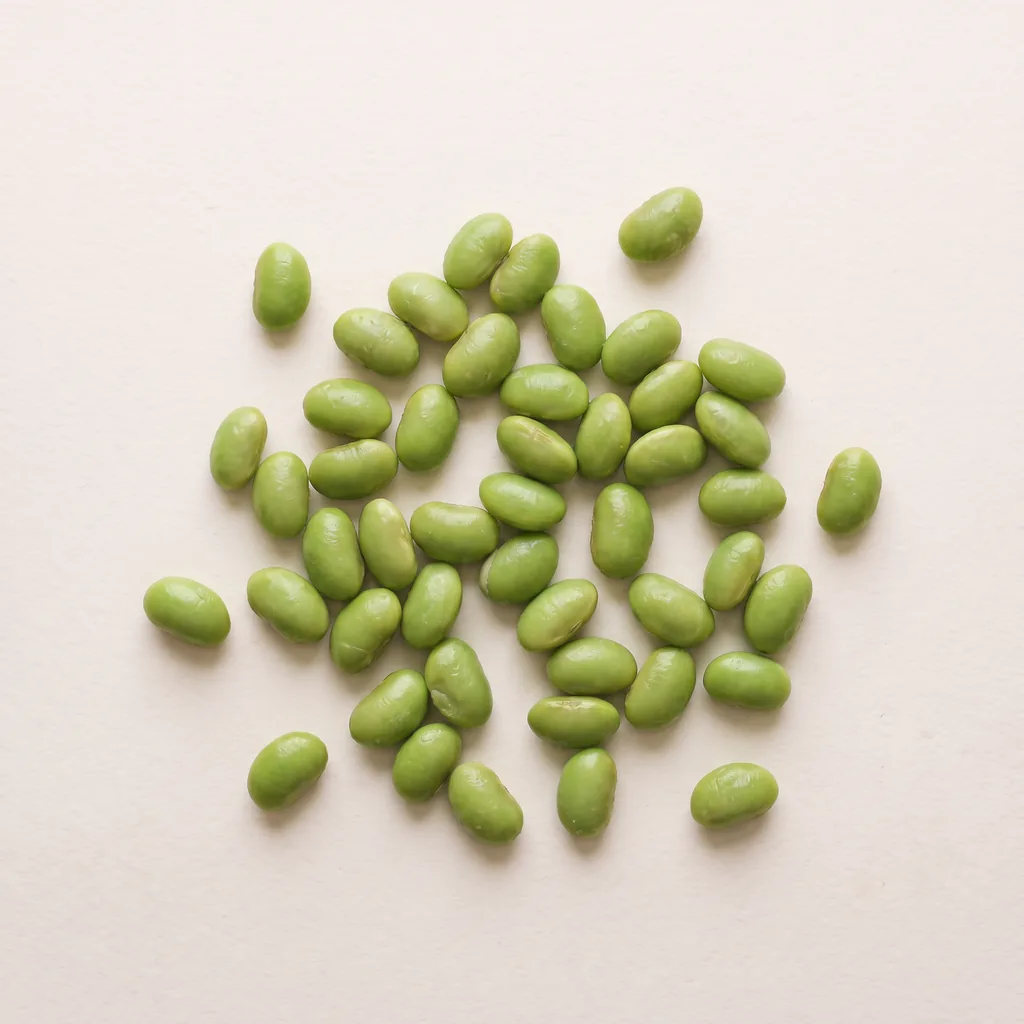
Edamame means young soybeans picked from their fuzzy pods while tender and green. The name is Japanese. Soy comes from Asia. Today the United States is the largest soybean producer.
Nutrition
Protein, fiber, plant omega-3 fats, folate, choline, vitamin B6, iron and zinc are all in edamame. These support muscles, digestion, nervous system development, energy, and immunity.
Iron absorption
To help the body absorb iron, pair edamame with a vitamin C food such as bell pepper, broccoli, or citrus.
How do you prepare edamame for babies?
Boil or steam edamame and take the beans out of the pods. Mash them at 6 months. Olive oil, formula or breast milk will loosen the mash. You can also spread it on toast strips. From 9 months, flatten the beans or peel the skin and split them in half. The skin is not a choking cause. If it sticks in the mouth, mild gagging can occur.
Soy dishes are frequently cooked alongside egg, fish, peanut, or sesame. Introduce common allergens on their own first.
No whole beans
A whole edamame bean is hard, round, and slippery. This app does not serve whole beans.
Preparation by age
The same food is served differently at each age. What matters is how your baby sits, grasps and chews, more than the calendar.
Prep time: 10 min
6 months
6 months · How to prepare as a puréemash
Boil shelled frozen edamame until soft, then mash or blend until smooth. Whole beans are not served at this age. Soy is a new allergen, so give it alone for the first time, in the morning, in a small amount. You can loosen the purée with breast milk, formula, or a little olive oil, or spread it on toast strips.
9 months
9 months · How to preparemash
Flatten each boiled bean with a finger before serving, or mash them into rice and vegetable purées. Whole beans are not served because they are hard, small, and round.
9 months · How to prepare as halvescube
Cut: Halved
Take cooked beans out of the pods. Peel off the thin outer skin and split each bean in half. Place the soft halves on the tray for baby's pincer grasp. If the skin sticks, there may be some mild gagging.
12 months
12 months · How to servecube
Serve edamame as flattened or halved beans. Whole firm beans are mashed or split until age 4. Do not serve edamame in the pod.
Is edamame a choking hazard for babies?
Choking risk: high
Edamame is firm, round and slippery. Mash it first. From 9 months, flatten each bean or split it in half. Do not serve whole beans.
Edamame carries a choking risk. It is round, firm, and slippery. Mash it first, then flatten the beans or split them in half.
The source says whole beans may be offered after about 18 months to a child who chews well and does not rush. This app is more cautious and does not recommend whole beans. Stay with your child during meals.
Is edamame a common allergen?
Edamame is young soy. Soy is a common allergen in babies. Good news: soy allergy affects fewer than 1 child in 100. Most reactions are mild, but severe ones have occurred. Nearly 70% of children outgrow it by age 10. For this reason the World Health Organization does not list soy among the global priority allergens.
A child with soy allergy should avoid tofu, tempeh, miso, natto, soy sauce, and packaged foods that list soy. Soy oil that is highly refined, and soy lecithin, contain very little allergen protein. Most people tolerate them. Even so, check with your doctor before offering them to a child with a soy allergy.
Soy and peanut sensitization can appear together on tests, but that is not always a true allergy. If a baby has reacted to soy and has not yet tried peanut, start peanut with an allergist. If your child already eats peanut without trouble, there is no reason to stop it.
About 10 to 14% of children with cow's milk allergy also react to soy. This is more likely under 6 months. Talk to your doctor if your baby has a known milk allergy.
People with birch pollen allergy may feel a brief itch in the mouth. Serious reactions have been reported in people who also have peanut allergy.
Soy is a recognized trigger of FPIES. FPIES brings repeated vomiting and diarrhea a few hours after eating. Untreated, it can cause serious fluid loss. If soy is eaten daily, the chronic form can cause reflux, weight loss, and poor growth. FPIES that starts early usually passes by age 3 to 5.
Begin with a plain food such as cooked, mashed edamame. Offer a small amount at the first meals. If there is no reaction, raise it slowly. Once introduced, keep it in the diet, ideally twice a week.
Emergency
If there is trouble breathing, facial swelling, widespread hives, or repeated vomiting, call emergency services right away.
Key nutrients
Frequently asked questions about edamame
Are the phytoestrogens in soy a concern?
There is no evidence that babies and toddlers need to limit phytoestrogens. A varied, balanced diet is what matters.
Is the bean skin a choking hazard?
The thin skin is not a choking cause. If it sticks in the mouth it may cause mild gagging.
Can a baby with milk allergy eat edamame?
About 10 to 14% of children with milk allergy also react to soy. Ask your pediatrician or allergist before giving it.
Are soy oil and soy lecithin safe with soy allergy?
Soy oil that is highly refined, and soy lecithin, contain very little allergen protein. Most people tolerate them. Even so, check with your doctor before offering them to a child with a soy allergy.
Sources for this page
- Dünya Sağlık Örgütü. (2023). Guideline for complementary feeding of infants and young children 6-23 months of age.
- NHS. (n.d.). Preparing food safely for babies.
- CDC, Infant and Toddler Nutrition. (n.d.). Choking Hazards.
- Halken S, Muraro A, de Silva D, Khaleva E, Angier E, Arasi S, et al. (2021). EAACI guideline: Preventing the development of food allergy in infants and young children (2020 update). European Academy of Allergy and Clinical Immunology. doi:10.1111/pai.13496
- Türkiye Ulusal Alerji ve Klinik İmmünoloji Derneği. (n.d.). Besin Alerjisi, öncelikli 10 besin.
- American Academy of Pediatrics, HealthyChildren. (n.d.). Choking Prevention for Babies and Children.
- Solid Starts. (n.d.). First Foods Database.
- Savage JH, Kaeding AJ, Matsui EC, Wood RA. (2010). The natural history of soy allergy. J Allergy Clin Immunol. doi:10.1016/j.jaci.2009.12.994
- Nowak-Węgrzyn A. (2015). Nowak-Wegrzyn A. Allergy and Asthma Proceedings 36(3), 172-184. Allergy and Asthma Proceedings. doi:10.2500/aap.2015.36.3811
- Messina M, Duncan A, Messina V, Lynch H, Kiel J, Erdman JW. (2022). The health effects of soy: A reference guide for health professionals. Frontiers in Nutrition. doi:10.3389/fnut.2022.970364
Guides on iron, allergen introduction, gagging and drinks. Read the starting solids guides
Medical note
This page is for information only and is not a substitute for medical advice, diagnosis or treatment. Talk to your pediatrician before any feeding decision, especially about allergen introduction and reactions.
The Lokmini app
Log edamame, reactions and your allergen journey in the app.
Open in LokminiLokmini is coming soon to the App Store.
Astro Tasarım Simay Yenice · Türkiye · merhaba@lokmini.com