Cottage cheese
- First taste
- 6 months
- Choking risk
- low
- Common allergen
- yes
- Iron
- low
Can be salty · no honey
Contains allergens
Each new allergen is offered on its own and watched for two hours. Our allergen introduction guide is available in Turkish for now.
When can babies eat cottage cheese?
Cottage cheese can start when your baby is ready for solids, around 6 months. It can be high in sodium. Still, over time it can be one of many foods you offer.
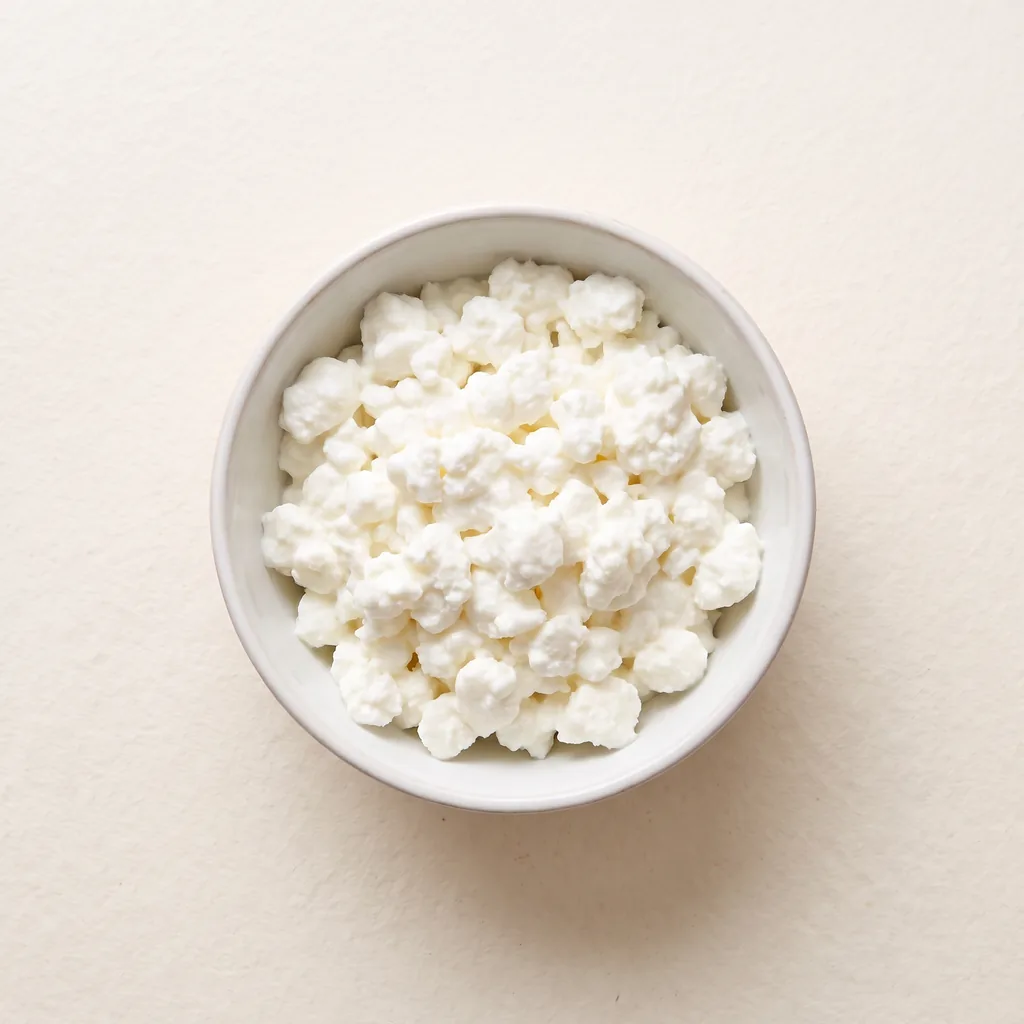
Cottage cheese is a fresh, soft cheese. Warming skimmed milk forms curds. These curds are mixed with cream, whole milk and salt. The result is cottage cheese.
Nutrition
Protein and fat are plentiful here. You also get calcium, choline, folate and phosphorus, plus potassium, selenium, zinc and the vitamins B6 and B12. These nutrients matter for growth, development, energy, bone density, brain development and electrolyte balance. Cultured cottage cheese also carries probiotics.
How do you prepare cottage cheese for babies?
Sodium
Sodium can run high in cottage cheese. If a lower-sodium type is available, pick it. If not, don't worry. To cut sodium, rinse the cheese in a fine-mesh strainer under cold water. This can lower sodium by about 60 percent. It is not required.
The source gives no numeric daily sodium limit. Ask a health professional about your baby's total salt intake.
Honey
Do not serve cottage cheese with honey. Babies are at risk of botulism. Honey is not given before 12 months.
Do not give honey to a baby under 12 months.
How it differs from farmer's cheese
Cottage cheese is one kind of farmer's cheese. Farmer's cheeses are often pressed curds of cow's milk. Once separated from whey, the curds go into a mold and drain. Making queso blanco and queso fresco follows nearly the same steps. That makes them firmer. Cottage cheese curds are moistened with cream or whole milk. Textures differ, and flavors are close.
Preparation by age
The same food is served differently at each age. What matters is how your baby sits, grasps and chews, more than the calendar.
6 months
6 months · How to serve in a bowl or mixed inmash
Spoon the cottage cheese into a bowl and let your baby eat with their hands. Or stir it into a soft, spoonable food such as yogurt or a purée. Use the back of a fork to press large curds gently. Your baby should sit upright.
6 months · How to spread on stripsstrip
Spread the cottage cheese thinly on an easy-to-hold strip such as bread or toast. Your baby holds the strip and eats. Do not combine it with honey. Honey is not given before 12 months.
12 months
12 months · How to serve alone or with seasoningscube
Serve cottage cheese alone or with savory and sweet foods. Set a small dish of herbs and spices on the side so your child can season the cheese as they like. To encourage spoon use, load the spoon ahead and let your child take it.
Is cottage cheese a choking hazard for babies?
Choking risk: low
Risk is low. If your baby sits upright and feeds themself, the curds are not a problem. If this concerns you, press large curds flat using the back of a fork.
Cottage cheese is a low-risk food. In theory, any food can cause choking. Curds vary in size and your baby may swallow them whole. If your baby sits upright and feeds themself, the risk is very low. Stay within reach at meals.
If you worry, use a fork's back to flatten big curds gently ahead of serving.
Is cottage cheese a common allergen?
Most cottage cheese comes from cow's milk. The World Health Organization counts cow's milk as a global priority allergen. In young children, about one in five childhood food allergies is to milk. Sheep, goat and buffalo milk can trigger similar reactions. The good news is that milk allergy often fades. Most children with cow's milk allergy outgrow it by age 6. Many babies with mild milk protein allergy (such as painless blood in stool) can restart milk around the first birthday with expert guidance.
FPIES
Milk is often behind food protein-induced enterocolitis syndrome (FPIES). Acute FPIES brings sudden, repeated vomiting and diarrhea a few hours after eating. Untreated, it leads to serious fluid loss. When milk is eaten regularly, chronic FPIES can show up as reflux, weight loss and poor growth. Symptoms usually improve once milk leaves the diet. FPIES that starts early is often outgrown by age 3 to 5.
If repeated vomiting and diarrhea start a few hours after a dairy food, seek medical care.
Lactose intolerance
With lactose intolerance, the body has trouble processing milk sugar. It can cause bloating, gas, diarrhea and nausea. It can be mistaken for an allergy. Ask a child health professional with any questions. Many lactose-free dairy foods are on the market.
If you suspect milk allergy, talk to an allergist before offering cheese. The allergist may suggest testing or may ask you to give dairy in the clinic under supervision. When risk is judged low, starting at home may be advised. Begin with a small amount for the first servings, and raise it slowly if there is no reaction. If you already gave milk and ruled out allergy, pasteurized cheeses can be given without starting small.
Key nutrients
Frequently asked questions about cottage cheese
When can babies eat cottage cheese?
When ready for solids, around 6 months. Sodium can be high, yet it still fits in a varied diet.
Can I reduce the salt in cottage cheese?
Yes. Rinse it in a fine-mesh strainer under cold water. This can cut sodium by about 60 percent. It is not required.
Can I serve honey with cottage cheese?
No. Honey is not given before 12 months because of the risk of botulism in babies.
Is cottage cheese a choking risk?
The risk is low. If your baby sits upright and feeds themself, curds are not a problem. If you worry, press large curds lightly with a fork.
Sources for this page
- Journal of the American Dietetic Association. (1983). Vermeulen RT, Sedor FA, Kimm SY. Journal of the American Dietetic Association 82(4):394-396.
- Warren CM, Jhaveri S, Warrier MR, Smith B, Gupta RS. (2013). The epidemiology of milk allergy in US children. Annals of Allergy, Asthma & Immunology. doi:10.1016/j.anai.2013.02.016
- El-Agamy EI. (2007). El-Agamy EI. Small Ruminant Research 68:64-72. Small Ruminant Research. doi:10.1016/j.smallrumres.2006.09.016
- Nowak-Węgrzyn A. (2015). Nowak-Węgrzyn A. Allergy and Asthma Proceedings 36(3):172-184. Allergy and Asthma Proceedings. doi:10.2500/aap.2015.36.3811
Guides on iron, allergen introduction, gagging and drinks. Read the starting solids guides
Medical note
This page is for information only and is not a substitute for medical advice, diagnosis or treatment. Talk to your pediatrician before any feeding decision, especially about allergen introduction and reactions.
The Lokmini app
Log cottage cheese, reactions and your allergen journey in the app.
Open in LokminiLokmini is coming soon to the App Store.
Astro Tasarım Simay Yenice · Türkiye · merhaba@lokmini.com