Cornmeal
- First taste
- 6 months
- Choking risk
- low
- Common allergen
- no
- Iron
- low
Gluten free · polenta and grits
When can babies eat cornmeal?
Cornmeal can start when your baby is ready for solids, around 6 months.
Corn that is dried and ground fine is known by several names, among them grits, masa harina and polenta. The method of keeping corn this way began in Central and South America. You will find cornmeal in yellow, white, red, or blue, and in textures from coarse to fine. In Turkey it is common in Black Sea cooking, in dishes like kuymak and in cornbread.
Nutrition
Cornmeal is rich in carbohydrates that give quick energy. It has a little fiber, which helps the gut microbiome and blood sugar balance. It gives plenty of folate. It also carries B vitamins such as vitamin B6 and niacin. These are needed for growth and development.
How do you prepare cornmeal for babies?
Porridge and polenta
Cook cornmeal with water or breast milk into a soft porridge or a thick stew. Your baby can eat it by hand or with a spoon. Once polenta has cooled and firmed up, you can slice it thin or cut it into sticks. The slices should be soft enough to mash with light pressure. If you pan-fry them, do not let them turn hard or crisp.
Bread and pancakes
Cornmeal also makes bread, muffins and pancakes. Wet bread tends to cling to the tongue and the roof of the mouth, which can make a child gag. Serve the soft inside in small pieces.
For slippery fruit
You can lightly roll slippery fruit such as avocado, apricot halves or mango spears in cornmeal. It gives your baby a better grip.
Gluten
Cornmeal is gluten free. This makes it an option for anyone with a wheat allergy, celiac disease, or gluten sensitivity. Store-bought items like cornbread and corn cakes can contain some wheat flour. Read the ingredient label.
Preparation by age
The same food is served differently at each age. What matters is how your baby sits, grasps and chews, more than the calendar.
Prep time: 20 min
6 months
6 months · How to prepare as a puréemash
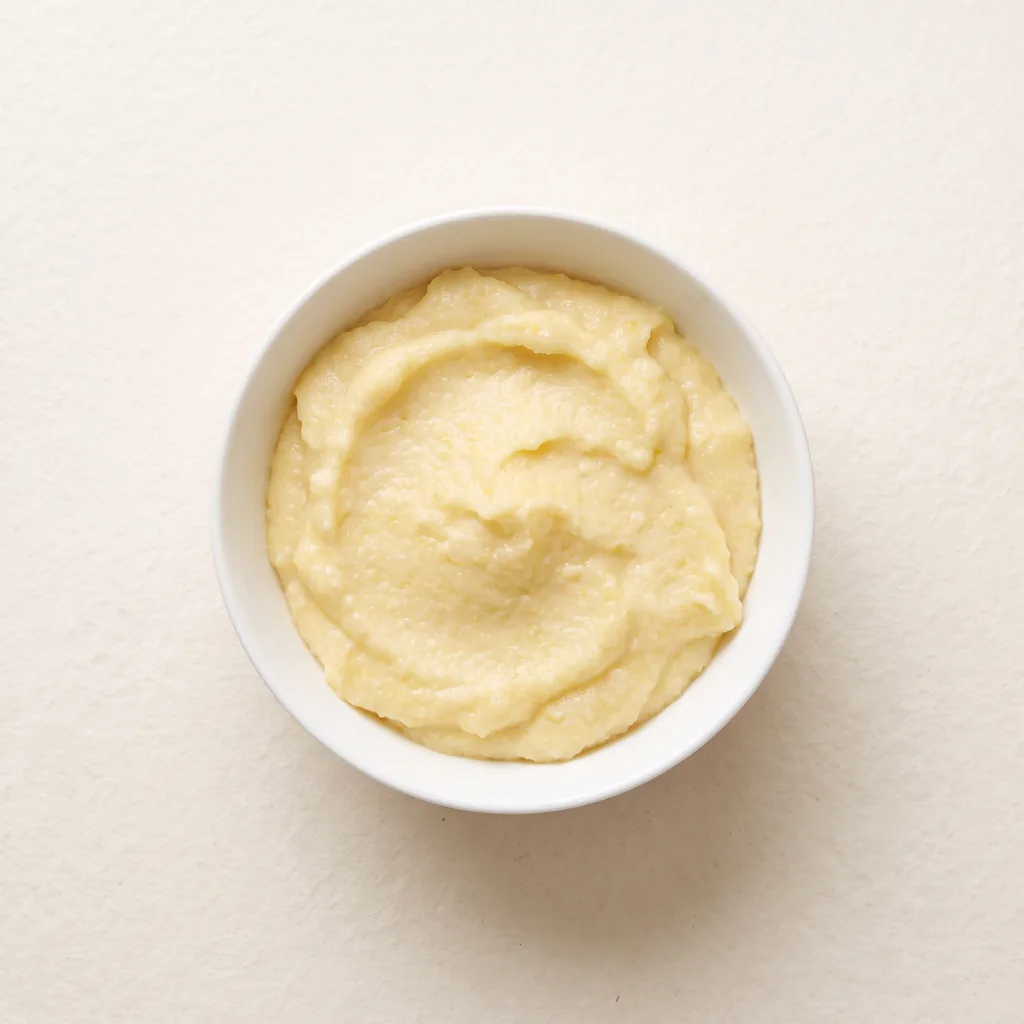
Stir cornmeal into water or breast milk until it reaches a thick porridge (polenta) consistency. Cook it on low heat for 10 minutes and let it cool. Serve with a spoon, or let it set and cut it into finger-thick strips. It is gluten free, so it can be used before wheat has been introduced.
9 months
9 months · How to preparecube
Cut: Bite sized piece
Serve the polenta that has cooled and set in small cubes, or bake a soft cornbread with cornmeal and break the inside into small pieces. Do not serve the hard crust.
12 months
12 months · How to preparecube
Cut: Bite sized piece
Keep giving the soft inside of the cornbread in small pieces, made with no salt or very little. When you set aside a portion from corn fritters or kuymak-type dishes, cut back on salt and fat.
Is cornmeal a choking hazard for babies?
Choking risk: low
Cornmeal is low risk when prepared soft like porridge. Hard or crispy polenta slices and dry bread crust raise the risk.
Cornmeal is a low-risk food. In theory, any food can cause choking. Hard or crispy preparations raise the risk. Prepare it for your child's age and stay close at meals.
Cutting rule
At 6 months, porridge and soft thin slices. At 9 months, soft bite-sized pieces. Slices should mash under light pressure. Do not fry them hard or crisp.
Is cornmeal a common allergen?
Cornmeal is made from corn. Corn allergy is uncommon but has been reported. Symptoms range from brief itching in the mouth to anaphylaxis. A corn allergy sometimes appears together with an allergy to chitinase or lipid transfer proteins. Corn can cross-react with other grains such as rice, wheat and barley. Most people with corn allergy eat other grains safely, and the reverse also holds.
Start with a small amount at the first few meals. If there is no reaction, increase it slowly.
Key nutrients
Frequently asked questions about cornmeal
Is cornmeal gluten free?
Yes. Yet cornbread, corn cakes, and similar products can contain wheat flour. Read the ingredient label.
Are polenta and cornmeal the same?
Polenta is the cooked porridge of cornmeal. Grits and masa harina are other names for dried, ground corn made in different ways.
Does my baby need a high chair?
No. A chair helps create a safe setup, but a lap seat or a shared spot on the floor also works.
Sources for this page
- Dünya Sağlık Örgütü. (2023). Guideline for complementary feeding of infants and young children 6-23 months of age.
- NHS. (n.d.). Preparing food safely for babies.
- CDC, Infant and Toddler Nutrition. (n.d.). Choking Hazards.
- Scibilia J, Pastorello EA, Zisa G, Ottolenghi A, Ballmer‐Weber B, Pravettoni V, et al. (2008). Maize food allergy: a double‐blind placebo‐controlled study. Clinical and Experimental Allergy. doi:10.1111/j.1365-2222.2008.03094.x
- Pastorello EA, Farioli L, Pravettoni V, Ispano M, Scibola E, Trambaioli C, et al. (2000). The maize major allergen, which is responsible for food-induced allergic reactions, is a lipid transfer protein. Journal of Allergy and Clinical Immunology. doi:10.1067/mai.2000.108712
Guides on iron, allergen introduction, gagging and drinks. Read the starting solids guides
Medical note
This page is for information only and is not a substitute for medical advice, diagnosis or treatment. Talk to your pediatrician before any feeding decision, especially about allergen introduction and reactions.
The Lokmini app
Log cornmeal, reactions and your allergen journey in the app.
Open in LokminiLokmini is coming soon to the App Store.
Astro Tasarım Simay Yenice · Türkiye · merhaba@lokmini.com