Collard greens
- First taste
- 6 months
- Choking risk
- low
- Common allergen
- no
- Iron
- low
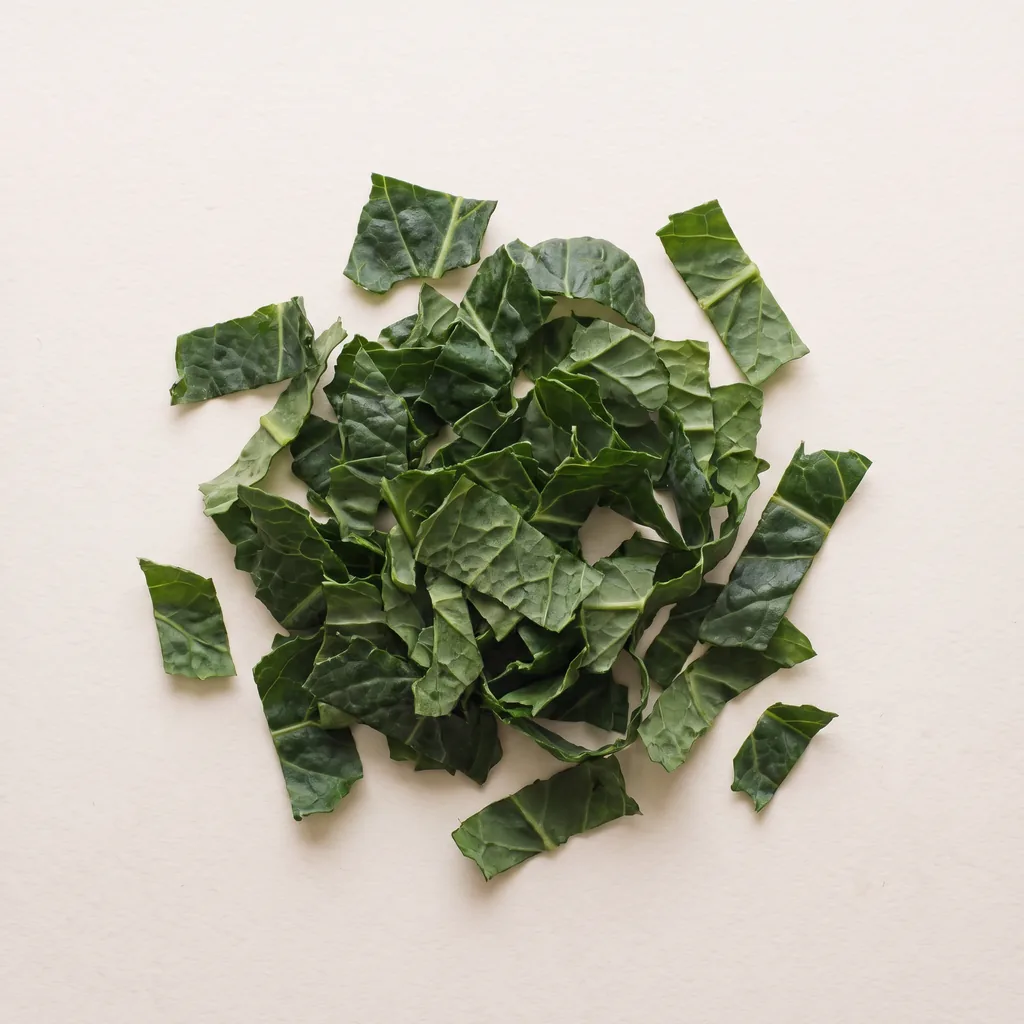
Chop fine, mix into soft foods
When can babies eat collard greens?
Collard greens can start when your baby is ready for solids, around 6 months.
Collards are native to Western Asia and Eastern Europe. It is a staple in many places, from the Americas and Africa to the Caribbean, Britain and India. It has many varieties and many names, such as couve, haakh and sukuma. People eat it raw, sometimes as a wrap, or cooked in sandwiches, stews, grain dishes and sides.
Nutrition
Collards bring a lot of fiber and water. They supply calcium, folate, magnesium and potassium. The vitamin list is long: K, E, C, B6 and A. Plant compounds called glucosinolates are in there too. All of this helps the gut microbiome, bones, brain, eyes, iron uptake and blood clotting.
How do you prepare collard greens for babies?
Why mix it into soft foods
Bits of soft cooked leaf can stick to the tongue and the inside of baby's mouth. That leads to gagging. They are easier to eat when you mix small pieces into soft foods like mashed potato, or into finger foods such as egg strips and meat patties.
Raw leaves
After 9 months you can offer thin shreds of raw leaf. They are a little harder to chew, but the texture is good for eating skills. Spitting out is part of learning.
Nitrates
Collards contain nitrates. Nitrates are natural compounds that can affect oxygen in the blood if eaten in excess. Babies who feed themselves usually do not eat huge amounts. Offer nitrate-containing vegetables as part of a varied diet. The benefit of a balanced diet outweighs the risk of overeating.
Squash, spinach, lettuce, carrots, beets and arugula also contain nitrates.
Preparation by age
The same food is served differently at each age. What matters is how your baby sits, grasps and chews, more than the calendar.
6 months
6 months · How to chop fine and mix inmash
Cut: Finely chopped
Cook the leaves until very soft. Remove the stems and chop very fine. Stir into a soft food such as mashed potato, oat porridge or polenta. You can also fold it into egg strips or meat patties. Small pieces served alone can stick to the tongue and cause gagging.
9 months
9 months · How to prepare thin shredsstrip
Cut: Finely chopped
Shred cooked or raw leaves into thin strands. Encourage your baby to pick up the strands with the fingers. Raw leaves are a bit harder to chew, but the texture builds eating skills. Spitting out is normal. Keep stirring finely chopped cooked leaves into meals too.
12 months
12 months · How to prepare chopped leavescube
Leaves can go on the plate cooked or raw, as small chopped bits, thin shreds or bigger pieces. Some spitting continues. More gets swallowed as molars come in. Pre-load a spoon or fork and rest it next to the food so your child can pick it up.
Is collard greens a choking hazard for babies?
Choking risk: low
Cooked leaves can cling to the tongue and palate and cause gagging or coughing. Chop fine and mix into soft foods. Offer water in an open cup.
Collards are a low-risk vegetable. In theory, any food can cause choking. When leaves cling to the tongue or palate, gagging or coughing can happen. Offer water in an open cup beside the food. Stay close at meals.
Is collard greens a common allergen?
Collards are not a common allergen. Allergies to other cruciferous vegetables do exist, though. Someone allergic to those vegetables may react to collards as well. People with pollen food allergy syndrome, especially those sensitive to mugwort pollen, may react to cruciferous vegetables. This causes brief itching in the mouth. A dangerous reaction is not expected.
For the first try, offer a small amount and watch your baby's response.
Key nutrients
Frequently asked questions about collard greens
What can I use instead of collards?
Close substitutes are black cabbage, kale or other leaf cabbage. The preparation principles are the same. Cook well, chop fine and stir into a soft food.
Can babies eat raw collards?
After 9 months, as thin shreds. They are a bit harder to chew, but the texture is good for eating skills. Spitting out is normal.
Do the nitrates in collards harm babies?
They are usually not a concern. Offer nitrate-containing vegetables as part of a varied diet. Babies who feed themselves do not usually eat huge amounts.
Sources for this page
- Mitra S, Emran TB, Chandran D, Zidan BMRM, Das R, Mamada SS, et al. (2022). Cruciferous vegetables as a treasure of functional foods bioactive compounds: Targeting p53 family in gastrointestinal tract and associated cancers. Frontiers in Nutrition. doi:10.3389/fnut.2022.951935
- Vovolis V, Poulios G, Koutsostathis N. (2009). ΙgE‐mediated allergy to raw cabbage but not to cooked. Allergy. doi:10.1111/j.1398-9995.2009.02007.x
- Scott O, Galicia-Connolly E, Adams D, Surette S, Vohra S, Yager JY. (2012). The Safety of Cruciferous Plants in Humans: A Systematic Review. Journal of Biomedicine and Biotechnology. doi:10.1155/2012/503241
- Hermanides HK, Laheÿ‐ de Boer AM, Zuidmeer L, Guikers C, van Ree R, Knulst AC. (2006). Brassica oleracea pollen, a new source of occupational allergens. Allergy. doi:10.1111/j.1398-9995.2006.01055.x
- Brkić D, Bošnir J, Bevardi M, Bošković AG, Miloš S, Lasić D, et al. (2017). NITRATE IN LEAFY GREEN VEGETABLES AND ESTIMATED INTAKE. African Journal of Traditional, Complementary and Alternative Medicines. doi:10.21010/ajtcam.v14i3.4
Guides on iron, allergen introduction, gagging and drinks. Read the starting solids guides
Medical note
This page is for information only and is not a substitute for medical advice, diagnosis or treatment. Talk to your pediatrician before any feeding decision, especially about allergen introduction and reactions.
The Lokmini app
Log collard greens, reactions and your allergen journey in the app.
Open in LokminiLokmini is coming soon to the App Store.
Astro Tasarım Simay Yenice · Türkiye · merhaba@lokmini.com