Cod
- First taste
- 6 months
- Choking risk
- low
- Common allergen
- yes
- Iron
- low
Fish allergen · bones removed
Contains allergens
Each new allergen is offered on its own and watched for two hours. Our allergen introduction guide is available in Turkish for now.
When can babies eat cod?
Cod can start when your baby is ready for solids, around 6 months. Compared with other fish, its mercury level is low to moderate.
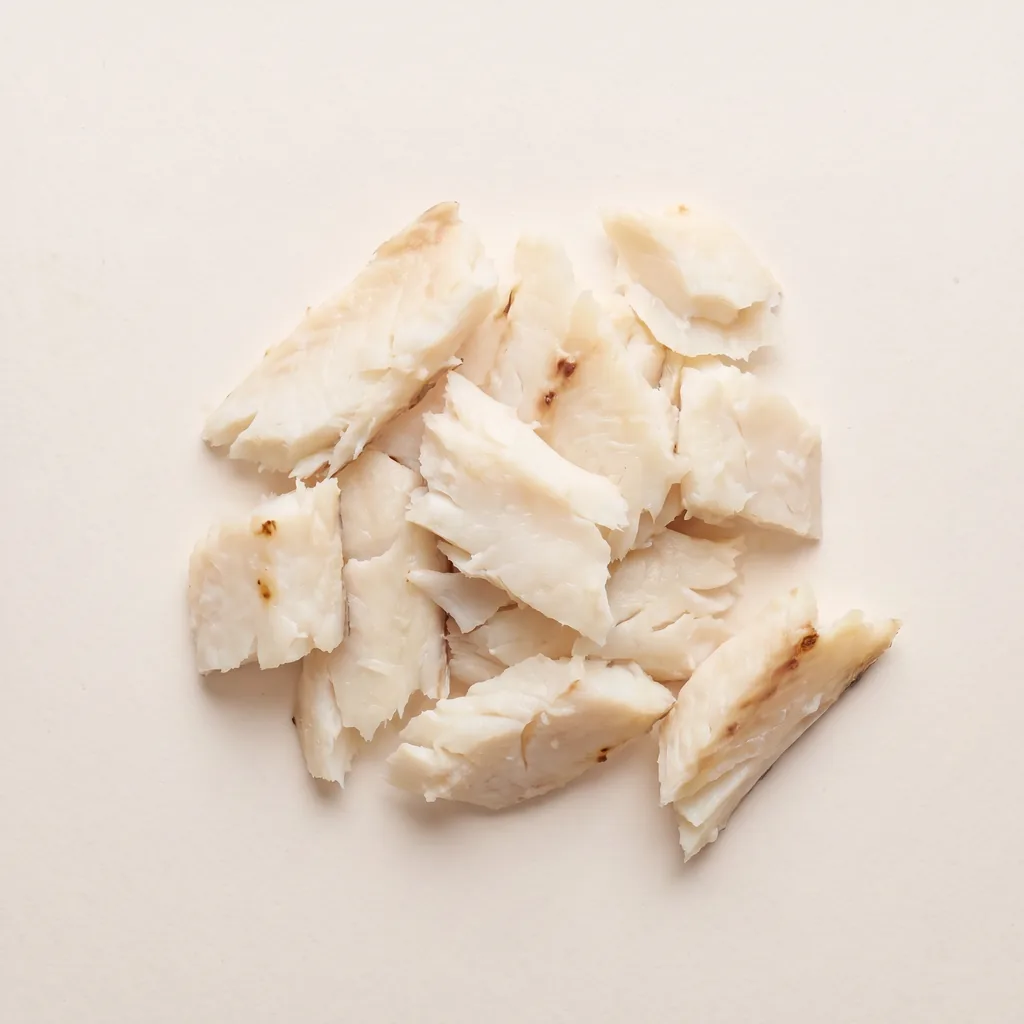
Cod is among the most widely eaten fish in the world. The taste is mild and the flesh falls into flakes. That makes it handy for dishes such as fish cakes. To keep for long, it is dried and salted. In that form it goes by names such as bacalao, klippfisk and saltfish.
Nutrition
Cod gives plenty of protein and omega-3 fats. It also supplies choline, selenium, magnesium, potassium and the vitamins B6 and B12. Together they help growth, the brain, eyesight, the heart, body salts and hormones.
How do you prepare cod for babies?
Fresh, boneless, skinless
Cook the cod fresh. Remove the skin and all bones. After cooking, run a finger through the fish. Even one bone can slip through.
Salted and dried cod
Dried, salted cod (such as bacalao) is very salty. To suit a baby, it must be soaked in water for a long time to draw out the salt. Ask a health professional about salt.
The source gives no safe salt level for salted cod for babies. Ask a professional before offering this product.
How often
Once common allergens have been tried, regular servings are advised, ideally twice a week. It does not have to be the same fish each time. Finned fish share the same main proteins, so you can rotate species by availability and taste.
Preparation by age
The same food is served differently at each age. What matters is how your baby sits, grasps and chews, more than the calendar.
6 months
6 months · How to prepare as stripsstrip
Cut: Finger strip
Cook the cod fresh. Remove the skin and every bone. Cut the fish into strips as thick as two adult fingers side by side. Soft cod cakes that are bigger than your baby's mouth also work.
6 months · How to flake and mixmash
Cut: Shredded
Flake cooked, boneless cod with a fork. Stir it into a soft food such as a purée, yogurt or porridge. Your baby can eat it by spoon or by hand.
9 months
9 months · How to prepare small piecescube
Cut: Bite sized piece
Cut cooked, boneless cod into bite-sized pieces. Your baby can practice the pincer grasp with them. Keep offering long strips and large cakes for biting and tearing practice.
12 months
12 months · How to prepare bites and cakescube
Serve cooked, boneless cod as bites, cakes or flakes, alone or mixed into other dishes. This age is also a good time for fork and spoon practice.
Is cod a choking hazard for babies?
Choking risk: low
Cooked, boneless, skinless cod is low risk. A fish bone may get stuck in baby's mouth, throat or food pipe. Check every portion for bones.
Cooked cod without bones and skin is low risk. In theory, any food can cause choking. A fish bone, however, may get stuck in baby's mouth, throat or food pipe. To lower this risk, pick out the bones with care after cooking. Prepare it for your child's age and stay close at meals.
Bone check
Feel through cooked fish by hand before serving. Make sure no bones remain in cakes either.
Is cod a common allergen?
Cod is a common allergen. Finned fish are counted as common allergens. Cod, halibut, salmon and tuna are among the most frequent triggers. Around 0.2 percent of the world's population has an allergy to finned fish. The rate in children is lower than in adults. About 40 percent of people with fish allergy have their first reaction in adulthood. Most do not outgrow it.
Some people also react to proteins that become airborne while fish cooks. If this applies to your baby, you may avoid cooking fish at home while your baby is present.
Reacting to other fish
About half of the people allergic to one fish react to another. The cause is beta-parvalbumin, a protein found in most fish. Because of cross-contact and mislabeling risks, allergists often advise avoiding all finned fish. The allergist decides which fish may be safe. If your baby is allergic to cod, ask an allergist before offering any other fish.
FPIES
Fish with fins can set off FPIES, short for food protein-induced enterocolitis syndrome. FPIES is a delayed allergy. A few hours after eating, it causes sudden, repeated vomiting and diarrhea. Left untreated, it can lead to serious fluid loss. FPIES to fish can also start later in life and often lasts a lifetime.
If repeated vomiting and diarrhea begin a few hours after eating fish, seek medical care.
Scombroid poisoning
Histamine builds up in fish that was not kept cold. Eating it can cause symptoms that look like an allergy. This is a kind of food poisoning, not an allergy. Keeping fish cold enough lowers the risk.
If you suspect a fish allergy, talk to an allergist before offering cod. For the first try, offer a small amount and watch. If all goes well, raise it slowly.
Key nutrients
Frequently asked questions about cod
How often can I give fish?
Once common allergens have been tried, regular servings are advised, ideally twice a week. It need not be the same fish. Finned fish share the same main proteins, so you can rotate species.
Is cod safe in terms of mercury?
According to the source, cod has low to moderate mercury compared with other fish. Ask your pediatrician how often to serve it.
Can I give cod cakes?
Yes. Cakes are fine from 6 months when soft and wider than baby's mouth. Make sure no bones remain inside.
Is scombroid poisoning the same as fish allergy?
No. Scombroid poisoning is food poisoning from histamine that builds up in fish kept too warm. Its symptoms look like allergy.
Sources for this page
- U.S. Food and Drug Administration. (2019). Advice about eating fish.
- Tsabouri S, Triga M, Makris M, Kalogeromitros D, Church MK, Priftis KN. (2012). Fish and shellfish allergy in children: Review of a persistent food allergy. Pediatric Allergy and Immunology. doi:10.1111/j.1399-3038.2012.01275.x
- Moonesinghe H, Mackenzie H, Venter C, Kilburn S, Turner P, Weir K, et al. (2016). Prevalence of fish and shellfish allergy. Annals of Allergy, Asthma & Immunology. doi:10.1016/j.anai.2016.07.015
- James JM, Crespo JF. (2007). James JM, Crespo JF. Allergic reactions to foods by inhalation. Current Allergy and Asthma Reports. doi:10.1007/s11882-007-0017-z
- Crespo JF, Pascual C, Vallecillo A, Esteban MM. (1995). Sensitization to Inhalant Allergens in Children Diagnosed with Food Hypersensitivity. Allergy and Asthma Proceedings. doi:10.2500/108854195778771381
Guides on iron, allergen introduction, gagging and drinks. Read the starting solids guides
Medical note
This page is for information only and is not a substitute for medical advice, diagnosis or treatment. Talk to your pediatrician before any feeding decision, especially about allergen introduction and reactions.
The Lokmini app
Log cod, reactions and your allergen journey in the app.
Open in LokminiLokmini is coming soon to the App Store.
Astro Tasarım Simay Yenice · Türkiye · merhaba@lokmini.com