Chestnut
- First taste
- 6 months
- Choking risk
- high
- Common allergen
- no
- Iron
- low
Grind or thin to paste · candied later
When can babies eat chestnut?
Chestnut can be offered finely ground or as a thinned paste when your baby is ready for solids, around 6 months. Whole chestnuts, chopped pieces, candied chestnuts and clumps of paste raise choking risk. How you prepare it matters.
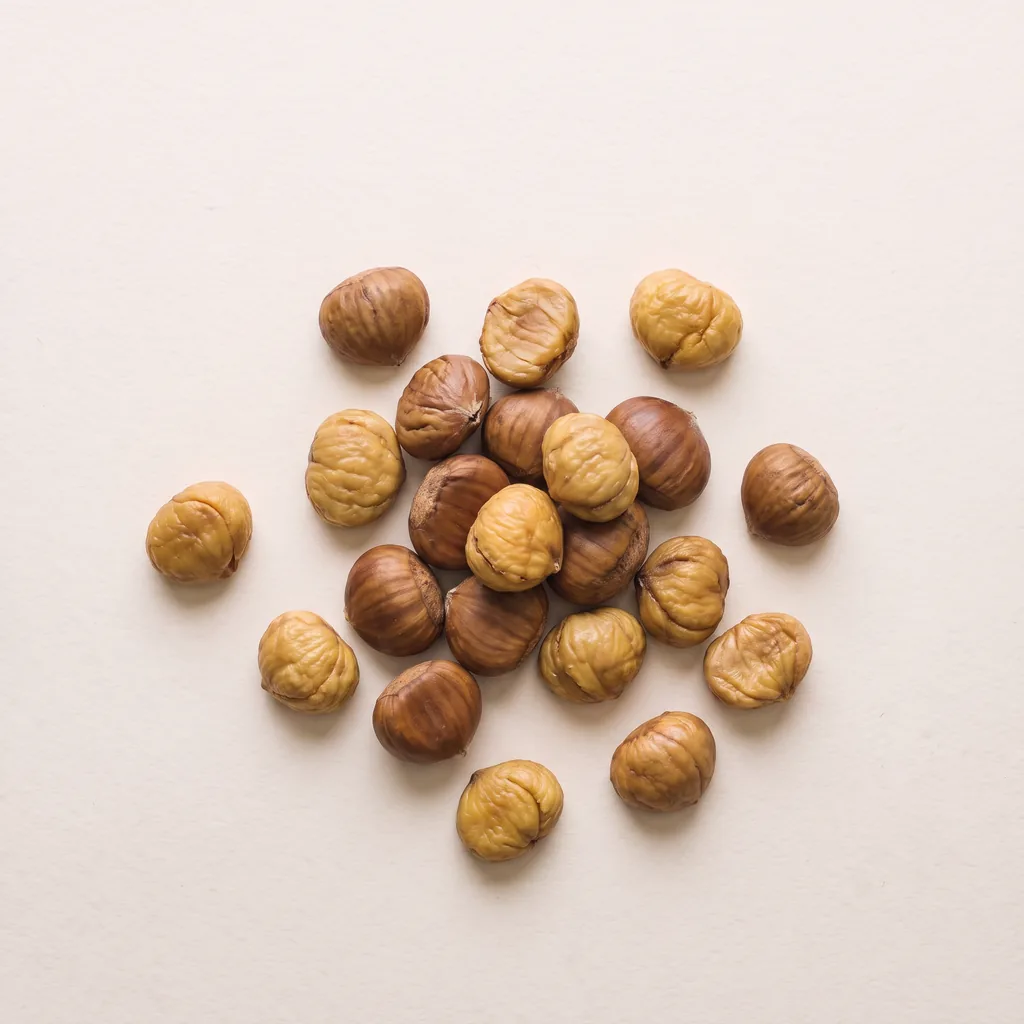
The Northern Hemisphere is home to chestnut trees. The fruit is a pale, dense seed inside a smooth brown shell.
Horse chestnut and water chestnut
Chestnut is unrelated to horse chestnut, which can be toxic. Water chestnut is a separate plant, an edible tuber.
Nutrition
Chestnut gives carbohydrates and fiber. Vitamins B6, C and K, plus zinc, potassium, magnesium and folate, are in there as well. These nutrients support growth, the gut microbiome, brain development, immunity and blood clotting.
How do you prepare chestnut for babies?
Shopping tip
To save time, pick pre-cooked, vacuum-sealed chestnuts. If you buy fresh, give them a shake. Fresh chestnuts do not rattle. A rattle means the inside has dried out.
Sweetened chestnut paste
Chestnut paste loosened with water or another liquid can go into meals from about 6 months, within a varied menu. It is better to wait until your child is older to serve sweetened pastes and spreads regularly. A taste of sugar now and then is fine. Steady added sugar harms teeth over time.
Older children
Once a child is past 24 months, many are ready to try a whole cooked, peeled chestnut. Start with soft packaged ones. Chew thoroughly in front of your child first. Your child should sit safely. After age 3, candied chestnuts that are soft and chewy can be offered if your child takes small bites, chews well and can spit out food when needed.
Preparation by age
The same food is served differently at each age. What matters is how your baby sits, grasps and chews, more than the calendar.
6 months
6 months · How to prepare ground or as pastemash
Cut: Ground
Grind cooked, peeled chestnuts in a mortar, a food processor or on a grater until no large bits remain. The result can look like powder or paste. Sprinkle it on soft foods or stir it in. If you use chestnut paste, loosen it with a little water, breast milk or formula into a smooth pourable sauce. It is rich in fiber, so start small. Do not serve candied chestnuts.
9 months
9 months · How to prepare crumbly piecescube
Slice packaged cooked chestnuts thinly or squash them with your fingers into crumbs. Pieces need to be soft and easy to crumble when pressed. Place them straight on the tray or table so your baby takes one piece at a time. Skip the bowl, since a baby can scoop many pieces at once. You can keep offering ground chestnut and thinned paste.
12 months
12 months · How to serve thin slices and pasteslice
Slice cooked, peeled chestnuts thinly or smash them into pieces. Make each piece soft so it crumbles with ease. If it does not, grind it finely instead. Place the pieces on the tray or table. At this age your child may also handle undiluted chestnut paste or nut butter. Spread a thin layer and offer water or milk in an open cup to wash down sticky bits. Do not serve candied chestnuts.
Is chestnut a choking hazard for babies?
Choking risk: high
Cooked chestnut is firm, round, slippery and crumbly. Do not serve whole or in large pieces. Grind it, thin it into paste, or make thin pieces that crumble easily.
Cooked chestnut is firm, round and slippery. It can be hard to chew or crumbly. All of these raise risk. Prepare it for your child's age. Stay within arm's reach at meals.
Forms to avoid
Do not give young babies whole chestnuts, large pieces, candied chestnuts or clumps of paste.
Is chestnut a common allergen?
The source classes chestnut as a tree nut but not as a common allergen. Primary chestnut allergy is very rare.
Chestnut has proteins resembling those in latex, avocado, banana and kiwi, a link known as latex-fruit syndrome. Reactions can be a mild itchy mouth (brief tingling or stinging) or a severe body-wide reaction.
People with chestnut allergy but no latex allergy can also be sensitive to mugwort pollen and peach.
Offer a small amount at first and watch.
Key nutrients
Frequently asked questions about chestnut
Is chestnut a tree nut and an allergen?
The source classes it as a tree nut but not as a common allergen. Primary allergy is rare. Cross-reactions can occur in people with latex allergy.
Does chestnut cause gas?
It is high in fiber, so it may cause gas or loose stools. Start with a small amount.
What can I make with chestnut flour?
You can use it for pancakes or muffins. These make suitable finger foods for babies.
Sources for this page
- Dünya Sağlık Örgütü. (2023). Guideline for complementary feeding of infants and young children 6-23 months of age.
- CDC, Infant and Toddler Nutrition. (n.d.). Choking Hazards.
- Antico A. (1996). Oral Allergy Syndrome Induced by Chestnut (Castanea sativa). Annals of Allergy, Asthma and Immunology. doi:10.1016/S1081-1206(10)63404-7
- Slater JE. (1994). Latex allergy. Journal of Allergy and Clinical Immunology. doi:10.1016/0091-6749(94)90031-0
- ESPGHAN Committee on Nutrition, Fidler Mis N, Braegger C, Bronsky J, Campoy C, Domellöf M, et al. (2017). Sugar in Infants, Children and Adolescents. Journal of Pediatric Gastroenterology and Nutrition. doi:10.1097/MPG.0000000000001733
Guides on iron, allergen introduction, gagging and drinks. Read the starting solids guides
Medical note
This page is for information only and is not a substitute for medical advice, diagnosis or treatment. Talk to your pediatrician before any feeding decision, especially about allergen introduction and reactions.
The Lokmini app
Log chestnut, reactions and your allergen journey in the app.
Open in LokminiLokmini is coming soon to the App Store.
Astro Tasarım Simay Yenice · Türkiye · merhaba@lokmini.com