Cheese
- First taste
- 6 months
- Choking risk
- medium
- Common allergen
- yes
- Iron
- low
Milk allergen · pasteurized only, no cubes
Contains allergens
Each new allergen is offered on its own and watched for two hours. Our allergen introduction guide is available in Turkish for now.
When can babies eat cheese?
Pasteurized cheese can be offered when your baby is about 6 months old and ready for solids. Salt content can be high. A small taste now and then in a balanced diet is fine.
Any kind of milk can be turned into cheese. It is thought to come from the Mediterranean region. Cow, goat and sheep milk are the most common. In eastern Asia, water buffalo and yak milk are used as well. Flavor and texture vary with the milk, the fermenting bacteria and the method.
Nutrition
Most cheeses supply protein and fat, plus calcium, selenium, zinc, vitamin A and vitamin B12. These support growth, brain function, bones, vision and immunity. When you shop, pick pasteurized products.
How much cheese
There is no upper limit. You can serve pasteurized cheese every day if you like. Do not fret over the exact amount your baby eats. A baby may eat a lot at one meal and very little at another. Both are fine as long as cheese sits among a variety of foods. Serve salty cheeses like feta and parmesan only now and then.
How do you prepare cheese for babies?
Which cheese
Pasteurized soft and semi-firm cheeses are suitable. Do not serve mold-ripened, smear-ripened or raw milk cheeses. They carry a risk of foodborne illness.
No age makes raw milk cheese risk-free. Salmonellosis and listeriosis are harmful infections for babies and can be more severe in them.
Plant-based cheeses
Plant-based cheeses are fine if prepared for your baby's age. Try any allergens inside it one at a time first, for instance soy, tree nuts or wheat. Nut, oil, pea and soy based kinds exist.
Preparation by age
The same food is served differently at each age. What matters is how your baby sits, grasps and chews, more than the calendar.
6 months
6 months · How to serve soft cheesemash
Spread pasteurized soft cheese thinly on toast or another finger food. You can also put some in a bowl for your baby to scoop by spoon or hand. Avoid mold-ripened, smear-ripened and raw milk cheeses.
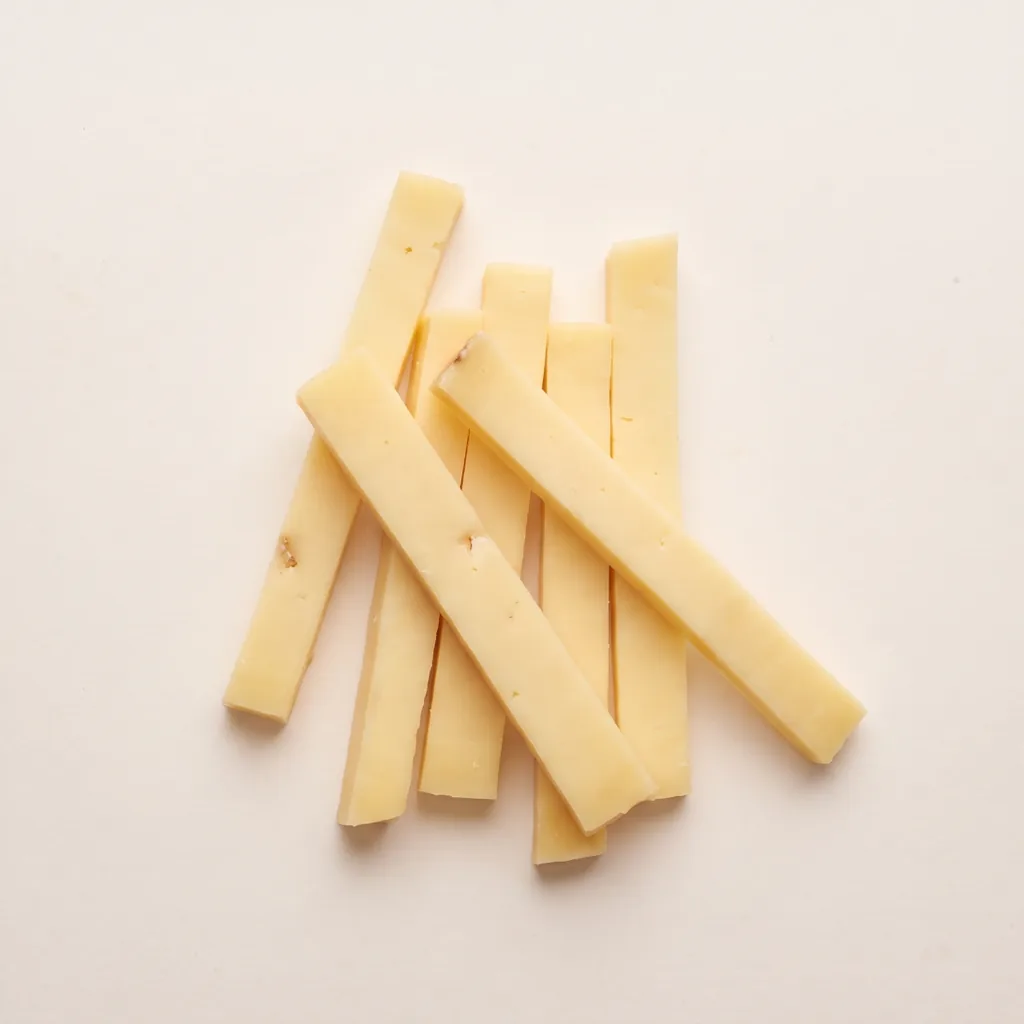
6 months · How to cut semi-firm cheesestrip
Cut: Finger strip
Cut pasteurized semi-firm cheese into long, thin, flat pieces. Your baby can hold and gnaw them. You can melt shredded cheese into dishes in small amounts, since big melted clumps raise the risk. Do not give cubes or large chunks.
9 months
9 months · How to cut and serve small piecescube
Cut: Bite sized piece
Once your baby develops the pincer grasp, cut bite-sized pieces from a flat slice of cheese. Long flat slices still work for biting. Serve shreds alone or in a dish. Keep avoiding cube shapes.
12 months
12 months · How to serve on bread or foodslice
Add soft cheese, thinly sliced or melted semi-firm cheese, or grated hard cheese to bread, eggs, vegetables, or grain and bean dishes. You can melt cheese in a thin layer. Remove large melted clumps. Do not serve cheese in a stroller, a car seat or while your child runs around.
Is cheese a choking hazard for babies?
Choking risk: medium
Firm and springy are two words that fit cheese. In the mouth it can become a sticky lump. Skip cubes and big chunks. Offer thin flat slices, shreds, or soft cheese spread on bread.
Cheese tends to be firm and springy. In the mouth it can turn into a sticky lump. These traits raise choking risk. Prepare cheese to suit your baby's age. Keep your baby within arm's reach during meals.
Forms to avoid
Do not serve cubes of cheese or big melted clumps.
Is cheese a common allergen?
Cheese is usually made from cow's milk. The World Health Organization lists cow's milk among its global priority allergens. About one in five food allergies in young children is to milk. Buffalo, goat and sheep milk products can trigger similar reactions. The good news is that milk allergy often passes with time. Most children outgrow it by age 6.
Aged cheeses contain histamine. Sensitive children may get a rash from it.
Milk is also a frequent cause of a delayed allergy called FPIES. Repeated vomiting and diarrhea appear a few hours after eating. Untreated, it can lead to fluid loss. Most children outgrow it between ages 3 and 5.
Lactose intolerance can be mistaken for an allergy and is rare in babies. Aged cheeses have little lactose.
If you suspect a milk allergy, talk to an allergist before serving cheese. If milk is already safely in your baby's diet, serve cheese freely. If milk has not been tried, start with a very small amount and raise it if no reaction follows.
Signs of an allergy
If you see hives, facial swelling, repeated vomiting or trouble breathing, stop feeding and call a doctor.
Key nutrients
Frequently asked questions about cheese
Which cheese can my baby eat?
Pasteurized soft and semi-firm cheeses are suitable. Do not give raw milk, mold-ripened or smear-ripened cheeses.
Isn't cheese too salty?
Cheese has some sodium. A baby's sodium needs are low, so serve very salty cheeses like feta and parmesan only now and then.
How much cheese can a baby eat a day?
There is no set limit. You can serve pasteurized cheese daily. Do not worry about the exact amount.
Sources for this page
- Dünya Sağlık Örgütü. (2023). Guideline for complementary feeding of infants and young children 6-23 months of age.
- NHS. (n.d.). Preparing food safely for babies.
- CDC, Infant and Toddler Nutrition. (n.d.). Choking Hazards.
- Warren CM, Jhaveri S, Warrier MR, Smith B, Gupta RS. (2013). The epidemiology of milk allergy in US children. Annals of Allergy, Asthma and Immunology. doi:10.1016/j.anai.2013.02.016
- COMMITTEE ON INFECTIOUS DISEASES, COMMITTEE ON NUTRITION, Brady MT, Byington CL, Davies HD, Edwards KM, et al. (2014). Consumption of raw or unpasteurized milk and milk products by pregnant women and children (AAP Committee on Infectious Diseases and Committee on Nutrition). Pediatrics. doi:10.1542/peds.2013-3502
Guides on iron, allergen introduction, gagging and drinks. Read the starting solids guides
Medical note
This page is for information only and is not a substitute for medical advice, diagnosis or treatment. Talk to your pediatrician before any feeding decision, especially about allergen introduction and reactions.
The Lokmini app
Log cheese, reactions and your allergen journey in the app.
Open in LokminiLokmini is coming soon to the App Store.
Astro Tasarım Simay Yenice · Türkiye · merhaba@lokmini.com