Cheddar cheese
- First taste
- 6 months
- Choking risk
- medium
- Common allergen
- yes
- Iron
- low
Milk allergen · pasteurized, flat slices
Contains allergens
Each new allergen is offered on its own and watched for two hours. Our allergen introduction guide is available in Turkish for now.
When can babies eat Cheddar cheese?
Cheddar can be offered, pasteurized, when your baby is about 6 months old and ready for solids. Sodium may run high. Within a varied diet, a taste now and then is not a worry. Choosing pasteurized lowers the risk of foodborne illness.
Cheddar's color, flavor and texture depend on the cow's diet and on how the cheese is made. It is named after the village of Cheddar in England. There it is made by traditional farmhouse methods from local cows' milk and tastes sharp and tangy.
Nutrition
Cheddar supplies protein and fat, along with calcium, selenium, zinc, vitamin A and vitamin B12. These support growth, brain function, bone density, vision and immunity.
How do you prepare Cheddar cheese for babies?
General principles
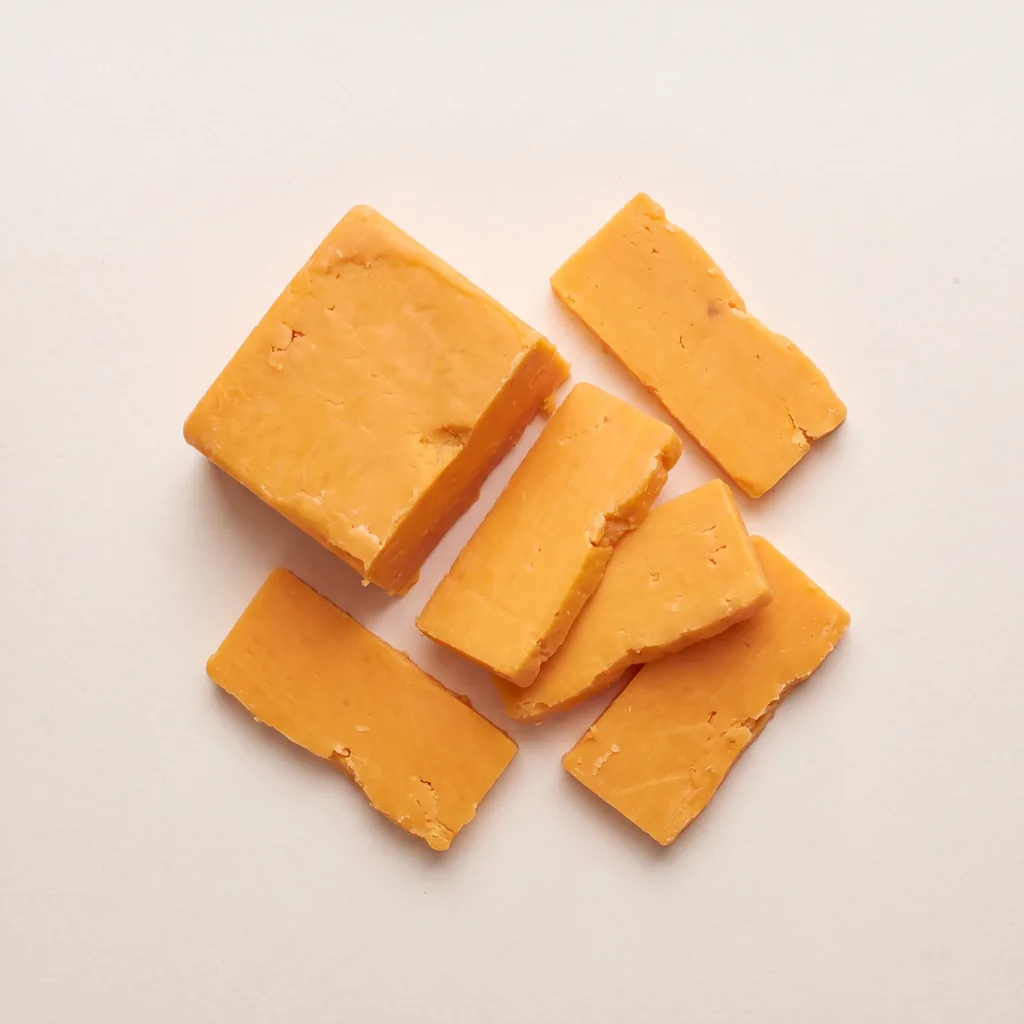
Always choose pasteurized cheddar. At 6 and 9 months long flat slices or shreds are the safest forms. Sprinkle melted cheese sparingly, because big melted clumps are hard for a small baby to chew.
Babies eat little solid food on their own, so they take in little salt. Sodium is a needed mineral. Still, do not serve very salty cheeses often.
Australia and New Zealand
In these countries cheddar is often sold as 'tasty cheese'.
Preparation by age
The same food is served differently at each age. What matters is how your baby sits, grasps and chews, more than the calendar.
6 months
6 months · How to cut and serve for baby-led weaningstrip
Cut: Finger strip
Cut pasteurized cheddar into long, thin, flat slices. Your baby can grab them easily and the risk is lower. To melt it, grate it and sprinkle a little. Avoid big melted clumps and cubes.
9 months
9 months · How to cut and serve small piecescube
Tear bite-sized pieces from a flat slice, or grate the cheese and serve it alone or mixed into a dish. Cubes and big melted clumps carry a high risk, so avoid them.
12 months
12 months · How to serve on breadslice
Spread melted cheese thinly on bread, tortilla, pasta, beans or vegetables. It should not be too hot, but not so cool that it hardens and clumps. You can also give bite-sized pieces cut from thin slices.
Is Cheddar cheese a choking hazard for babies?
Choking risk: medium
Cheddar is a firm cheese that can clump in the mouth. Skip cubes and big chunks. Offer long thin slices, shreds or a thin melted layer.
Cheeses like cheddar are firm. They can clump in the mouth into a mass that is hard to manage. These traits raise choking risk. Prepare the cheese for your baby's age. Stay within arm's reach during meals.
Forms to avoid
Do not serve cubes of cheese or big melted clumps.
Is Cheddar cheese a common allergen?
Cheddar is usually made from cow's milk, a common allergen. In young children about one in five food allergies is to milk. Sheep, goat and buffalo milk products can trigger similar reactions. The good news is that milk allergy often passes with time. Most children with milk allergy outgrow it by age 6.
Aged cheeses contain histamine. Children who are sensitive to it may get a rash.
Milk is also a frequent cause of a delayed allergy called FPIES. Repeated vomiting and diarrhea start a few hours after eating. Untreated, it can lead to fluid loss. Most children outgrow FPIES between ages 3 and 5.
Lactose intolerance can be mistaken for an allergy. It is uncommon in babies. Aged cheeses have little lactose and are often better tolerated.
If you suspect a milk allergy, talk to an allergist before serving cheese. If milk is already safely in your baby's diet, you can serve pasteurized cheese freely. If milk has not been tried, start with a very small amount and raise it if no reaction follows.
Signs of an allergy
If you see hives, facial swelling, repeated vomiting or trouble breathing, stop feeding and call a doctor.
Key nutrients
Frequently asked questions about Cheddar cheese
Is cheddar too salty for babies?
It can be high in sodium. An occasional small serving is fine. Choose pasteurized and do not serve it too often.
How should I cut cheddar?
At 6 months, in long, thin, flat slices. From 9 months, serve shreds or small pieces torn off a flat slice. Do not serve cubes.
Does cheddar contain lactose?
Aged cheeses have little lactose. People with lactose intolerance often tolerate cheese better than milk. Lactose intolerance is uncommon in babies.
Sources for this page
- Dünya Sağlık Örgütü. (2023). Guideline for complementary feeding of infants and young children 6-23 months of age.
- NHS. (n.d.). Preparing food safely for babies.
- CDC, Infant and Toddler Nutrition. (n.d.). Choking Hazards.
- Warren CM, Jhaveri S, Warrier MR, Smith B, Gupta RS. (2013). The epidemiology of milk allergy in US children. Annals of Allergy, Asthma and Immunology. doi:10.1016/j.anai.2013.02.016
- COMMITTEE ON INFECTIOUS DISEASES, COMMITTEE ON NUTRITION, Brady MT, Byington CL, Davies HD, Edwards KM, et al. (2014). Consumption of raw or unpasteurized milk and milk products by pregnant women and children (AAP Committee on Infectious Diseases and Committee on Nutrition). Pediatrics. doi:10.1542/peds.2013-3502
Guides on iron, allergen introduction, gagging and drinks. Read the starting solids guides
Medical note
This page is for information only and is not a substitute for medical advice, diagnosis or treatment. Talk to your pediatrician before any feeding decision, especially about allergen introduction and reactions.
The Lokmini app
Log Cheddar cheese, reactions and your allergen journey in the app.
Open in LokminiLokmini is coming soon to the App Store.
Astro Tasarım Simay Yenice · Türkiye · merhaba@lokmini.com