Celery
- First taste
- 6 months
- Choking risk
- high
- Common allergen
- no
- Iron
- low
Raw stalk is a high choking risk · cook it
When can babies eat celery?
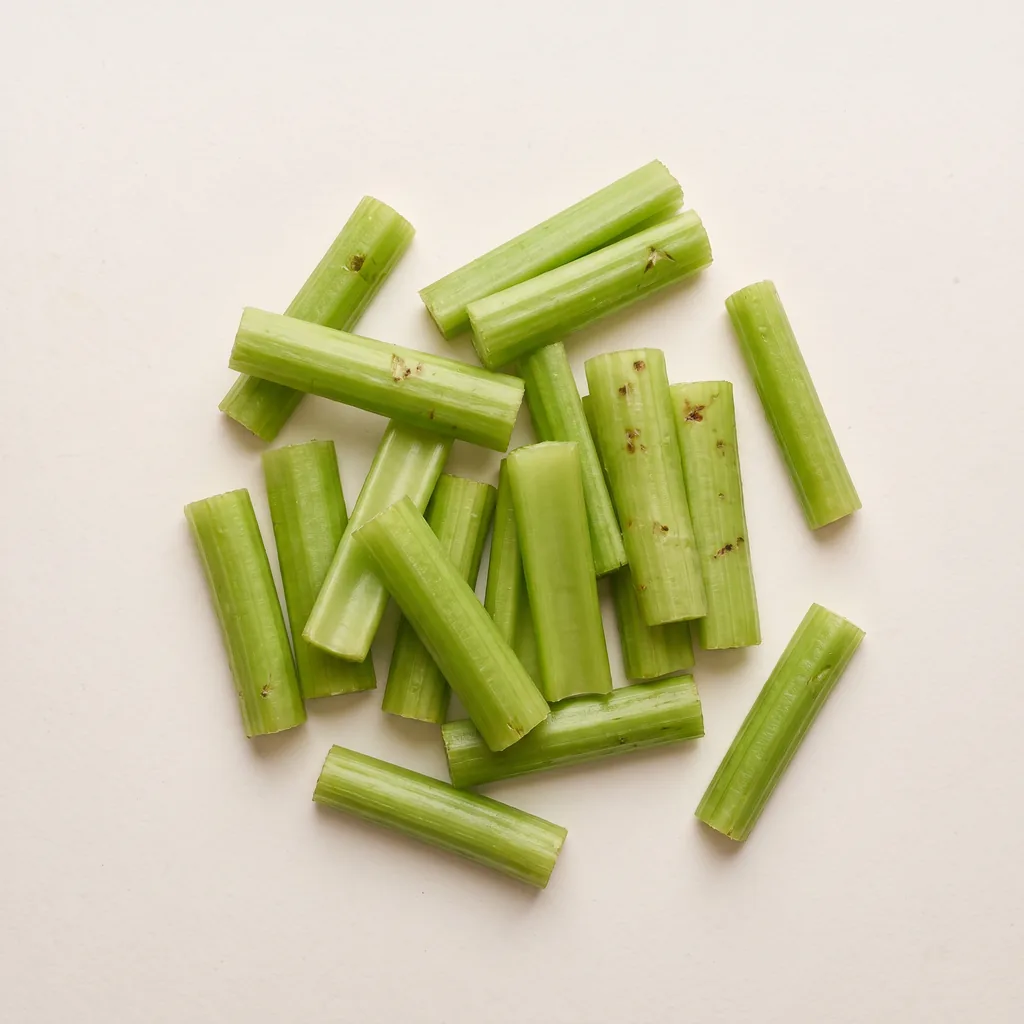
Celery stalks can start when your baby is about 6 months old and ready for solids. Raw stalk is a high choking risk, so it needs age-appropriate preparation. Celery comes from wild greens around the Mediterranean. Leaf celery is common in Asia and stalk celery in the Americas.
Celery gives vitamin K for the blood, some folate for growth, and carotenoids that turn into vitamin A. It also carries antioxidant compounds that help the gut and immunity.
Sodium worries
Celery holds more sodium than most vegetables, yet it still does not count as a salty food. You can relax about it.
How do you prepare celery for babies?
6 to 11 months
Slice the stalk across into thin half moons and simmer until soft. Stir the pieces into stew, warm porridge or yogurt. After 9 months you can also serve them alone as finger food.
Gnawing a raw stalk
Some families give a whole raw stalk as a chewing stick. It strengthens the jaw and teaches the tongue to move food sideways. Freezing the stalk makes it firm at first, then it softens as the baby chews. A baby who already has teeth and a strong bite, though, may snap off a piece. Because of this risk, consider the method only if you feel confident and your baby is closely watched. If a piece breaks off, let your baby spit it out alone and keep your finger out of the mouth. Kneeling in front of your baby helps gravity bring the food forward.
12 months and up
Cut raw celery crosswise and start with very thin slivers. Avoid large raw pieces. Try raw celery sticks only when your child bites and chews well, around age 2 or later. Splitting the stick lengthwise and offering a dip makes it easier to chew. Your child should sit and be supervised.
Preparation by age
The same food is served differently at each age. What matters is how your baby sits, grasps and chews, more than the calendar.
6 months
6 months · How to serve mixed into soft foodsmash
Cut: Thin slice
Slice the stalk across into thin half moons, then simmer or steam them soft. Stir the cooked pieces into scoopable foods such as stew, warm porridge or yogurt. Do not give raw pieces.
9 months
9 months · How to cut and serve as finger foodcube
Cut: Thin slice
Cook thin crosswise half moons until soft. Serve them alone as finger food or stirred into stew or yogurt.
12 months
12 months · How to cut and serve raw thin slicesslice
Cut: Thin slice
Most children can handle raw celery in the mouth at this age. Cut the stalk crosswise and start with very thin half-moon slivers. Make the slices a little thicker as skills grow. Do not give raw chunks.
Is celery a choking hazard for babies?
Choking risk: high
Raw celery is very hard, and small cut pieces are tough for babies. Give young babies thin cooked half-moon slices. Wait until about 24 months for raw celery sticks, and only if your child chews well.
Raw celery is very hard and is often cut into small pieces that are difficult for babies. The choking risk is high. Prepare it in a way that suits your baby's age. Keep your baby within arm's reach at meals.
High risk
Do not give young babies raw celery pieces or large raw chopped stalk. Cook it first or slice it very thin.
Is celery a common allergen?
Celery is not on this app's common allergen list. An allergy is uncommon, but reports say it is getting more frequent. Reactions range from mild to severe. People sensitive to parsley-family foods such as carrot and fennel, or to birch and mugwort pollen, may cross-react. Coriander, cumin, dill, aniseed and parsley can cross-react as well. Short itching or burning in the mouth may occur. Cooking lowers the reaction, but some people react to cooked celery too.
Anaphylaxis has been reported in people who exercised within 4 hours of eating celery. Skin contact followed by sun can cause an itchy, pigmented rash.
Offer a small amount at first. If there is no reaction, raise the portion.
Key nutrients
Frequently asked questions about celery
Can babies have celery juice?
Not before 12 months. Even later, keep it limited, because the nitrate level can be high. Serving the whole vegetable is more nutritious.
Should I worry about nitrates in celery?
Not for most healthy children. EFSA and the American Academy of Pediatrics mostly regard vegetable nitrates as harmless. Babies under 3 months and those with health problems are more sensitive.
When can my child eat raw celery sticks?
When your child bites and chews well, often around age 2. Split it lengthwise first, offer a dip, and supervise.
Sources for this page
- Dünya Sağlık Örgütü. (2023). Guideline for complementary feeding of infants and young children 6-23 months of age.
- NHS. (n.d.). Preparing food safely for babies.
- CDC, Infant and Toddler Nutrition. (n.d.). Choking Hazards.
- Bruznican S, De Clercq H, Eeckhaut T, Van Huylenbroeck J, Geelen D. (2020). Celery and Celeriac: A Critical View on Present and Future Breeding. Frontiers in Plant Science. doi:10.3389/fpls.2019.01699
- Greer FR, Shannon M, the Committee on Nutrition, and the Committee on Environmental Health. (2005). Greer FR, Shannon M. Infant methemoglobinemia: the role of dietary nitrate in food and water. Pediatrics. doi:10.1542/peds.2005-1497
Guides on iron, allergen introduction, gagging and drinks. Read the starting solids guides
Medical note
This page is for information only and is not a substitute for medical advice, diagnosis or treatment. Talk to your pediatrician before any feeding decision, especially about allergen introduction and reactions.
The Lokmini app
Log celery, reactions and your allergen journey in the app.
Open in LokminiLokmini is coming soon to the App Store.
Astro Tasarım Simay Yenice · Türkiye · merhaba@lokmini.com