Cauliflower
- First taste
- 6 months
- Choking risk
- low
- Common allergen
- no
- Iron
- low
Steam until soft, never serve raw or firm
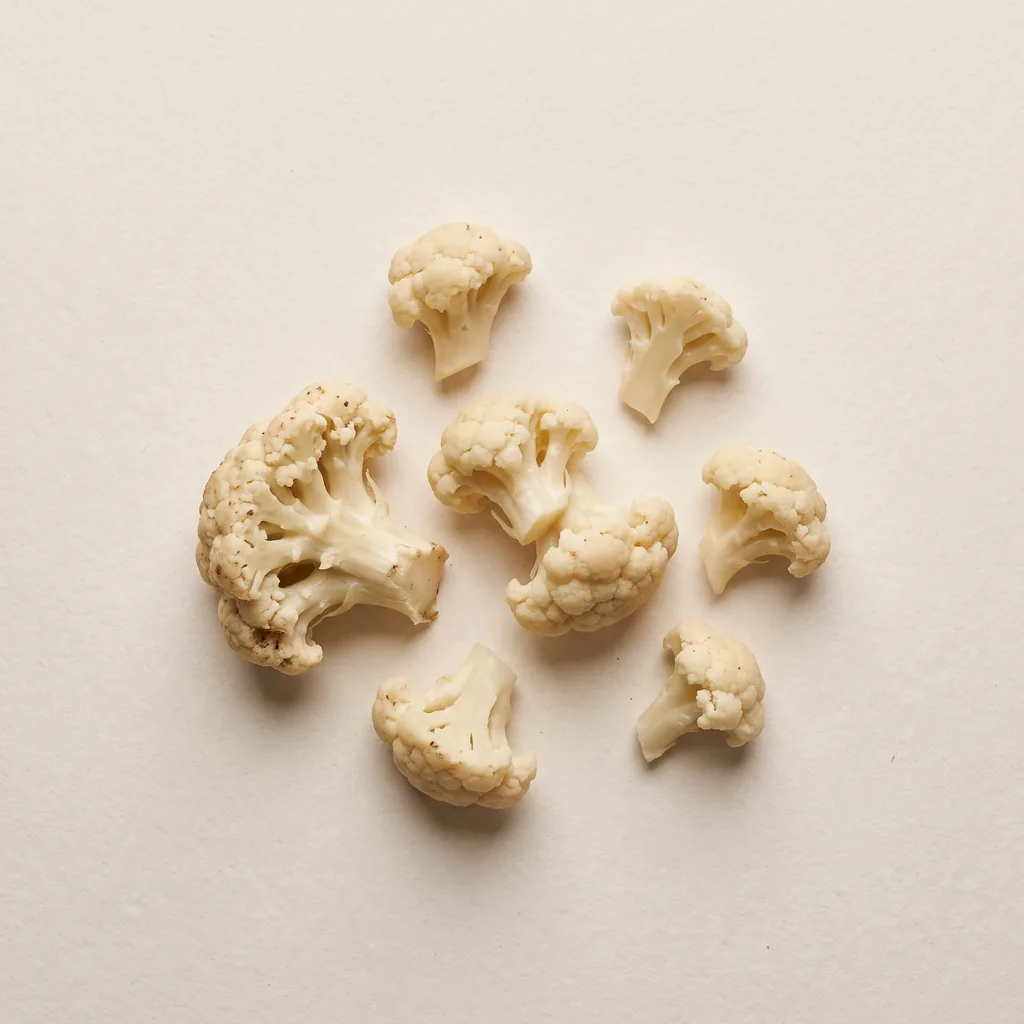
When can babies eat cauliflower?
Cauliflower can start when your baby is about 6 months old and ready for solids. It belongs to the cabbage family and was bred from wild cabbage around the Mediterranean. Besides the cream-colored kind, there are green, orange and purple types.
Cauliflower gives fiber, vitamin B6, folate and choline. Fiber helps digestion, while folate and B6 support growth. Its vitamin C helps the body absorb plant iron.
Nutrients by color
Green types carry chlorophyll and purple ones carry anthocyanins. All types hold beta-carotene, and orange types hold the most.
How do you prepare cauliflower for babies?
Start with big pieces
Larger pieces are easier for a 6-month-old. A floret with a crown about three adult fingers wide is a good size. Steam it to the softness you want. Longer steaming makes it softer.
A firm floret is easier for the tongue to push out. A soft floret lowers choking risk but can bring more gagging. If you serve a firm floret, cut it in half lengthwise. You can also mash the florets or chop them fine and serve them on a spoon.
Stalk sticks
Peel the main stalk to get rid of its tough outer layer. Steam it until soft. Then cut rectangular sticks about two fingers thick. A round cylinder adds risk if a piece breaks off, so keep the sticks flat.
Helping iron absorption
The vitamin C in cauliflower improves how well plant iron is absorbed. Serve it with beans, lentils, dark leafy greens, mushrooms or tofu.
Preparation by age
The same food is served differently at each age. What matters is how your baby sits, grasps and chews, more than the calendar.
6 months
6 months · How to preparemash
Cut: Fork mashed
Prepare cauliflower the way you prepare broccoli. Steam the florets with the stem as a handle until a fork mashes them easily. Cauliflower has fermentable fibers that can cause gas and bloating in some babies. Start with a small portion and wait 2-3 days before adding another new food, so you can watch the digestive response.
9 months
9 months · How to cut and serve small piecescube
Cut: Bite sized piece
Break very soft cooked florets into bite-sized pieces. Your baby practices the pincer grasp with them. You can keep offering large florets too, and show how to take a bite.
12 months
12 months · How to cut and serve with a forkcube
Cut: Bite sized piece
Chop cooked florets into bite-sized pieces, pre-load a fork and set it in front of your child. You can add cauliflower to family meals. Near the second birthday, once biting and chewing are steady, cook it a little less each time.
Is cauliflower a choking hazard for babies?
Choking risk: low
Raw or firm cauliflower is tough to chew and raises choking risk. Cook it until very soft. Cut firm florets in half lengthwise so the stem stops being round.
Cauliflower that is raw or not cooked enough is hard and tough to chew, which raises choking risk. Prepare it in a way that fits your baby's age. Stay within arm's reach during meals.
Safe cutting
Split firm florets lengthwise. Cut stalk sticks flat, not round.
Is cauliflower a common allergen?
Cauliflower is not a common allergen. An allergy is rare but possible. People sensitive to other crucifers such as mustard greens or broccoli may react to cauliflower too. In pollen food allergy syndrome, especially with mugwort pollen sensitivity, there can be short itching or tingling in the mouth. This reaction is usually not dangerous.
Begin with a small amount. When no reaction follows, raise the portion at later meals.
Key nutrients
Frequently asked questions about cauliflower
Does cauliflower cause gas in babies?
It can in some babies. Its fermentable fibers may cause gas and bloating. Start with a small portion and watch your baby for a day or two.
Can I give raw cauliflower?
Not to young children. Raw cauliflower is hard and carries a choking risk. Steam it soft first.
How long should I cook it?
Cook until a fork mashes it easily. The time depends on the floret size. Near the second birthday you can shorten it a little for a firmer bite.
Sources for this page
- Dünya Sağlık Örgütü. (2023). Guideline for complementary feeding of infants and young children 6-23 months of age.
- NHS. (n.d.). Preparing food safely for babies.
- CDC, Infant and Toddler Nutrition. (n.d.). Choking Hazards.
- Jin P, Yao D, Xu F, Wang H, Zheng Y. (2015). Effect of light on quality and bioactive compounds in postharvest broccoli florets. Food Chemistry. doi:10.1016/j.foodchem.2014.09.134
Guides on iron, allergen introduction, gagging and drinks. Read the starting solids guides
Medical note
This page is for information only and is not a substitute for medical advice, diagnosis or treatment. Talk to your pediatrician before any feeding decision, especially about allergen introduction and reactions.
The Lokmini app
Log cauliflower, reactions and your allergen journey in the app.
Open in LokminiLokmini is coming soon to the App Store.
Astro Tasarım Simay Yenice · Türkiye · merhaba@lokmini.com