Cashew
- First taste
- 6 months
- Choking risk
- high
- Common allergen
- yes
- Iron
- medium
Tree nut allergen · never whole
Contains allergens
Each new allergen is offered on its own and watched for two hours. Our allergen introduction guide is available in Turkish for now.
When can babies eat cashew?
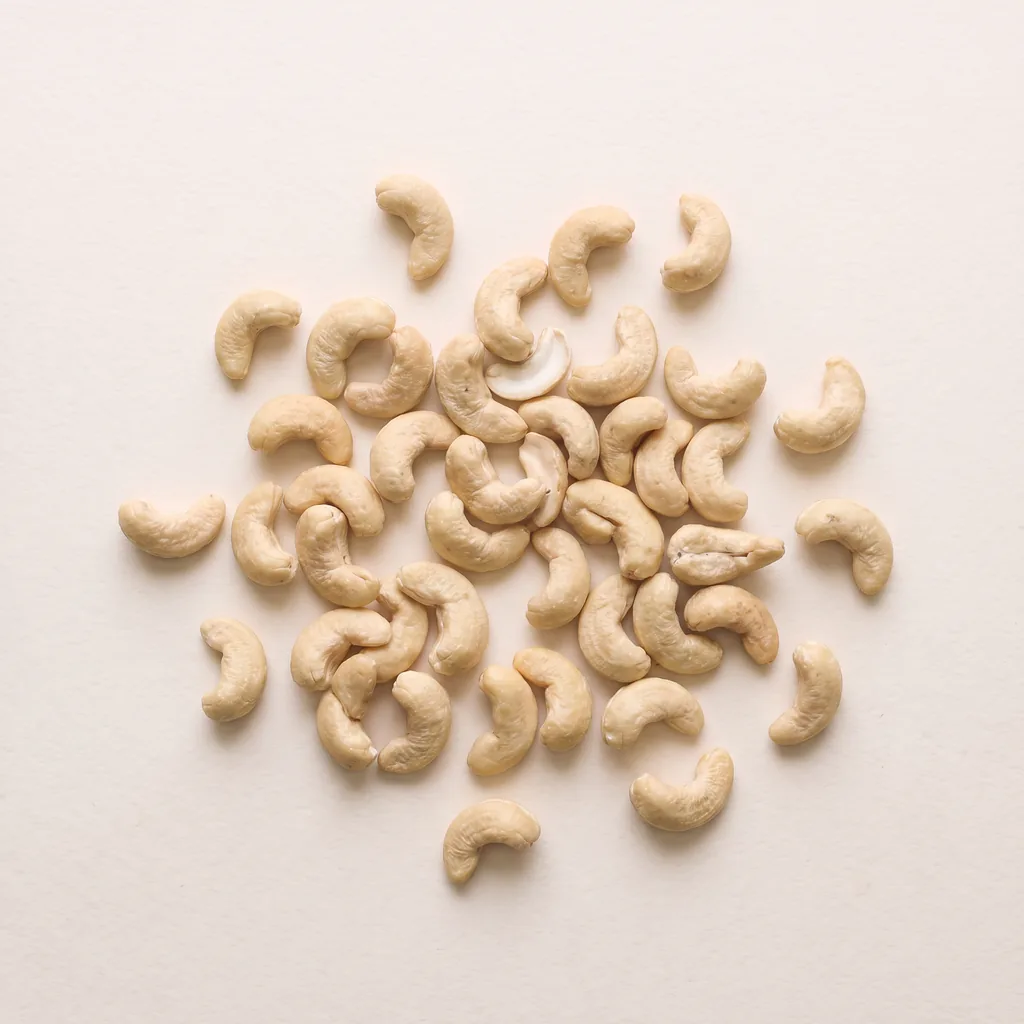
Cashews are a food that can begin, finely ground or as a smooth butter, once your baby nears 6 months and is ready to eat solids. Whole nuts, nut pieces and thick butter all carry a choking risk. Follow the steps for each age with care.
The cashew tree is native to Central and South America. Today India grows more cashews than anywhere else.
Inside you will find healthy fats, protein, a little carbohydrate and fiber. Iron, magnesium, potassium, selenium, zinc and vitamins E and K are there too. Together they add to growth, gut bacteria, blood, hormones, defenses, clotting and bones. To keep nuts fresh, store them somewhere cool and dark, or in the fridge.
How do you prepare cashew for babies?
6 months and up
Loosen smooth, honey-free butter with applesauce, milk (breast milk or formula) or water until no clumps are left. Spoon it over porridge or cooked vegetables as a sauce. The same thinned butter can be brushed in a very thin layer on a toast strip. Give water in an open cup for sticky bites. Another way is to grind the nuts to a powder and dust a pinch over avocado, banana or steamed veggie sticks.
For cashew cream, soak the nuts for a few hours until they turn slightly soft, then blend until silky. Spread a spoonful or two over pancakes, porridge, cooked meat, fish, legumes or tofu. After 12 months, cashew milk can be tried now and then as a drink.
24 months and up: learning whole cashews
According to the source, a child with well-developed eating skills can practice with cashew halves after 24 months. The child takes small bites, chews well, does not overfill the mouth and spits out half-chewed bits. All medical bodies count nuts as a choking risk until age 4 and beyond. I flagged this conflict.
Offer nuts while your child sits upright and is paying attention. Show first: take a tiny bite from a half, push it to your back teeth with your tongue, and chew with your mouth open. Then hold a half firmly and let your child bite it. Never place the nut in the mouth yourself. One or two pieces at a time is plenty. If you feel uneasy, wait a few weeks. Afterward, check that the mouth is empty.
Cashew milk
Cashew milk works as an ingredient in food. As a drink, hold off until the first birthday, or it pushes out breast milk or formula. Plenty of cashew milks fall short of what a growing child needs. When you can choose, pick one with added calcium and vitamin D.
Preparation by age
The same food is served differently at each age. What matters is how your baby sits, grasps and chews, more than the calendar.
Prep time: 5 min
6 months
6 months · How to prepare as a puréemash
Cut: Ground
Grind raw or roasted unsalted cashews to a flour-like powder and stir them into yogurt or fruit purée, or thin smooth cashew butter with water. Whole cashews are not served until age 4. Tree nuts are a new allergen, so offer them alone the first time, in the morning and in a small amount.
9 months
9 months · How to servemash
Cut: Ground
Sprinkle ground cashew on soft foods, or spread thinned cashew butter very thinly on a bread strip. Do not serve thick butter alone on a spoon.
12 months
12 months · How to servemash
Cut: Ground
Carry on with ground cashew and thinned cashew butter. Soaked and blended cashews can thicken unsalted sauces and soups. Whole cashews are not served until age 4.
Is cashew a choking hazard for babies?
Choking risk: high
Whole or broken cashews are not served until age 4. Grind to a flour-like powder, or thin smooth butter and mix it in. Do not serve thick butter alone on a spoon.
Whole cashews are tiny, hard and demanding to chew, while the butter may stick. Each of these pushes the choking risk up. Prepare nuts and butter to suit your child's age. Stay beside your baby throughout the meal.
Is cashew a common allergen?
Cashew is one of the common allergens. Botanically a seed, it is grouped with tree nuts for allergy purposes. Its protein resembles that of pistachio, so around three quarters of children allergic to cashew also react to pistachio. Between 0.5 and 1.2 percent of the population has a tree nut allergy. It tends to stay for life, and only about one child in eleven grows out of it.
Sumac and pink peppercorn come from the same plant family as cashew (Anacardiaceae). People allergic to cashew might react to those spices. Mango sits in that family too, yet most cashew-allergic people can eat mango flesh with no problem.
Being allergic to one nut makes another allergy more likely. Still, you do not need to drop every nut. A varied diet counts for a child's growth and quality of life. With a cashew allergy, let an allergist decide which nuts are safe.
Most babies need no testing beforehand, even when allergy runs in the family. If your baby has severe eczema, has reacted to a food before, or may have a nut allergy, talk to a pediatrician or allergist before trying cashew at home. The doctor tells you whether to start at home or under clinic supervision. More and more evidence shows that giving allergens early protects, so do not wait longer than needed.
For the first try at home, give very little: a pinch of finely ground cashew, or an eighth of a teaspoon of smooth butter thinned with formula, breast milk or water. After the first time, keep offering it, ideally twice weekly. Stop only when signs of a reaction show up.
Key nutrients
Frequently asked questions about cashew
Can babies have cashew butter?
Yes, from 6 months. Thin smooth, honey-free butter with formula, breast milk or water. Never serve thick butter alone on a spoon.
When can my baby drink cashew milk?
It is fine as an ingredient in food. As a drink, wait for the first birthday. Pick a kind with added calcium and vitamin D.
If there is a cashew allergy, can pistachio be served?
Roughly three of four children with cashew allergy also react to pistachio. Check with an allergist first.
Sources for this page
- Dünya Sağlık Örgütü. (2023). Guideline for complementary feeding of infants and young children 6-23 months of age.
- NHS. (n.d.). Preparing food safely for babies.
- CDC, Infant and Toddler Nutrition. (n.d.). Choking Hazards.
- Halken S, Muraro A, de Silva D, Khaleva E, Angier E, Arasi S, et al. (2021). EAACI guideline: Preventing the development of food allergy in infants and young children (2020 update). European Academy of Allergy and Clinical Immunology. doi:10.1111/pai.13496
- Türkiye Ulusal Alerji ve Klinik İmmünoloji Derneği. (n.d.). Besin Alerjisi, öncelikli 10 besin.
- American Academy of Pediatrics, HealthyChildren. (n.d.). Choking Prevention for Babies and Children.
- Brough HA, Caubet JC, Mazon A, Haddad D, Bergmann MM, Wassenberg J, et al. (2020). Defining challenge-proven coexistent nut and sesame seed allergy: A prospective multicenter European study. Journal of Allergy and Clinical Immunology. doi:10.1016/j.jaci.2019.09.036
- Cox AL, Eigenmann PA, Sicherer SH. (2021). Clinical Relevance of Cross-Reactivity in Food Allergy. J Allergy Clin Immunol Pract. doi:10.1016/j.jaip.2020.09.030
Guides on iron, allergen introduction, gagging and drinks. Read the starting solids guides
Medical note
This page is for information only and is not a substitute for medical advice, diagnosis or treatment. Talk to your pediatrician before any feeding decision, especially about allergen introduction and reactions.
The Lokmini app
Log cashew, reactions and your allergen journey in the app.
Open in LokminiLokmini is coming soon to the App Store.
Astro Tasarım Simay Yenice · Türkiye · merhaba@lokmini.com