Carrot
- First taste
- 6 months
- Choking risk
- high
- Common allergen
- no
- Iron
- low
Cook until soft, raw carrot is a choking risk
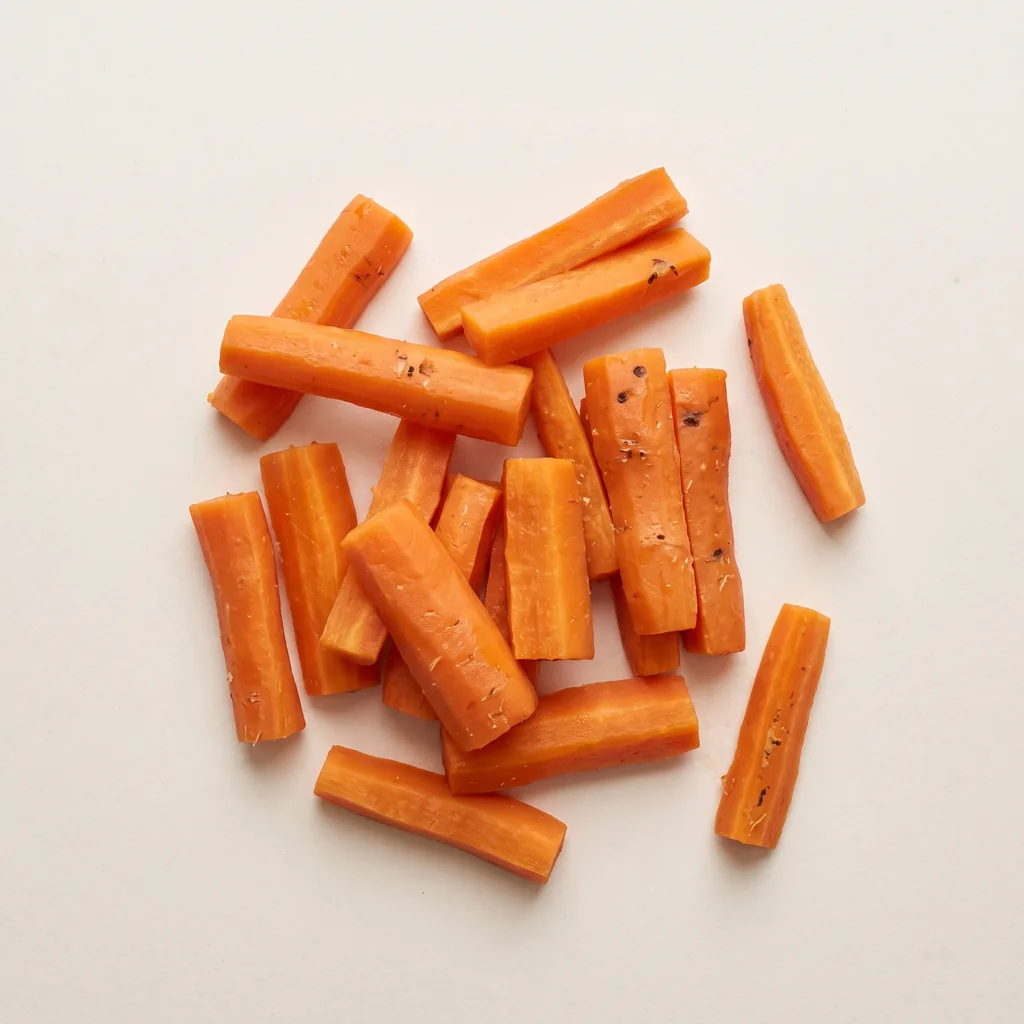
When can babies eat carrot?
Carrot can start when your baby is about 6 months old and ready for solids. Raw carrot, baby carrots and carrot sticks above all, is a common choking risk. So cook it soft first.
Carrots are mostly orange and sweet now, but they were not always. The root vegetable began in Southwest Asia. People first gathered the fragrant leaves and seeds for food and medicine. Later they learned to eat the root. Those roots were yellow or purple, not orange, with a thin shape and a more bitter taste than today's carrot.
Carrots of every color provide carbohydrates, fluid, fiber and folate. They also have vitamins A, B6 and K, plus magnesium and potassium. These support energy, hydration, digestion, brain growth and eyesight. They also hold carotenoids such as lutein and zeaxanthin.
How do you prepare carrot for babies?
Gnawing a raw carrot stick
The source says that, at your own risk, you can let a baby gnaw a thick, peeled raw carrot stick. Both ends should be about 2 cm thick, and the tapered tip, which snaps off more easily, should be left out. Little food reaches the belly at that meal. It does strengthen the jaw, teach the tongue to push food toward the sides where molars will appear, and give your baby touch cues for mapping the mouth.
A baby who has teeth and a strong jaw can bite a piece off. If that happens, keep your fingers out of the mouth. Put a hand on the back and lean your baby gently forward so the piece comes to the front and can be spat out. These moments can be scary, but they teach your baby what is not safe to swallow. This advice conflicts with the existing card's rule of no raw carrot, so it is flagged for review.
When to offer baby carrots
The safest choice is to hold off until your child is nearer to two. Baby carrots are high risk because of how firm and how shaped they are. Cooking until soft and cutting lengthwise into halves or quarters lowers the risk. Never give a baby a whole raw baby carrot. Give it to a toddler only when you trust the chewing skills, around age two or once the child has practiced breaking food down with the molars. Serve it when your child is seated and focused on eating.
After 24 months, a demonstration helps. Open your mouth, set the carrot on your back teeth and say you use strong back teeth and chew a lot. You can hold the carrot at the corner of your child's mouth so the teeth close on it.
Nitrates
Some vegetables, carrots included, hold natural nitrates. Babies who feed themselves rarely eat large amounts of solids. Nitrates in vegetables are mostly not a concern. In a balanced diet the benefit outweighs the unlikely risk.
To limit nitrate exposure, skip well water that has not been tested, and be careful with purées. Do not keep homemade purées of high-nitrate vegetables longer than 24 hours. Finish opened store-bought purées within 24 hours.
Preparation by age
The same food is served differently at each age. What matters is how your baby sits, grasps and chews, more than the calendar.
6 months
6 months · How to cut and serve for baby-led weaningstrip
Cook the carrot whole and unpeeled until a knife slides in easily. Next, halve it lengthwise and give your baby a thick piece to hold in the palm. If it squashes easily between two fingers, the texture is right. If you feed with a spoon, mash the cooked carrot and serve it on a pre-loaded spoon. Raw carrot is a high choking risk at this age.
9 months
9 months · How to cut and servecube
Cut: Bite sized piece
When your baby starts picking up small pieces between thumb and forefinger, serve cooked carrot in bite-sized cubes. Finely grated raw carrot can also be offered now. Raw carrot sticks are still too early.
12 months
12 months · How to cut and servecube
Cut: Bite sized piece
Keep serving cooked carrot in bite-sized pieces. As your child nears age two, raw carrot becomes an option. Cut raw carrot lengthwise into quarters and serve thin sticks. Whole baby carrots stay risky before age two because of their shape and firmness.
Is carrot a choking hazard for babies?
Choking risk: high
Raw carrot is hard and round, so it is not served raw until age 4. Cook until soft enough to squash between your fingers. Serve long finger sticks at 6 to 9 months and small cubes after 9 months.
Carrots, above all baby carrots and carrot sticks, are a common choking risk. To lower the risk, cook until soft and cut for your child's age. Stay with your baby during meals.
Is carrot a common allergen?
Carrot is not a common allergen. Allergy is rare but has been reported. People with birch pollen allergy may be allergic to raw carrot or have oral allergy syndrome. The mouth itches, tingles or burns briefly, which is usually not dangerous. Cooking the carrot reduces the reaction.
Offer a small amount alone for the first few meals. If there is no reaction, increase gradually.
Key nutrients
Frequently asked questions about carrot
When can I serve raw baby carrots?
Waiting until close to age two is safest. Never give a baby a whole raw baby carrot. Cook until soft and cut lengthwise.
Should I worry about nitrates in carrots?
Usually not. Avoid untested well water and do not keep homemade purées longer than 24 hours.
How do I check cooked carrot?
A knife should slide in easily, and the carrot should squash easily between two fingers.
Sources for this page
- Dünya Sağlık Örgütü. (2023). Guideline for complementary feeding of infants and young children 6-23 months of age.
- NHS. (n.d.). Preparing food safely for babies.
- CDC, Infant and Toddler Nutrition. (n.d.). Choking Hazards.
- Xiang Z, Block M, Löfman C, Nilsson G. (2001). IgE-mediated mast cell degranulation and recovery monitored by time-lapse photography. Journal of Allergy and Clinical Immunology. doi:10.1067/mai.2001.116124
- Brkić D, Bošnir J, Bevardi M, Bošković AG, Miloš S, Lasić D, et al. (2017). NITRATE IN LEAFY GREEN VEGETABLES AND ESTIMATED INTAKE. African Journal of Traditional, Complementary and Alternative Medicines. doi:10.21010/ajtcam.v14i3.4
- Greer FR, Shannon M, the Committee on Nutrition, and the Committee on Environmental Health. (2005). Greer FR, Shannon M. Infant methemoglobinemia: the role of dietary nitrate in food and water. Pediatrics. doi:10.1542/peds.2005-1497
Guides on iron, allergen introduction, gagging and drinks. Read the starting solids guides
Medical note
This page is for information only and is not a substitute for medical advice, diagnosis or treatment. Talk to your pediatrician before any feeding decision, especially about allergen introduction and reactions.
The Lokmini app
Log carrot, reactions and your allergen journey in the app.
Open in LokminiLokmini is coming soon to the App Store.
Astro Tasarım Simay Yenice · Türkiye · merhaba@lokmini.com