Butternut squash
- First taste
- 6 months
- Choking risk
- low
- Common allergen
- no
- Iron
- low
Source of vitamin A and fiber, cook well
When can babies eat butternut squash?
Butternut squash can start when your baby is about 6 months old and ready for solids. Squash is a plant native to Central America. Butternut is a winter squash variety related to calabaza. It also grows in cooler climates.
Butternut is a good source of fiber. It supplies vitamin A (eyes), B vitamins (blood), vitamin C (skin) and vitamin E (brain growth). Vitamin C also aids absorption of plant iron, so serve butternut with iron sources such as lentils, beans, nut butters and seeds. The body turns some carotenoids into vitamin A. The longer the squash cures after harvest, the more carotenoids build up inside.
How do you prepare butternut squash for babies?
Cutting and cooking
Peel the squash first and scoop out the seeds. Cut it into crescent slices or cubes. Roast, steam or boil it. It should squash easily when pressed with a finger.
You can serve a baby crescent slices and purée together. Older children get bite-sized pieces with a fork.
Itchy hands
People who prepare winter squash sometimes get an itchy rash on their hands. Wash your hands when you finish. Right before the meal, you can smooth a protective layer of plain white petroleum jelly over baby's face, and wash face and hands once the meal is over.
Preparation by age
The same food is served differently at each age. What matters is how your baby sits, grasps and chews, more than the calendar.
6 months
6 months · How to prepare crescent slicesstrip
Cut: Thick wedge
Peel the squash and scoop out the seeds. Cut it into crescent slices and cook until very soft. Hand a slice to your baby. If a piece breaks off, stay calm and give your baby a chance to move it forward alone.
6 months · How to prepare as a puréemash
Cut: Fork mashed
Mash the cooked squash. Serve it thick enough for your baby to scoop by hand or eat from a pre-loaded spoon. You can mix it with iron sources such as lentils, beans or seed butter.
9 months
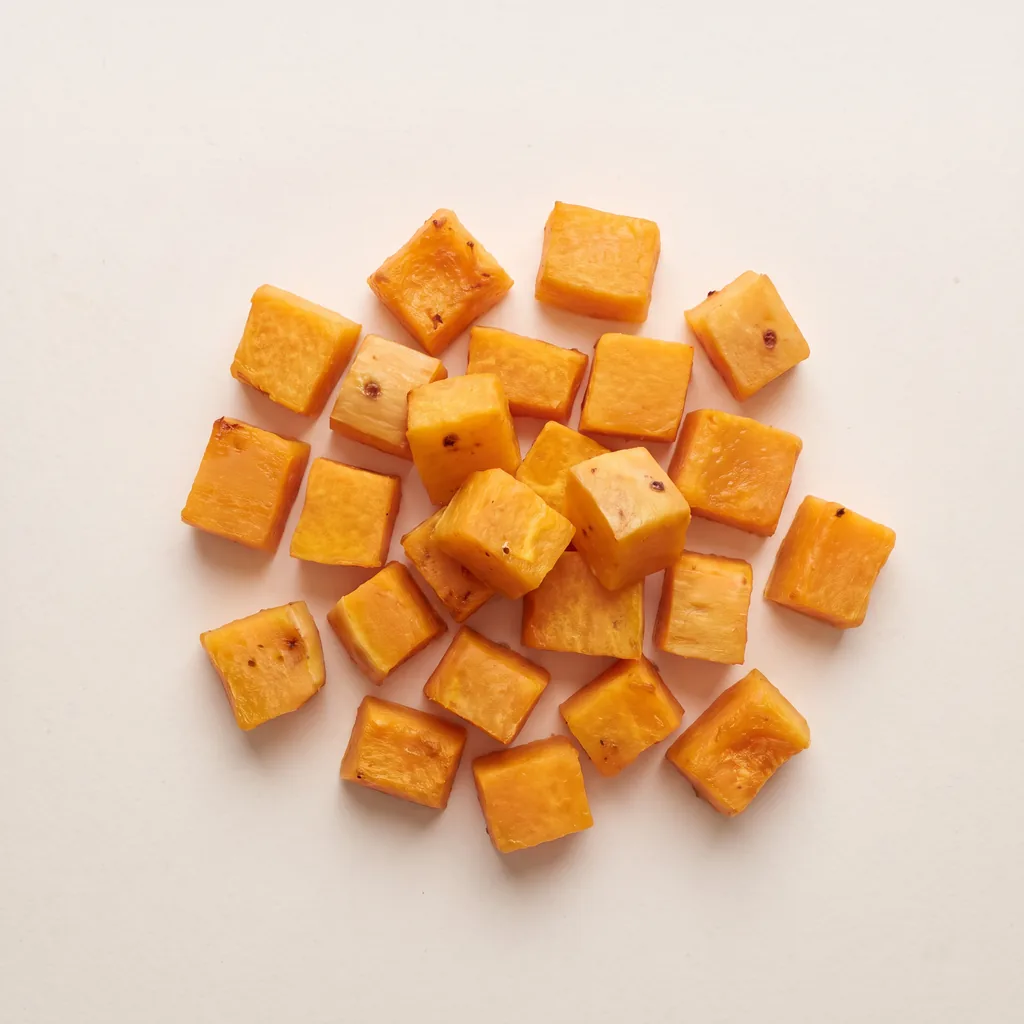
9 months · How to prepare small piecescube
Cut: Bite sized piece
Cut well-cooked squash into bite-sized pieces. Your baby practices picking them up between thumb and forefinger. You can keep offering larger slices for biting practice, or keep serving purée.
12 months
12 months · How to prepare with a forkcube
Cut: Bite sized piece
Serve well-cooked squash in bite-sized pieces with a fork. If your child is not interested in utensils, do not push. Steady use usually settles in after the second birthday.
Is butternut squash a choking hazard for babies?
Choking risk: low
Well-cooked butternut is low risk. Do not serve raw or firm pieces. If a large piece breaks off a crescent slice, stay calm and let your baby work it forward.
Well-cooked butternut is a low-risk food. Any food can still cause choking. Prepare it for your baby's age and stay with your baby during meals.
Is butternut squash a common allergen?
Butternut squash is not a common allergen. Allergy is rare. Handling winter squash, though, sometimes leaves an itchy rash on the skin of the hands.
Offer a small amount alone for the first few meals. If there is no reaction, increase gradually.
Key nutrients
Frequently asked questions about butternut squash
Can I serve raw butternut?
No. Cook it until soft first. Raw squash is hard and not suitable for a small baby.
Is it the same as pumpkin?
Not quite. Butternut is a winter squash with a longer, pear shape. Preparation and cooking are similar to pumpkin.
What should I pair it with for iron?
Vitamin C helps with plant iron absorption. Serve butternut with lentils, beans, nut butters or seeds.
Sources for this page
- Zhang MK, Zhang MP, Mazourek M, Tadmor Y, Li L. (2014). Regulatory control of carotenoid accumulation in winter squash during storage. Planta. doi:10.1007/s00425-014-2147-6
- Black HS, Boehm F, Edge R, Truscott TG. (2020). The Benefits and Risks of Certain Dietary Carotenoids that Exhibit both Anti- and Pro-Oxidative Mechanisms—A Comprehensive Review. Antioxidants. doi:10.3390/antiox9030264
- Potter TS, Hashimoto K. (1994). Butternut squash (Cucurbita moschata) dermatitis. Contact Dermatitis. doi:10.1111/j.1600-0536.1994.tb00588.x
- Dünya Sağlık Örgütü. (2023). Guideline for complementary feeding of infants and young children 6-23 months of age.
- CDC, Infant and Toddler Nutrition. (n.d.). Choking Hazards.
Guides on iron, allergen introduction, gagging and drinks. Read the starting solids guides
Medical note
This page is for information only and is not a substitute for medical advice, diagnosis or treatment. Talk to your pediatrician before any feeding decision, especially about allergen introduction and reactions.
The Lokmini app
Log butternut squash, reactions and your allergen journey in the app.
Open in LokminiLokmini is coming soon to the App Store.
Astro Tasarım Simay Yenice · Türkiye · merhaba@lokmini.com