Butter
- First taste
- 6 months
- Choking risk
- low
- Common allergen
- yes
- Iron
- low
Milk allergen · energy-dense fat
Contains allergens
Each new allergen is offered on its own and watched for two hours. Our allergen introduction guide is available in Turkish for now.
When can babies eat butter?
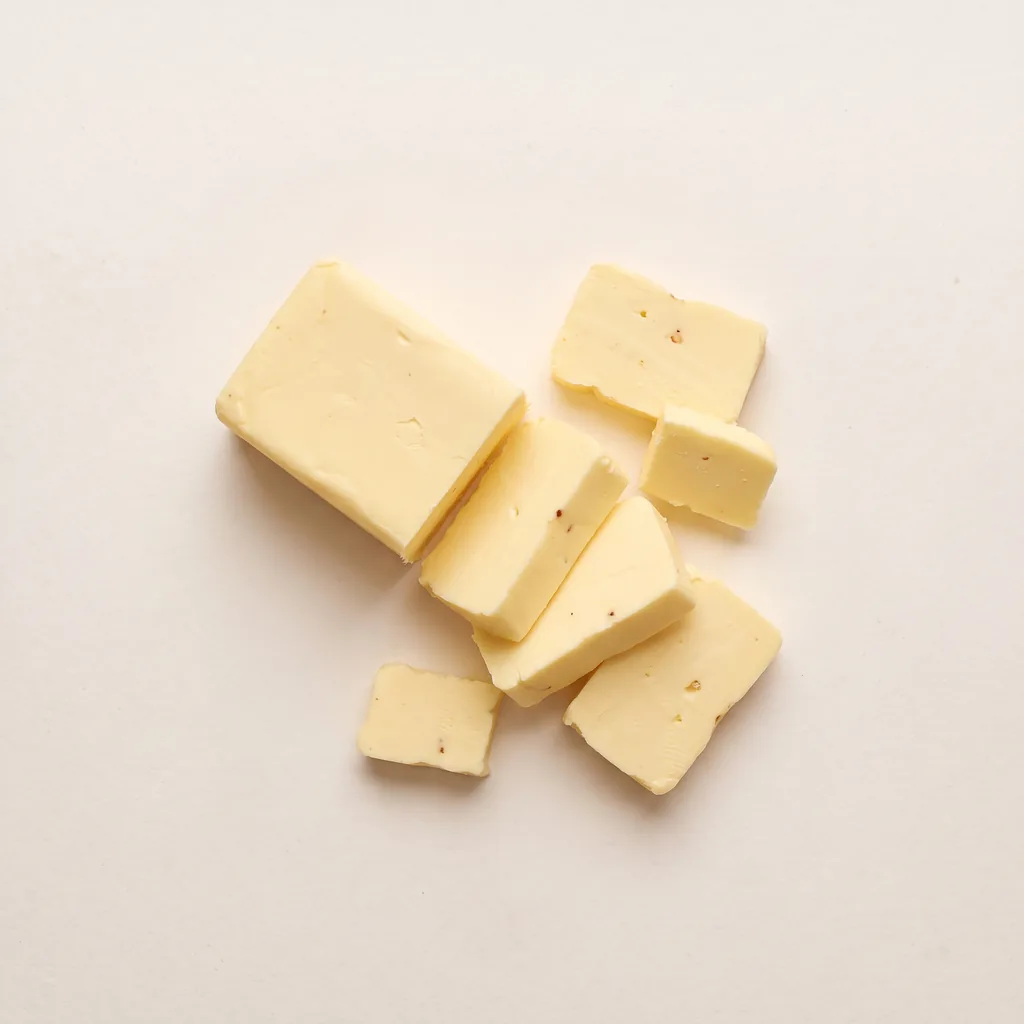
Butter can start when your baby is about 6 months old and ready for solids. It is made from milk fat and protein, most often from cow's milk. It was once peasant food, then a luxury for nobles. Today it enriches kitchens worldwide. It goes on bread, into baked goods, onto vegetables cooked in ghee, in herb butters, on grains flavored with fermented smen and in stews enriched with spiced niter kibbeh.
Butter gives dense energy for a baby's rapid growth. Saturated fat is one of the most common fats in breast milk. It provides omega-3 fatty acids and the vitamins K, E, D and A. Together they help the developing brain, skin, bones, defenses and clotting.
How do you prepare butter for babies?
Add it to meals
Stir butter into mashed vegetables or porridge. You can cook suitable fruit and vegetables in butter. Spread it in a thin layer on suitable foods, for example a toast strip. Leave no firm, cold chunks.
From 12 months, whipped or melted butter can be a dip. Near the second birthday a child can spread soft butter with a suitable knife.
How much
Babies and toddlers do not need their butter intake counted or capped. Fat gives plenty of energy for the fast growth of the brain and body. Butter keeps in the freezer for about 6 to 9 months from purchase.
Preparation by age
The same food is served differently at each age. What matters is how your baby sits, grasps and chews, more than the calendar.
Prep time: 2 min
6 months
6 months · How to prepare in a puréemash
Stir a small piece of unsalted butter into vegetable purée, bulgur or oat porridge and let it melt. Fat matters for your baby's energy needs. The measure is half a teaspoon per serving. It contains traces of cow's milk protein, so ask the doctor if your baby has a milk allergy.
9 months
9 months · How to servemash
Keep using a small amount of unsalted butter when cooking vegetables and grains, or spread it very thinly on a soft strip of bread. Thick butter is never served alone as a bite.
12 months
12 months · How to servemash
Keep using unsalted butter in moderation in meals and on bread. Choose unsalted butter and olive oil over salted butter and margarine.
Is butter a choking hazard for babies?
Choking risk: low
Butter is low risk. Make sure no firm, cold chunks of butter are left in a meal, as they can be a choking risk.
Butter is low risk when prepared for your baby's age. Any food can still cause choking. Do not leave firm, cold chunks of butter in a meal. Stay with your baby during meals.
Is butter a common allergen?
Butter is mostly made from cow's milk. Milk is a common allergen and causes about one in five childhood food allergies. Sheep, goat and buffalo milk products can cause similar reactions.
Milk allergy often fades. Most children with cow's milk allergy outgrow it by age 6. Many babies with mild symptoms can reintroduce milk around their first birthday with a doctor's guidance. Milk is also a common cause of FPIES, a delayed allergy. In FPIES, repeated vomiting and diarrhea start suddenly a few hours after eating. FPIES that starts early usually fades by 3 to 5 years. Lactose intolerance is different from allergy.
If you suspect a milk allergy, ask an allergist before serving butter. Once milk has been given and an allergy ruled out, butter can be served without a small first portion.
Key nutrients
Frequently asked questions about butter
How much butter can I give?
The amount does not need to be counted or capped. Fat is an important energy source for babies.
Can ghee be used?
Yes, forms such as ghee can be used in meals. If you suspect a milk allergy, ask an allergist first.
Is butter bad for the heart, and is it a concern for babies?
Research shows butter has a place in a balanced diet, and its effect on the heart may be more neutral than once thought. Babies have high fat needs.
Sources for this page
- Dünya Sağlık Örgütü. (2023). Guideline for complementary feeding of infants and young children 6-23 months of age.
- NHS. (n.d.). Preparing food safely for babies.
- CDC, Infant and Toddler Nutrition. (n.d.). Choking Hazards.
- Halken S, Muraro A, de Silva D, Khaleva E, Angier E, Arasi S, et al. (2021). EAACI guideline: Preventing the development of food allergy in infants and young children (2020 update). European Academy of Allergy and Clinical Immunology. doi:10.1111/pai.13496
- Türkiye Ulusal Alerji ve Klinik İmmünoloji Derneği. (n.d.). Besin Alerjisi, öncelikli 10 besin.
- Ramiro-Cortijo D, Singh P, Liu Y, Medina-Morales E, Yakah W, Freedman SD, et al. (2020). Breast Milk Lipids and Fatty Acids in Regulating Neonatal Intestinal Development and Protecting against Intestinal Injury. Nutrients. doi:10.3390/nu12020534
- Uauy R, Dangour AD. (2009). Fat and Fatty Acid Requirements and Recommendations for Infants of 0–2 Years and Children of 2–18 Years. Annals of Nutrition and Metabolism. doi:10.1159/000228997
Guides on iron, allergen introduction, gagging and drinks. Read the starting solids guides
Medical note
This page is for information only and is not a substitute for medical advice, diagnosis or treatment. Talk to your pediatrician before any feeding decision, especially about allergen introduction and reactions.
The Lokmini app
Log butter, reactions and your allergen journey in the app.
Open in LokminiLokmini is coming soon to the App Store.
Astro Tasarım Simay Yenice · Türkiye · merhaba@lokmini.com