Burrata
- First taste
- 6 months
- Choking risk
- medium
- Common allergen
- yes
- Iron
- low
Milk allergen · pasteurized only
Contains allergens
Each new allergen is offered on its own and watched for two hours. Our allergen introduction guide is available in Turkish for now.
When can babies eat burrata?
Burrata can start when your baby is about 6 months old and ready for solids. Choose pasteurized burrata to lower the risk of foodborne illness.
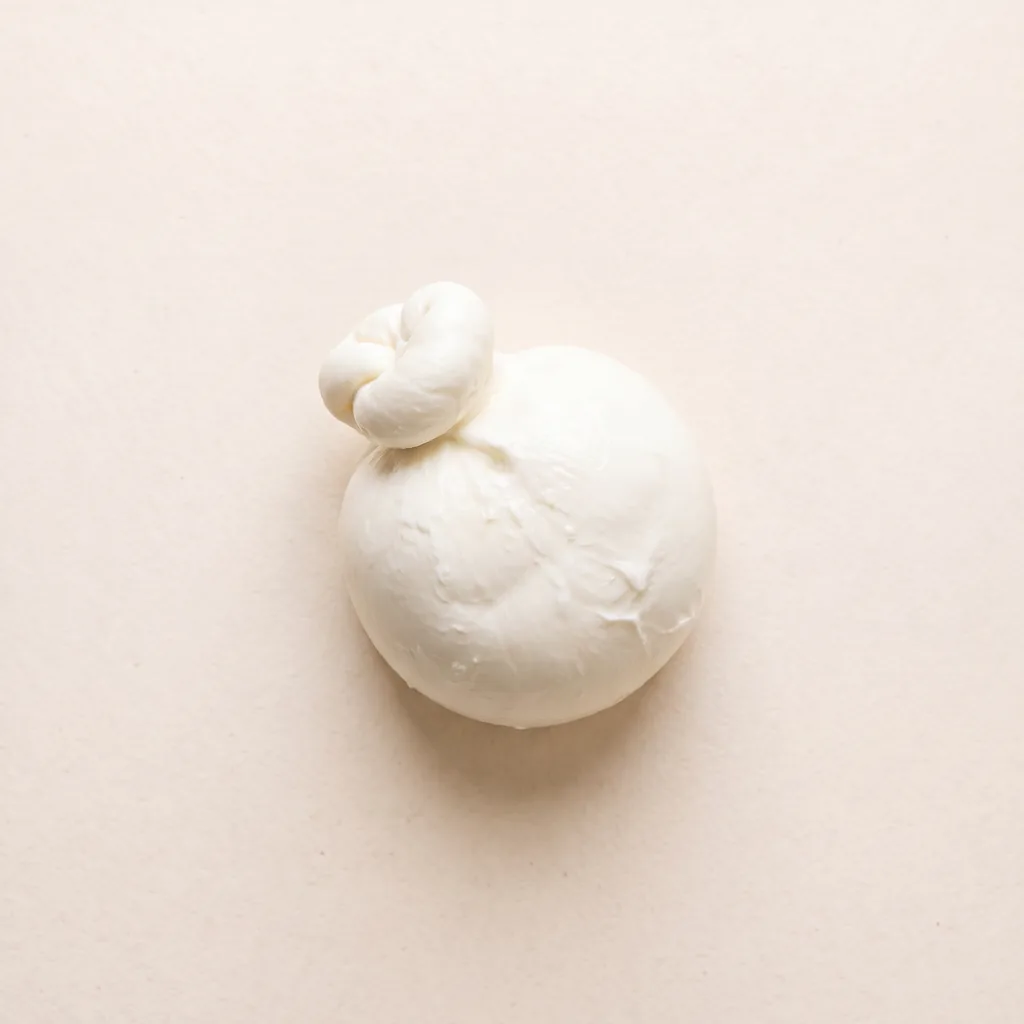
Burrata comes from southern Italy and is made from cow's milk. To make burrata, a ball of fresh mozzarella is stretched and filled with cream and stracciatella, which are shreds of the same cheese. The ball is stored in water or whey. It is usually served at room temperature. When the shell is opened, the creamy center flows out. Its mild, buttery taste goes well with bread, pasta and vegetables such as broccoli, fava beans, tomatoes and zucchini.
It provides protein, fat, calcium, selenium, zinc, vitamin A and vitamin B12. These nutrients support growth, development, brain function, bone density, vision, energy and immunity.
How do you prepare burrata for babies?
Shell and center
You can cut strips or small pieces from the shell. The center can be scooped by spoon or by hand. You can spread cheese thinly on bread or toast, or stir it into vegetable purée.
There is no set limit on cheese. You can serve pasteurized cheese every day if you like. A baby may eat a lot or very little at a meal. Both are fine within a varied diet.
Preparation by age
The same food is served differently at each age. What matters is how your baby sits, grasps and chews, more than the calendar.
6 months
6 months · How to prepare shell stripsstrip
Cut: Finger strip
Cut long strips from the shell of pasteurized burrata, about as thick as two adult fingers, and hand them to your baby.
6 months · How to prepare the soft centermash
You can offer the soft middle plain or stir it into other food. Your baby can scoop it with hands or eat it from a pre-loaded spoon.
12 months
12 months · How to prepare pieces and stripscube
Cut the shell of pasteurized burrata into small pieces or long strips. The soft center works too. At this age both are good for fork and spoon practice. If your child stuffs the mouth, put fewer pieces out at a time.
Is burrata a choking hazard for babies?
Choking risk: medium
The outer shell can be firm and springy, a choking risk. Offer it as long strips or small pieces. Serve the soft center on a spoon.
The firm, springy outer shell of burrata raises the choking risk. Serve the shell as age-appropriate strips or small pieces. Stay with your baby during meals.
Is burrata a common allergen?
Burrata is mostly made from cow's milk, a common allergen. Milk accounts for about one in five childhood food allergies. Buffalo, goat and sheep milk products can cause similar reactions. Some burrata is made from buffalo milk.
Milk allergy often fades with time. Most children with cow's milk allergy outgrow it by age 6. Many babies with mild symptoms can reintroduce milk around their first birthday with a doctor's guidance.
Milk can cause food protein-induced enterocolitis syndrome (FPIES). It is a delayed allergy. A few hours after eating, repeated vomiting and diarrhea start suddenly. Left untreated, it can cause serious dehydration. FPIES that starts early usually fades by 3 to 5 years. Lactose intolerance can be mistaken for allergy, but it is a different condition.
If you suspect a milk allergy, see an allergist before serving cheese. If your child's risk is low, you can start at home. Offer a small amount alone for the first few meals. If there is no reaction, increase gradually.
Key nutrients
Frequently asked questions about burrata
Can I serve burrata made from raw milk?
Choose pasteurized burrata. Pasteurization lowers the risk of foodborne illness. Check the label for the word pasteurized.
How much cheese can a baby eat?
There is no limit. You can serve pasteurized cheese daily. Do not track amounts. Focus on a varied diet.
Are lactose intolerance and milk allergy the same?
No. With lactose intolerance the body has trouble processing milk sugar, causing bloating, gas and diarrhea. Milk allergy is an immune reaction. Ask your pediatrician if unsure.
Sources for this page
- COMMITTEE ON INFECTIOUS DISEASES, COMMITTEE ON NUTRITION, Brady MT, Byington CL, Davies HD, Edwards KM, et al. (2014). Consumption of Raw or Unpasteurized Milk and Milk Products by Pregnant Women and Children. American Academy of Pediatrics, Pediatrics 133(1). doi:10.1542/peds.2013-3502
- Food Safety and Quality Series No. 14. (2022). Risk Assessment of Food Allergens. Part 2: Review and establish threshold levels in foods for the priority allergens. doi:10.4060/cc2946en
- Warren CM, Jhaveri S, Warrier MR, Smith B, Gupta RS. (2013). The epidemiology of milk allergy in US children. Annals of Allergy, Asthma and Immunology. doi:10.1016/j.anai.2013.02.016
- El-Agamy EI. (2007). El-Agamy EI. The challenge of cow milk protein allergy. Small Ruminant Research. doi:10.1016/j.smallrumres.2006.09.016
- Nowak-Węgrzyn A. (2015). Nowak-Wegrzyn A. Food protein-induced enterocolitis syndrome and allergic proctocolitis. Allergy and Asthma Proceedings. doi:10.2500/aap.2015.36.3811
Guides on iron, allergen introduction, gagging and drinks. Read the starting solids guides
Medical note
This page is for information only and is not a substitute for medical advice, diagnosis or treatment. Talk to your pediatrician before any feeding decision, especially about allergen introduction and reactions.
The Lokmini app
Log burrata, reactions and your allergen journey in the app.
Open in LokminiLokmini is coming soon to the App Store.
Astro Tasarım Simay Yenice · Türkiye · merhaba@lokmini.com