Broccoli
- First taste
- 6 months
- Choking risk
- low
- Common allergen
- no
- Iron
- low
Steam it, and do not leave stems round
When can babies eat broccoli?
Broccoli can start when your baby is about 6 months old and ready for solids. Its name comes from an Italian word for small sprouts. It belongs to the same plant family as cabbage, cauliflower and Brussels sprouts, all bred from wild cabbage around the Mediterranean.
Broccoli provides vitamin A, vitamin B6, folate and fiber. Vitamin A supports the eyes, B6 and folate support growth and brain development, and fiber helps digestion.
How do you prepare broccoli for babies?
Start with big pieces
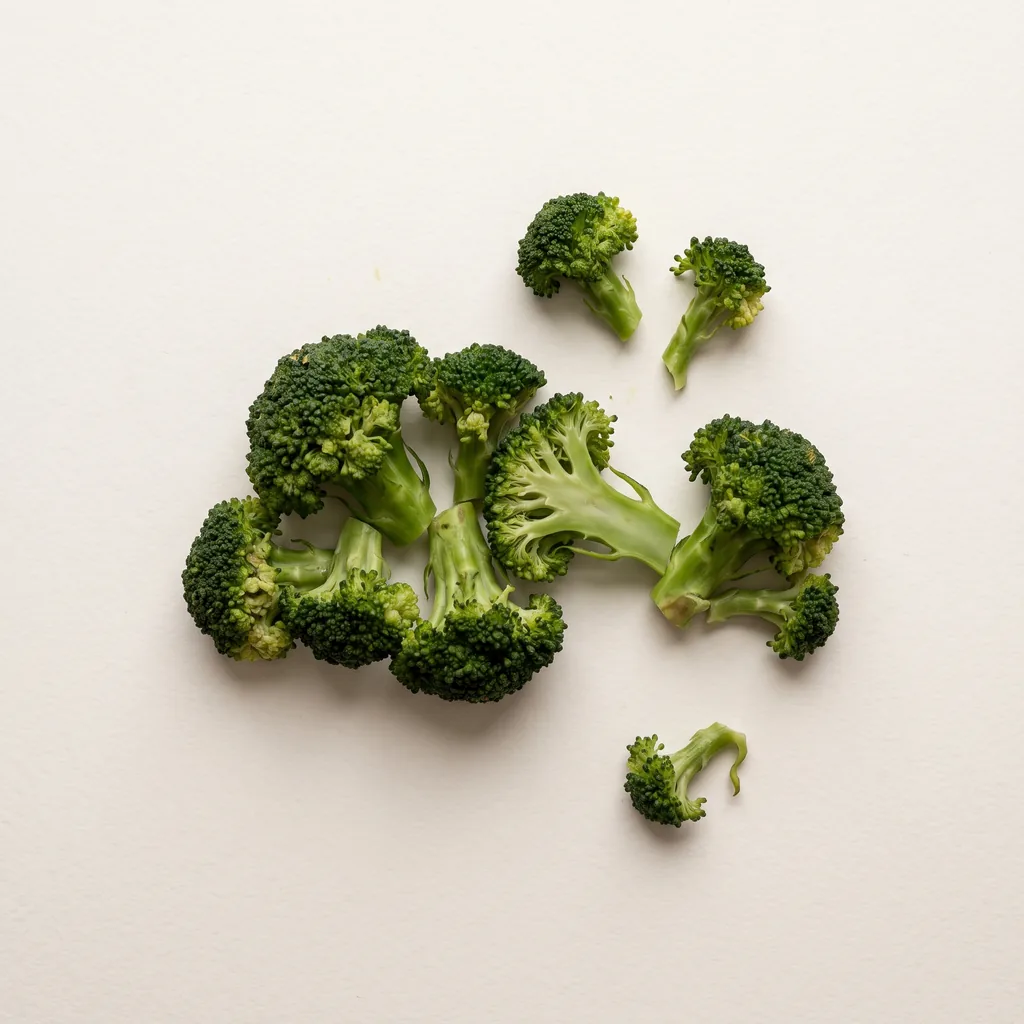
Larger pieces are easier for a 6-month-old to hold. A floret with a crown about three adult fingers wide works well, as does a stem stick steamed until soft. If you use the stem, peel off the tough outer skin and cut it into a rectangular stick. A round cylinder is riskier if a piece breaks off.
Cooking time sets the texture. Firmer broccoli is easier for the tongue to push out. Softer broccoli lowers the choking risk but can cause more gagging. If you offer a firm floret, split the stem lengthwise. You can also mash the florets or chop them finely and serve them on a spoon.
Cooking method
Steaming or microwaving keeps more nutrients than boiling. Roasting also works, but the texture turns tougher. For a young baby with tender gums, steaming gives the softest result.
Preparation by age
The same food is served differently at each age. What matters is how your baby sits, grasps and chews, more than the calendar.
6 months
6 months · How to cut and serve for baby-led weaningstrip
Cut: Large piece
Steam the broccoli by its stem until a fork mashes it easily. The floret forms a natural handle, so a 6-month-old can grab it in the palm and bring it to the mouth alone. For a purée, separate the florets from the stem and chop them very finely. Skip the fibrous stem part, because tough fibers can be a choking risk.
9 months
9 months · How to cut and serve small piecescube
Cut: Bite sized piece
Chop soft-cooked florets or stem into bite-sized pieces. If your baby struggles to pick up the small pieces, go back to larger florets and show how to take a bite.
12 months
12 months · How to cut and serve with a forkcube
Cut: Bite sized piece
Cut cooked broccoli into bite-sized pieces and pre-load them on a fork. As your child builds biting and chewing skills, you can steam it a little less. Add broccoli to family meals freely.
Is broccoli a choking hazard for babies?
Choking risk: low
Raw or undercooked broccoli is tough to chew. Steam it until soft. Split the stem lengthwise so it is no longer round.
Broccoli that is raw or undercooked is tough going for small mouths, so the choking risk goes up. Follow the age-based preparation steps above. Stay with your baby during the meal and keep them in sight.
Cooking time matters
Cook broccoli until it squashes when pressed with a finger. Split round stems lengthwise.
Is broccoli a common allergen?
Broccoli is not a common allergen. Allergy is rare but possible. People sensitive to other cruciferous vegetables, such as mustard greens or cauliflower, may react to broccoli too. People allergic to mugwort may feel a brief itch, tingle or burn inside the mouth. This is called oral allergy syndrome and is usually not dangerous.
Start with a small amount for the first few meals. If there is no reaction, increase the amount gradually.
Key nutrients
Frequently asked questions about broccoli
Can I give raw broccoli?
No. Raw broccoli is hard and carries a choking risk for babies. Steam it until soft before serving.
Can I serve the stem too?
Yes. Peel the tough outer layer, steam it until soft, and cut it into a flat rectangular stick rather than a round one.
Is steaming better than boiling?
Yes. Steaming or microwaving keeps more nutrients, while boiling loses more of them.
Sources for this page
- Dünya Sağlık Örgütü. (2023). Guideline for complementary feeding of infants and young children 6-23 months of age.
- NHS. (n.d.). Preparing food safely for babies.
- CDC, Infant and Toddler Nutrition. (n.d.). Choking Hazards.
- Sugita Y, Makino T, Mizawa M, Shimizu T. (2016). Mugwort-Mustard Allergy Syndrome due to Broccoli Consumption. Case Reports in Dermatological Medicine. doi:10.1155/2016/8413767
- Scott O, Galicia-Connolly E, Adams D, Surette S, Vohra S, Yager JY. (2012). The Safety of Cruciferous Plants in Humans: A Systematic Review. Journal of Biomedicine and Biotechnology. doi:10.1155/2012/503241
- Hermanides HK, Laheÿ‐ de Boer AM, Zuidmeer L, Guikers C, van Ree R, Knulst AC. (2006). Brassica oleracea pollen, a new source of occupational allergens. Allergy. doi:10.1111/j.1398-9995.2006.01055.x
Guides on iron, allergen introduction, gagging and drinks. Read the starting solids guides
Medical note
This page is for information only and is not a substitute for medical advice, diagnosis or treatment. Talk to your pediatrician before any feeding decision, especially about allergen introduction and reactions.
The Lokmini app
Log broccoli, reactions and your allergen journey in the app.
Open in LokminiLokmini is coming soon to the App Store.
Astro Tasarım Simay Yenice · Türkiye · merhaba@lokmini.com