Asian pear
- First taste
- 6 months
- Choking risk
- high
- Common allergen
- no
- Iron
- low
Firm, slippery fruit · cook it first
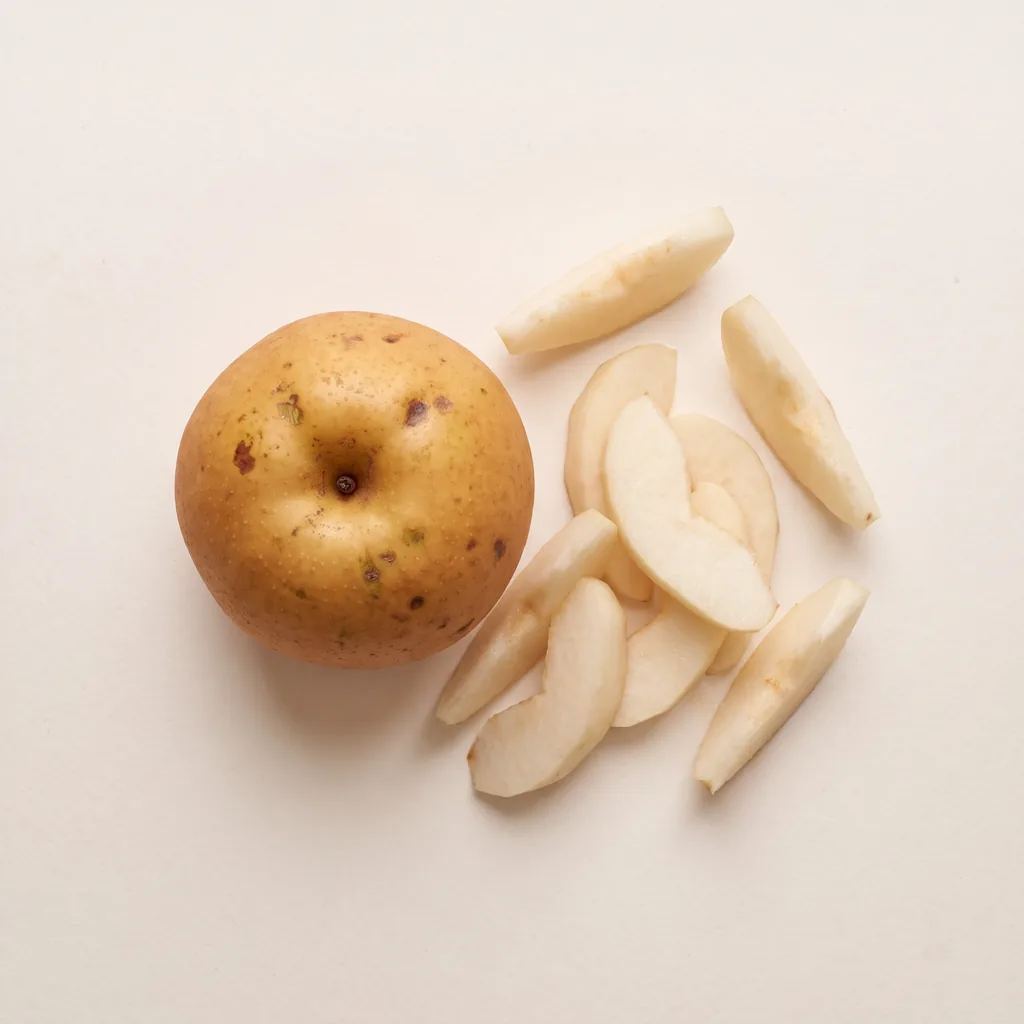
When can babies eat Asian pear?
You can start Asian pear once your baby is ready for solids, usually around 6 months.
This pear comes from the mountain regions of Central Asia. Today there are thousands of varieties. Ripe fruit can be sandy and spotted, golden, or bronze.
Asian pear gives fiber, vitamin C and copper. Fiber helps diversify the gut microbiome. Vitamin C supports skin and immunity. Iron from other foods is absorbed with the help of copper. Antioxidants are plentiful in the skin.
How do you prepare Asian pear for babies?
Cook first, then move to raw
In the early months, soft cooked pear fits best. Remove the core and stem. Raw pear waits until after 9 months and is served in very thin slices. Cutting raw fruit paper-thin lowers the choking risk when baby bites.
Your baby may chew the skin and then spit it out. That is normal. The skin also helps the fruit hold together.
Raw pear and young babies
Do not give raw pear in thick pieces to a young baby. Cook it soft or slice it paper-thin.
As your child grows
At 18 months, if your child chews well and sits calmly, try a whole raw pear. Biting a whole fruit is usually safer than biting a wedge. After age 2, thick sections such as quarters may be offered. Your child should take bites of a fitting size, shift the food sideways in the mouth and chew it thoroughly. Do not serve thick pear slices in a stroller or car seat.
Preparation by age
The same food is served differently at each age. What matters is how your baby sits, grasps and chews, more than the calendar.
6 months
6 months · How to prepare as cooked halves or wedgesslice
Cook the pear until soft. Remove the core and stem. Peeling is up to you. Serve large wedges or halves. To help baby grip the slippery fruit, coat it lightly with hemp seed, fine coconut or ground nut powder. Keep nut allergy risk in mind.
6 months · How to prepare as a mashmash
Cut: Fork mashed
Mash the cooked pear. Baby can scoop it with hands or a spoon. You can also stir the mash into spoonable foods such as yogurt.
9 months
9 months · How to prepare as thin raw slicesslice
Cooked soft halves can still be offered. Serve raw pear as thin rounds or half-rounds about 1 cm thick, with or without skin. Your baby may chew the skin and then spit it out. It looks wasteful, but it builds familiarity with skin and supports mouth skills. If your baby takes a large bite, do not put your fingers in their mouth. Wait a moment for baby to chew and swallow or spit. A hand on the back and a gentle forward lean helps the piece come toward the front of the mouth.
12 months
12 months · How to prepare as slicesslice
Keep offering soft cooked slices and thin raw rounds. The source suggests trying a whole raw pear at 18 months, if your child chews well and stays seated. A bite from the whole fruit usually leaves a flat piece. A bite from a wedge can leave a small, firm, pointed piece, which adds risk. If the skin is hard for your child, peel it or peel it in stripes. After age 2, a child who is ready can try thick raw sections.
Is Asian pear a choking hazard for babies?
Choking risk: high
Hard and slippery, even when ripe. Cook it soft for young babies, and slice raw pear very thin.
Yes, Asian pear can be a choking risk. Even ripe, it stays hard and slippery, and both qualities raise the risk.
For a young baby, serve soft cooked pear. If raw, slice it paper-thin. Hold off on a whole raw fruit until 18 months. Stay within arm's reach while your baby eats.
Firm and slippery
Do not serve raw pear as thick slices or small hard pieces.
Is Asian pear a common allergen?
Asian pear is not a common allergen. People with birch pollen allergy or pollen food allergy syndrome (oral allergy syndrome) may react to raw pear. The usual symptom is mild itching in the mouth, and a dangerous reaction is unlikely.
Start with a small amount at the first meals. If nothing unusual happens, raise it slowly over later meals.
Key nutrients
Frequently asked questions about Asian pear
Can babies eat raw Asian pear?
After 9 months, paper-thin raw slices are fine. Give younger babies soft cooked pear. Wait until 18 months for a whole raw pear.
Should I peel the skin?
It is optional. The skin may get chewed and spat out by your baby. The skin also keeps the fruit together. If your child struggles with it, peel it or peel in stripes.
How many meals a day should baby have?
It is flexible. Plan one sit-down meal a day at 6 to 7 months, two daily at 8 to 9 months, and three daily from about 10 months.
Sources for this page
- Reiland H, Slavin J. (2015). Systematic Review of Pears and Health. Nutrition Today. doi:10.1097/NT.0000000000000112
- Gotoda H, Maguchi S, Kawahara H, Terayama Y, Fukuda S. (2001). Springtime pollinosis and oral allergy syndrome in Sapporo. Auris Nasus Larynx. doi:10.1016/s0385-8146(01)00070-0
Guides on iron, allergen introduction, gagging and drinks. Read the starting solids guides
Medical note
This page is for information only and is not a substitute for medical advice, diagnosis or treatment. Talk to your pediatrician before any feeding decision, especially about allergen introduction and reactions.
The Lokmini app
Log Asian pear, reactions and your allergen journey in the app.
Open in LokminiLokmini is coming soon to the App Store.
Astro Tasarım Simay Yenice · Türkiye · merhaba@lokmini.com