Almond
- First taste
- 6 months
- Choking risk
- high
- Common allergen
- yes
- Iron
- medium
Tree nut allergen · never whole
Contains allergens
Each new allergen is offered on its own and watched for two hours. Our allergen introduction guide is available in Turkish for now.
When can babies eat almond?
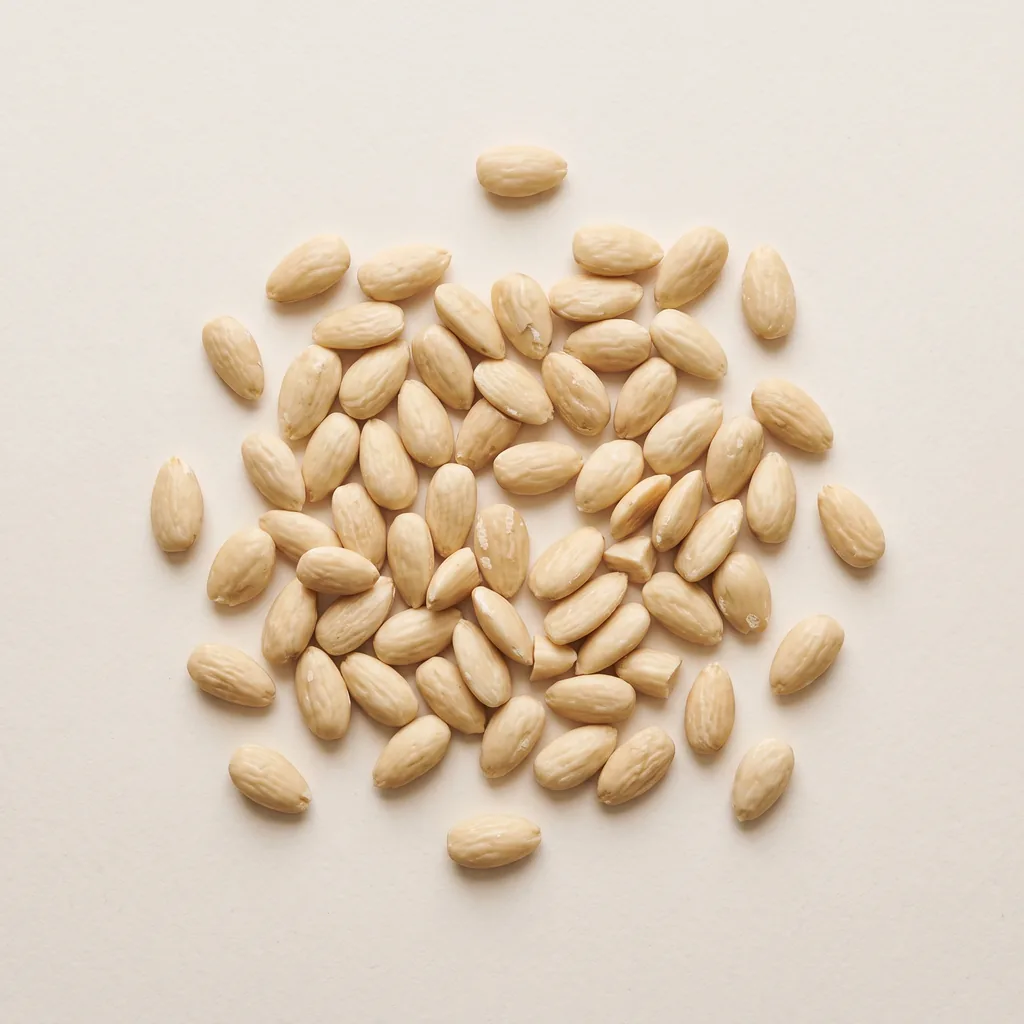
Almonds can be offered finely ground, or as a smooth, thinned nut butter, once your baby is about 6 months old and ready for solids. Botanically an almond is a seed. The almond is the seed inside the fruit of a tree that comes from southwest Asia, the way a cherry or peach holds a pit. People call the young fruit green almond, and in some cultures its soft flesh is a seasonal treat.
Almonds supply healthy fats and protein. They also hold zinc, vitamin E, iron, calcium, fiber, magnesium and potassium. They help growth, bone density, immunity and the gut microbiome. The skin is especially rich in antioxidants.
How do you prepare almond for babies?
For babies
Loosen smooth almond butter using water, milk from the breast, formula or applesauce. Offer it alone or stir it into porridge or yogurt. A very thin layer on a toast strip also works. An open cup of water on the side helps wash down sticky bits.
Grind almonds into a flour and dust it over sticky foods such as banana. You can also fold almond butter or flour into pancake, waffle and muffin batter.
From age 3
Keep serving finely ground almonds and smooth butter. Health organizations count whole almonds as a choking risk until age 4 and beyond. Almonds are hard and tough to bite into, so it is safer to practice chewing with a softer nut first.
A child may be ready when they take small bites, chew well, do not stuff the mouth and can spit out poorly chewed food. Serve nuts only to a child sitting upright and focused on the meal. Offer one or two at a time. If your child does not bite down, let them spit it out and try again in a few weeks.
Preparation by age
The same food is served differently at each age. What matters is how your baby sits, grasps and chews, more than the calendar.
6 months
6 months · How to prepare as a puréemash
Cut: Smooth puree
Loosen smooth almond butter using water, milk from the breast, formula or applesauce. Serve it plain, or mix it into yogurt or porridge. Almonds can also be ground to a flour and sprinkled over sticky foods such as banana. Whole and chopped almonds are a choking risk and are not given at this age.
12 months
12 months · How to servemash
Cut: Smooth puree
Keep stirring smooth almond butter into yogurt, hot cereal or batter. Ground almonds can be sprinkled over meals. Spread a thin layer on toast and offer water or milk alongside. After this age almond milk can be an occasional drink. Choose one that has added calcium and vitamin D.
Is almond a choking hazard for babies?
Choking risk: high
Whole, chopped and broken almonds stay off the menu until age 4. Almond butter is sticky, so thin it well with water, milk or purée.
Whole almonds are small, hard and tough to chew, and almond butter is sticky. Both raise the choking risk. Whole, chopped and broken almonds are not given before age 4. Always thin the butter well and mix it into yogurt or purée. Do not serve thick butter off a spoon on its own. Stay close while your baby eats.
Never whole almonds
Whole, chopped or broken almonds are not given before age 4.
Is almond a common allergen?
Almond is a common allergen. Although it is technically a seed, it counts as a tree nut. Between 0.5% and 1.2% of people have a tree nut allergy. The allergy is usually lifelong, and only about 9% of children outgrow it. Most reactions are mild, but severe ones have been reported.
People with birch pollen allergy may feel an itchy, tingly or burning mouth after eating almond, especially the skin. This is pollen-food syndrome, and a severe reaction is unlikely.
Allergy to one tree nut raises the chance of allergy to another. People allergic to almond are more likely to react to hazelnut, for example. That does not mean every nut must go. Work with an allergist to decide which nuts are safe.
First trial
Most babies do not need allergy testing before trying nuts. Before offering it at home, talk to your doctor or a pediatric allergist if your baby has severe eczema, has had an allergic reaction, or may have a nut allergy. For the first serving, give a pinch of finely ground almond or one eighth of a teaspoon of thinned butter.
Keep exposure regular
Once introduced without a reaction, keep offering it about twice a week if possible.
Key nutrients
Frequently asked questions about almond
Can babies have almond milk?
It can be an ingredient in solid foods. Hold off on it as a drink until after the first birthday. It should not stand in for breast milk or formula. Many almond milks fall short of what a growing child needs, so look for one with added calcium and vitamin D.
When can a child have whole almonds?
Health bodies treat whole and broken nuts as a choking risk until age 4. After age 3, a child with mature chewing skills may learn almonds once they practice with softer nuts. Almonds are hard, so they should come last.
Is allergy testing needed before almonds?
Most babies do not need it. If there is severe eczema, a previous allergic reaction or a suspected nut allergy, ask your doctor before offering it at home.
Sources for this page
- Dünya Sağlık Örgütü. (2023). Guideline for complementary feeding of infants and young children 6-23 months of age.
- NHS. (n.d.). Preparing food safely for babies.
- CDC, Infant and Toddler Nutrition. (n.d.). Choking Hazards.
- American Academy of Pediatrics, HealthyChildren. (n.d.). Choking Prevention for Babies and Children.
- Barreca D, Nabavi SM, Sureda A, Rasekhian M, Raciti R, Silva AS, et al. (2020). Almonds (Prunus Dulcis Mill. D. A. Webb): A Source of Nutrients and Health-Promoting Compounds. Nutrients. doi:10.3390/nu12030672
Guides on iron, allergen introduction, gagging and drinks. Read the starting solids guides
Medical note
This page is for information only and is not a substitute for medical advice, diagnosis or treatment. Talk to your pediatrician before any feeding decision, especially about allergen introduction and reactions.
The Lokmini app
Log almond, reactions and your allergen journey in the app.
Open in LokminiLokmini is coming soon to the App Store.
Astro Tasarım Simay Yenice · Türkiye · merhaba@lokmini.com