Sea bass
- First taste
- 6 months
- Choking risk
- medium
- Common allergen
- yes
- Iron
- low
Fish allergen · prefer farmed, boneless
Contains allergens
Each new allergen is offered on its own and watched for two hours. Our allergen introduction guide is available in Turkish for now.
When can babies eat sea bass?
Branzino can be served around 6 months, once baby is ready. You can serve farmed branzino two times a week. Wild branzino should stay at once a month or less because of its higher mercury.
Mercury
Wild branzino can hold significant mercury. Mercury is a lasting, building toxin for babies. Choose farmed branzino.
Names
Other names for this white fish include Mediterranean sea bass and European sea bass. The French call it loup de mer. Its size and mild, flaky flesh make it a favorite for whole-fish dishes.
Nutrition
Farmed branzino is generally low in mercury. It supplies protein, potassium, selenium, vitamins B6 and B12, and omega-3 fatty acids. These nutrients help growth, electrolyte balance, hormones, metabolism and red blood cells. Fish also gives vitamin D and selenium, which are scarce in other foods.
How do you prepare sea bass for babies?
Cook the fish, then remove the skin and every bone. Serve as strips, pieces or cakes. Make the cakes at home, since ready-made fish products are mostly too salty.
To keep mercury low, choose the fish lowest in mercury. Limit how much and how often you serve fish that is higher in it.
Preparation by age
The same food is served differently at each age. What matters is how your baby sits, grasps and chews, more than the calendar.
Prep time: 25 min
6 months
6 months · How to prepare as a puréemash
Cut: Shredded
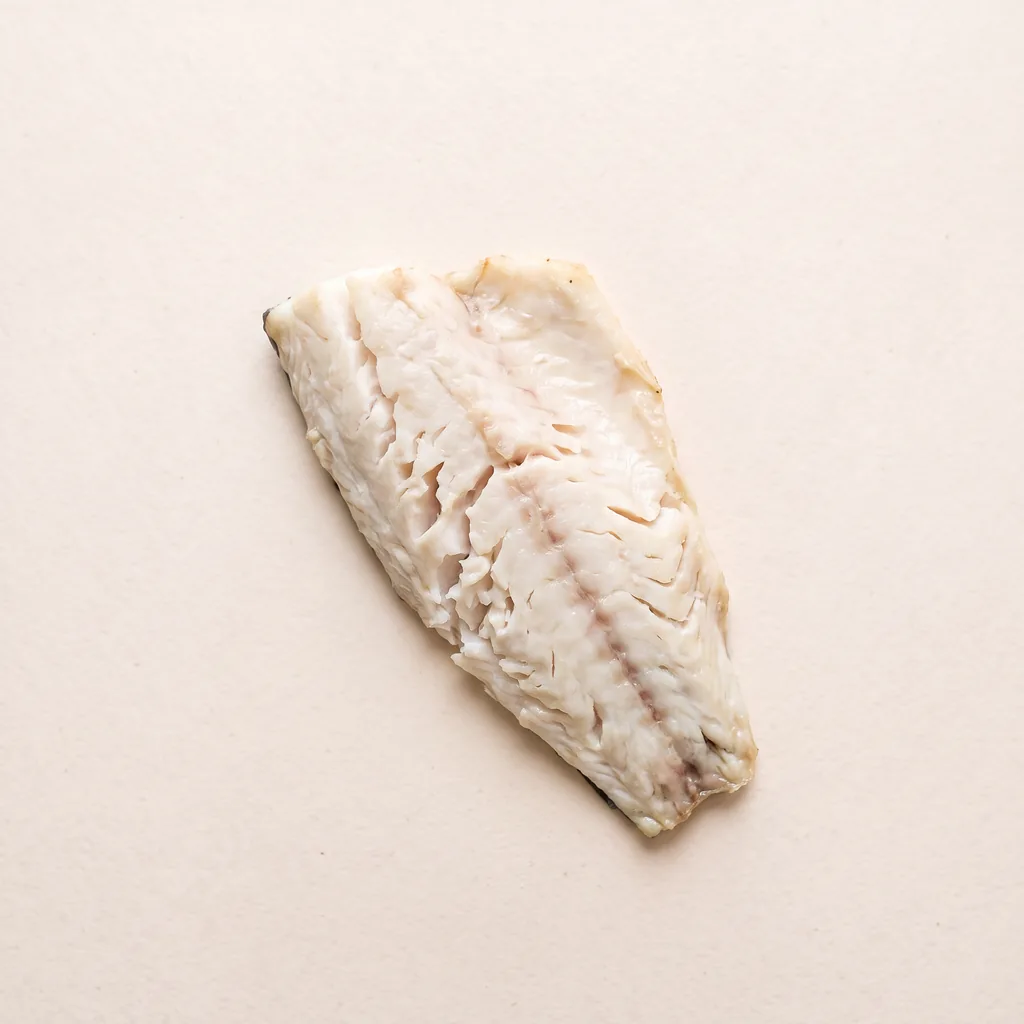
Steam or bake a sea bass fillet and remove the skin. As you flake the flesh, feel for bones with your fingers one by one. Soften it with breast milk or vegetable stock into a purée. Fish is a new allergen, so offer it alone the first time, in the morning and in a small amount.
6 months · How to serve as finger stripsstrip
Cut: Finger strip
Cut cooked, skinless, boneless branzino into strips about as wide as two adult pinkies. Serve plain or with a sauce. Baby may squish the fish in a fist, and that is normal. If you serve fish cakes, make them soft and larger than baby's mouth.
9 months
9 months · How to cut and servecube
Offer cooked, deboned sea bass as flakes, or mash it with potato into small fish cakes. Dry cooked fish can stick in the throat, so add olive oil.
12 months
12 months · How to cut and servecube
Cut: Bite sized piece
Keep offering sea bass in bite-sized, boneless pieces. Set aside a low-salt portion of baked or steamed sea bass, and keep checking every bite for bones.
12 months · How to cut and serveslice
Serve cooked, boneless fish as long strips, small pieces, cakes or flakes. You can stir it into other dishes. This is a good age for fork practice. Skip store-bought fish cakes and fish sticks, which are too salty, and make your own.
Is sea bass a choking hazard for babies?
Choking risk: medium
With every bone removed the choking risk is low. Check for bones twice.
With every bone removed the choking risk is low. Even a small bone can be dangerous, so run your fingers through the cooked fish as a second check.
Safe setting
Seat your child upright and stay within arm's reach during meals.
Is sea bass a common allergen?
The World Health Organization lists finned fish among its top global allergens. About 0.2 percent of people worldwide are allergic to finned fish. The rate in children is even lower than in adults. Around 40 percent of people with fish allergy have their first reaction in adulthood. Most do not outgrow it.
Proteins that become airborne while fish cooks can trigger some people. In that case you may have to skip cooking fish at home.
About half of people allergic to one fish react to another. The reason is the protein beta-parvalbumin. Because of cross-contact and mislabeling, allergists usually advise seeing a specialist before trying another fish.
Finned fish is also a trigger for the delayed allergy FPIES. A few hours after eating, repeated vomiting and diarrhea begin. This allergy can first show up later in life and often lasts for life.
Scombroid poisoning can be mistaken for fish allergy. Fish that was not kept cold builds up histamine, which gives allergy-like symptoms. Keeping fish cold enough lowers the risk.
At the first try
If you suspect an allergy, see an allergist before offering branzino. Give a small amount for the first few servings and watch. If all goes well, raise the amount slowly. After an allergen goes in, keeping it in the diet regularly (twice a week if possible) is advised. You need not serve every fish species several times a week, since finned fish share the same main protein.
Key nutrients
Frequently asked questions about sea bass
What is the difference between farmed and wild branzino?
Wild branzino can hold significant mercury. Farmed branzino is generally low in mercury. Keep wild to once a month at most.
Do branzino bones carry a choking risk?
With the bones removed the risk is low. Small bones are still dangerous, so check by hand.
If a child is allergic to one fish, can they eat another?
Cross-reaction occurs in about half of cases. An allergist should decide which fish is safe.
Sources for this page
- Dünya Sağlık Örgütü. (2023). Guideline for complementary feeding of infants and young children 6-23 months of age.
- NHS. (n.d.). Preparing food safely for babies.
- CDC, Infant and Toddler Nutrition. (n.d.). Choking Hazards.
- Halken S, Muraro A, de Silva D, Khaleva E, Angier E, Arasi S, et al. (2021). EAACI guideline: Preventing the development of food allergy in infants and young children (2020 update). European Academy of Allergy and Clinical Immunology. doi:10.1111/pai.13496
- Türkiye Ulusal Alerji ve Klinik İmmünoloji Derneği. (n.d.). Besin Alerjisi, öncelikli 10 besin.
- FDA ve EPA. (n.d.). Advice about Eating Fish.
- Rice KM, Walker EM, Wu M, Gillette C, Blough ER. (2014). Environmental Mercury and Its Toxic Effects. Journal of Preventive Medicine and Public Health. doi:10.3961/jpmph.2014.47.2.74
- Tsabouri S, Triga M, Makris M, Kalogeromitros D, Church MK, Priftis KN. (2012). Fish and shellfish allergy in children: Review of a persistent food allergy. Pediatric Allergy and Immunology. doi:10.1111/j.1399-3038.2012.01275.x
- Moonesinghe H, Mackenzie H, Venter C, Kilburn S, Turner P, Weir K, et al. (2016). Prevalence of fish and shellfish allergy. Annals of Allergy, Asthma & Immunology. doi:10.1016/j.anai.2016.07.015
Guides on iron, allergen introduction, gagging and drinks. Read the starting solids guides
Medical note
This page is for information only and is not a substitute for medical advice, diagnosis or treatment. Talk to your pediatrician before any feeding decision, especially about allergen introduction and reactions.
The Lokmini app
Log sea bass, reactions and your allergen journey in the app.
Open in LokminiLokmini is coming soon to the App Store.
Astro Tasarım Simay Yenice · Türkiye · merhaba@lokmini.com