Okra
- First taste
- 6 months
- Choking risk
- low
- Common allergen
- no
- Iron
- low
Serve cooked · slimy texture helps swallowing
When can babies eat okra?
Okra can be offered once baby is about 6 months old and ready for solids. It comes from Africa, where it has long flavored and thickened soups and stews. The whole plant is edible, but it is mostly grown for its green pods, which toughen as they age. So okra is picked soon after the flower drops, while it is tender and mildly grassy.
Fiber and fluid come with several micronutrients, among them zinc, vitamin C, vitamin K, vitamin B6, folate, potassium and magnesium. Together they support digestion, hydration, nervous system development, immunity and blood clotting.
How do you prepare okra for babies?
Cook okra thoroughly. It should mash easily between the fingers.
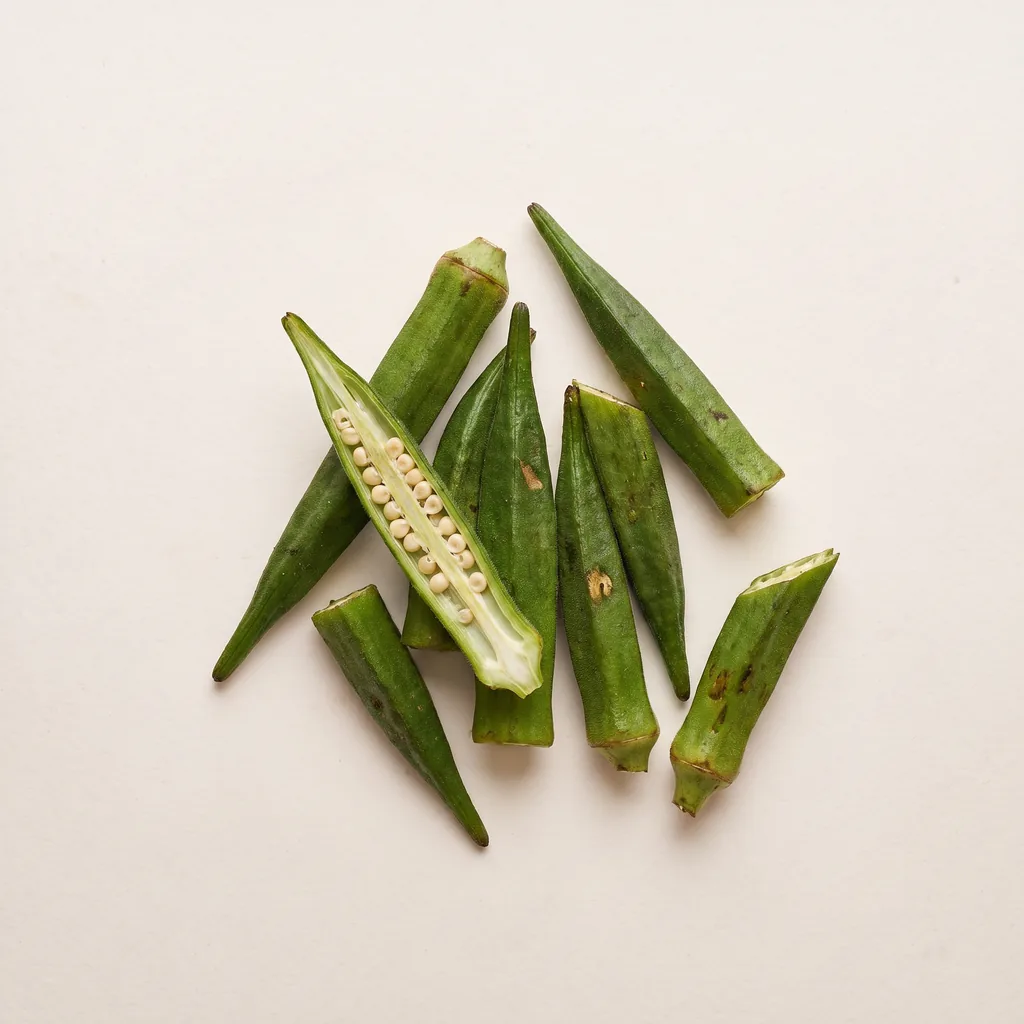
When a baby bites a whole pod, seeds can scatter in the mouth. The seeds carry a low choking risk but can feel odd and hard to manage. To avoid that, cut off the stem of a cooked pod and gently squeeze the seeds out. The pod opens into a soft, flat piece.
Cooked okra can be slippery. If your baby has trouble gripping it, roll the pieces in breadcrumbs.
Okra is stringy and tough to break down until the molars come in, at about 18 months. Expect a child to spit out pieces.
Preparation by age
The same food is served differently at each age. What matters is how your baby sits, grasps and chews, more than the calendar.
Prep time: 25 min
6 months
6 months · How to cut and serve for baby-led weaningstrip
Cook fresh or frozen okra until soft. Cut off the stem and hand over a large whole pod. Baby grips and sucks it. The slimy texture helps swallowing. If you are going by spoon, mash it and stir into bulgur or rice porridge.
6 months · How to mix into soft foodmash
Chop cooked okra and stir it into spoonable foods such as porridge, stew or thick soup. Baby can eat it by hand or from a preloaded spoon. It should be soft enough to mash easily between the fingers. The seeds carry a low choking risk, so you do not need to remove them.
9 months
9 months · How to cut and servecube
Serve cooked okra in small rings or chopped fine. You can set aside a portion of salt-free olive oil okra. Raw okra is not given because it is hard and fuzzy.
12 months
12 months · How to cut and servecube
Keep serving cooked okra as rings or small pieces. Set aside a low-salt portion from meat okra stew or okra soup, and shrink any large pieces of meat.
Is okra a choking hazard for babies?
Choking risk: low
Okra can be round and firm, so it is tough to chew. Cook it until very soft and never serve it raw. It should mash easily under finger pressure.
Okra is round, firm and tough to chew, so it carries a choking risk. Cook it well and prepare it in an age-appropriate way.
Stay within arm's reach of your baby during meals.
Is okra a common allergen?
Okra rarely causes food allergy. Skin irritation has been reported in farm workers who handle okra leaves and pods. One case report links okra to FPIES, a delayed vomiting reaction, in a toddler.
Start with a small amount for the first few meals. If nothing happens, increase it slowly.
Key nutrients
Frequently asked questions about okra
Are okra seeds a choking risk?
The seeds carry a low choking risk and you do not have to remove them. Biting a whole pod can scatter seeds in the mouth, which may startle baby.
Okra is slippery and baby cannot grip it. What can I do?
Roll the pieces in breadcrumbs, or chop the okra and stir it into spoonable foods such as porridge or stew.
Can babies eat raw okra?
No. Okra must be cooked well. Raw okra is hard and fuzzy.
Sources for this page
- Dünya Sağlık Örgütü. (2023). Guideline for complementary feeding of infants and young children 6-23 months of age.
- NHS. (n.d.). Preparing food safely for babies.
- CDC, Infant and Toddler Nutrition. (n.d.). Choking Hazards.
- Hall H, Anvari S, Schultz F, Ojuola O, Rider NL. (2024). Delayed presentation of food protein-induced enterocolitis syndrome (FPIES) to okra in a toddler. Allergy, Asthma & Clinical Immunology. doi:10.1186/s13223-024-00871-1
Guides on iron, allergen introduction, gagging and drinks. Read the starting solids guides
Medical note
This page is for information only and is not a substitute for medical advice, diagnosis or treatment. Talk to your pediatrician before any feeding decision, especially about allergen introduction and reactions.
The Lokmini app
Log okra, reactions and your allergen journey in the app.
Open in LokminiLokmini is coming soon to the App Store.
Astro Tasarım Simay Yenice · Türkiye · merhaba@lokmini.com