Duck
- First taste
- 6 months
- Choking risk
- medium
- Common allergen
- no
- Iron
- high
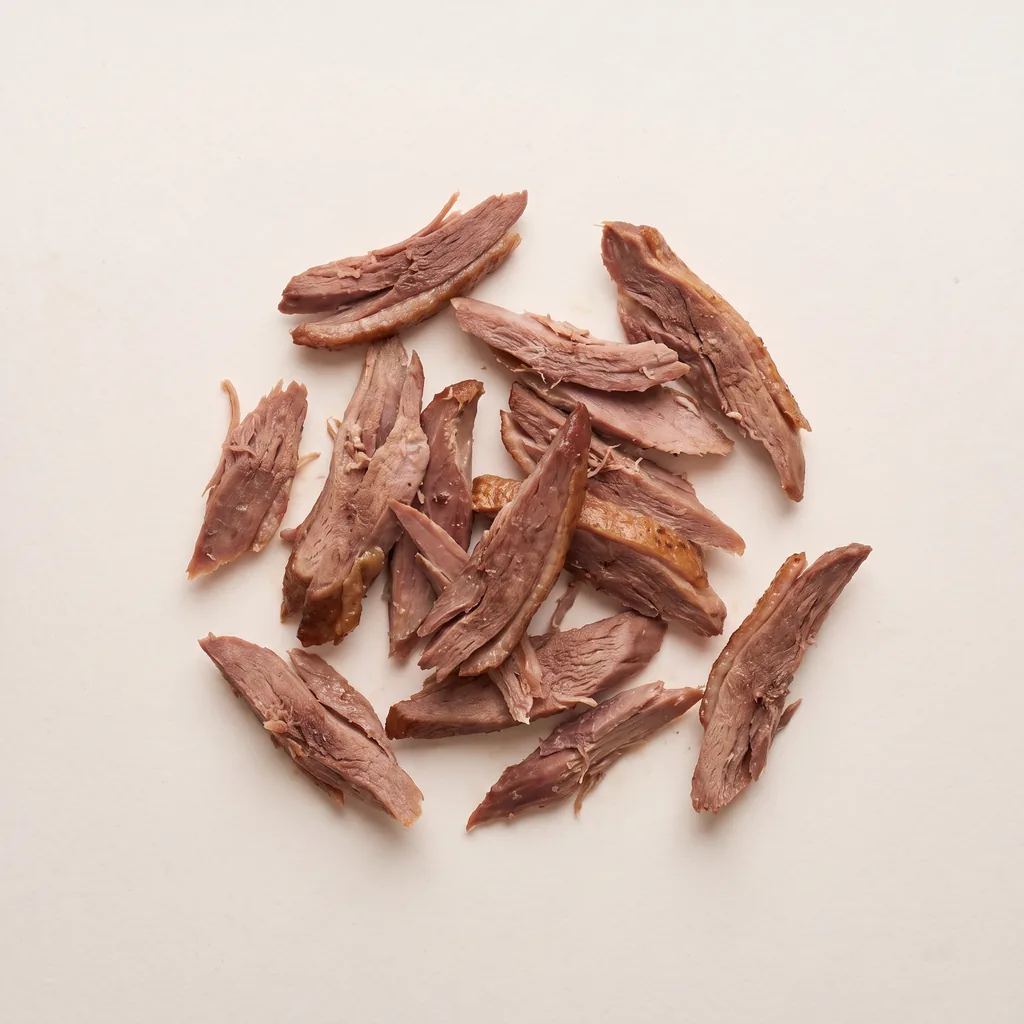
Iron-rich meat · well cooked, skinless
When can babies eat duck?
Duck can be offered from about 6 months when thoroughly cooked. Baby should be ready for solids.
Ducks are raised worldwide for eggs and for meat. Both wild and farmed ducks are edible, but they need different cooking to bring out their flavor. Compared with wild duck, farmed duck has more fat and is softer and less dense.
Nutrition
Duck is rich in protein and fat. Omega-3 fats are needed for growth and brain development. It also supplies choline, iron, selenium, zinc, plus B6, B12, and E vitamins. These support growth, the brain, red blood cells, immunity, and hormone function.
How do you prepare duck for babies?
Cook the meat through but do not dry it out. Dry meat is hard to chew and swallow. Slow cooking, braising, and sauces keep it tender.
Remove bone, cartilage, and skin before giving it to baby.
Wild duck
Cook wild duck until the inside reaches at least 165 F (74 C). Do not give it to your baby if you have any doubt about how it was hunted, handled or checked.
Preparation by age
The same food is served differently at each age. What matters is how your baby sits, grasps and chews, more than the calendar.
6 months
6 months · How to prepare as stripsstrip
Cut: Finger strip
Cook the meat thoroughly. Remove bone, loose cartilage, and skin. Cut long strips about as thick as two adult fingers together. If a bite breaks off, stay calm and let baby work it forward with the tongue. You can also offer a large drumstick bone stripped of loose cartilage, meat, and fat.
6 months · How to prepare as a puréemash
Mince or shred the cooked meat very finely. Mix it into soft foods like mashed vegetables, porridge or yogurt.
9 months
9 months · How to preparecube
Shred the cooked meat or cut thin, flat, bite-sized slices for baby's pincer grasp. Slow-cooked, braised, or sauced duck is soft and easier to chew. Do not cut cubes.
12 months
12 months · How to servecube
Cut: Bite sized piece
Offer cooked meat in bite-sized pieces for fingers or a fork. Slow-cooked, braised, or sauced duck is easier than dry meat. Removing skin and fat adds safety. Over time, familiarity with these textures makes acceptance more likely.
12 months · How to serve as a whole drumstickslice
Once you feel sure of your child's biting and chewing skills, offer a whole duck drumstick with loose cartilage removed.
Is duck a choking hazard for babies?
Choking risk: medium
Duck can be firm and hard to chew. Do not cut cubes or chunks. Remove bone, cartilage, and skin. Do not overcook, since dry meat is hard to swallow.
Duck carries a choking risk. It can be firm and hard to chew. Do not cut it into cubes or large chunks. Serve strips, shreds, or thin slices to suit your child's age.
Do not overcook it, because dry meat is harder to chew and swallow. Stay near baby during meals.
No cubes
Cubes or large chunks can seal the airway.
Is duck a common allergen?
Duck is not a common allergen. People allergic to chicken or turkey may be allergic to duck too, and poultry allergy cases have been reported.
Reports name duck as a trigger of FPIES. This reaction causes vomiting 2 to 4 hours after eating, and sometimes diarrhea. It is rare. People with fish, feather, or egg allergy may also test positive to poultry. The allergen protein is sensitive to heat, so well-cooked meat usually causes no symptoms.
Offer a small amount at the first meals. If there is no reaction, raise the amount slowly at later meals.
Key nutrients
Frequently asked questions about duck
Is duck suitable for babies?
Yes, from about 6 months if cooked thoroughly. It is rich in iron, zinc, B12, and omega-3 fats.
Can babies eat wild duck?
Yes, if cooked until the inside reaches at least 165 F (74 C). If you doubt how it was hunted or handled, do not serve it.
Can I serve the skin and fat?
Skin and fat are hard to chew. Leave them off for young babies. An older child can meet these textures over time.
Sources for this page
- Hemmer W, Klug C, Swoboda I. (2016). Update on the bird-egg syndrome and genuine poultry meat allergy. Allergo Journal International. doi:10.1007/s40629-016-0108-2
- Kuehn A, Codreanu‐Morel F, Lehners‐Weber C, Doyen V, Gomez‐André S, Bienvenu F, et al. (2016). Cross‐reactivity to fish and chicken meat – a new clinical syndrome. Allergy. doi:10.1111/all.12968
- Lee A, Sicherer S. (2022). A CASE OF ACUTE FOOD PROTEIN-INDUCED ENTEROCOLITIS (FPIES) TO FISH, TURKEY, AND DUCK. Annals of Allergy, Asthma & Immunology. doi:10.1016/j.anai.2022.08.936
- Wisconsin Medical Journal. (2006). Zacharisen MC. Wisconsin Medical Journal 105(5), 50-52.
Guides on iron, allergen introduction, gagging and drinks. Read the starting solids guides
Medical note
This page is for information only and is not a substitute for medical advice, diagnosis or treatment. Talk to your pediatrician before any feeding decision, especially about allergen introduction and reactions.
The Lokmini app
Log duck, reactions and your allergen journey in the app.
Open in LokminiLokmini is coming soon to the App Store.
Astro Tasarım Simay Yenice · Türkiye · merhaba@lokmini.com