Clams
- First taste
- 6 months
- Choking risk
- high
- Common allergen
- yes
- Iron
- high
Shellfish · always cook thoroughly
Contains allergens
Each new allergen is offered on its own and watched for two hours. Our allergen introduction guide is available in Turkish for now.
When can babies eat clams?
Clams can start when your baby is ready for solids, around 6 months. They must be cooked all the way through. Babies can get more seriously ill from foodborne bacteria.
Clams live in fresh water and in tidal coastal waters worldwide. There are many kinds. North America has quahogs and soft-shell clams, and Asia has geoducks and hamaguri.
Nutrition
Clams are a good source of protein. Clams contribute vitamin B12, choline, zinc, calcium and iron too. The level of cadmium depends on the waters where they grew. Cadmium is a heavy metal that can affect nervous system development in large amounts. If clams are a regular dish in your family, serve them as part of a varied diet.
Always cook them
Raw or undercooked clams carry a risk of illness from bacteria such as Vibrio. The inside should reach 145 F (63 C).
How do you prepare clams for babies?
Choosing and preparing
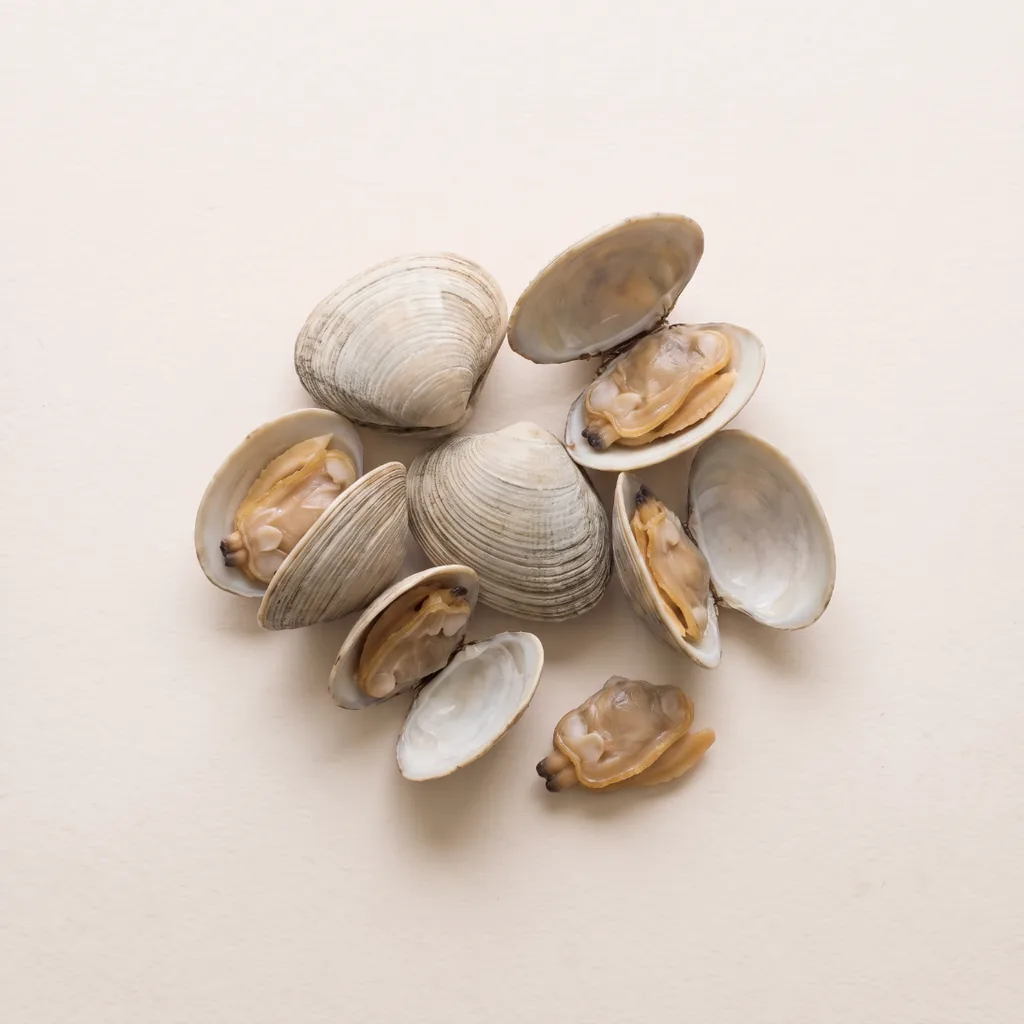
If you buy them in the shell, check freshness first. A fresh clam smells like the sea, not fishy or sour. The shell may be shut tight or slightly open. Tap an open shell gently. If it does not close, or the body does not react, throw it away. Also discard clams whose shells are cracked or broken.
Steamed clams are very slippery. Cook them well, then cut them to suit your child's age.
Canned clams
Canned clams can be offered from 6 months if they are minced fine. Look for a lower-sodium can with no added salt to keep salt down.
Raw clams
No age makes raw clams completely safe. Vibrio can cause watery diarrhea. The risk is higher with stomach acid medicines or a weak immune system. We suggest not giving raw clams to a baby.
Preparation by age
The same food is served differently at each age. What matters is how your baby sits, grasps and chews, more than the calendar.
6 months
6 months · How to prepare as a puréemash
Cut: Finely chopped
Cook the clams all the way through. Canned clams also work. Mince them very fine. Stir the mince into a soft food such as vegetable purée or yogurt. Your baby can eat it with a spoon or by hand.
9 months
9 months · How to prepare small piecescube
Mince well-cooked clams or slice them paper thin. You can serve them alone. If your baby cannot grip the slippery bits, stir them into pasta, rice or stew.
12 months
12 months · How to prepare as bite-sized piecescube
Cut: Bite sized piece
Cut cooked clams into small bites. Let your child pick them up with a spoon or fork. Serve them in a dish or on their own. Try whole clams only when you are sure your child chews well with the back teeth. That is often around age 2.
Is clams a choking hazard for babies?
Choking risk: high
Cooked clam is slippery and chewy, so large pieces are risky. Chop it very fine first and make the pieces bigger as your child grows.
Clams are a choking risk. They are chewy, slippery and often round. Preparing them for your child's age lowers the risk. Sit with your baby at meals and stay within arm's reach.
Cutting rule
At 6 months, mince very fine and mix into a soft food. At 9 months, mince or slice paper thin. Offer whole clams only to a child who chews well with the back teeth, usually after about age 2.
Is clams a common allergen?
Clams are mollusks. The World Health Organization counts only crustaceans, such as shrimp and crab, as priority allergens. Still, many regulators around the world label mollusks as allergens too. So the app marks clams as a shellfish allergen.
Shellfish allergy most often begins in adulthood. When it starts in childhood, it usually stays. A person allergic to clams may also react to mussels, octopus, oysters, scallops, snails and squid. The chance of reacting to crustaceans like shrimp and crab is above 70 percent.
If you think your baby may have a shellfish allergy, talk to an allergist before offering clams. Shellfish allergy does not mean fish allergy. But cross-contact can happen when foods share a kitchen and tools.
For the first try, offer a small amount and watch closely. If all goes well, raise the amount slowly over the next meals.
Key nutrients
Frequently asked questions about clams
Can babies eat canned clams?
Yes. They can have them from 6 months if the clams are minced very fine. Look for a lower-sodium can with no added salt.
At what age can babies eat steamed clams?
As soon as your baby is ready for solids. The clams must be fully cooked and cut for the baby's age. Steamed clams are very slippery.
How do I know clams are fresh?
They should smell like the sea, not fishy or sour. Tap an open shell. If it does not close, throw the clam away. Discard cracked shells too.
Can babies have raw clams?
No age makes raw clams completely safe. Vibrio bacteria cause watery diarrhea. We suggest serving them fully cooked.
Sources for this page
- Centers for Disease Control and Prevention. (2019). Vibrio species causing vibriosis.
- Lopata AL, O'Hehir RE, Lehrer SB. (2010). Shellfish allergy. Lopata AL, O'Hehir RE, Lehrer SB. Clinical and Experimental Allergy. doi:10.1111/j.1365-2222.2010.03513.x
- Chandravanshi L, Shiv K, Kumar S. (2021). Developmental toxicity of cadmium in infants and children: a review. Environ Anal Health Toxicol. doi:10.5620/eaht.2021003
- Cox AL, Eigenmann PA, Sicherer SH. (2021). Clinical Relevance of Cross-Reactivity in Food Allergy. J Allergy Clin Immunol Pract. doi:10.1016/j.jaip.2020.09.030
- Food Allergy Research & Education. (2022). Shellfish allergy.
Guides on iron, allergen introduction, gagging and drinks. Read the starting solids guides
Medical note
This page is for information only and is not a substitute for medical advice, diagnosis or treatment. Talk to your pediatrician before any feeding decision, especially about allergen introduction and reactions.
The Lokmini app
Log clams, reactions and your allergen journey in the app.
Open in LokminiLokmini is coming soon to the App Store.
Astro Tasarım Simay Yenice · Türkiye · merhaba@lokmini.com